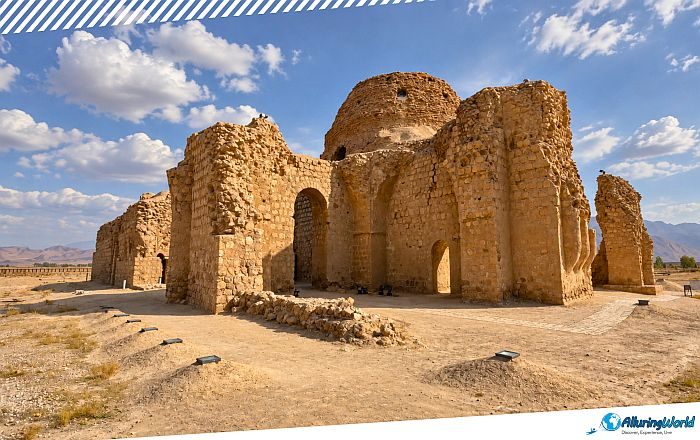
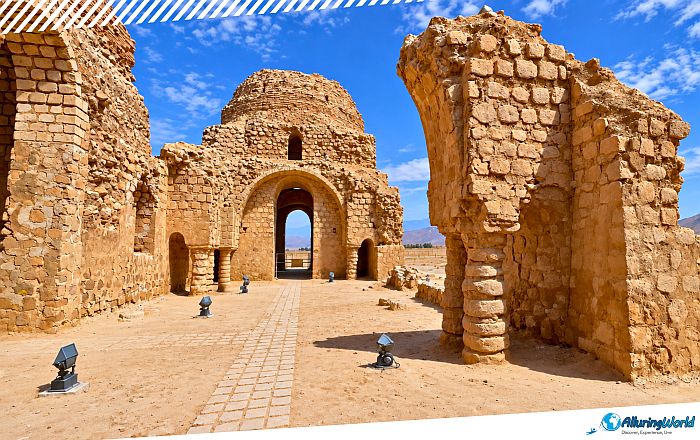
Sarvestan Palace, also known as the Sasanian Palace of Sarvestan or Kakh-e Sarvestan, is an ancient Sasanid-era stone and mortar structure that archaeologists consider a palace, located in the Central District of Sarvestan County, in the central part of the Province of Fars, within the southwestern part of the Islamic Republic of Iran. Located more precisely about 90 kilometers (56 miles) southeast of Shiraz and roughly 10 kilometers (6 miles) past the town of Sarvestan, from which it gets its name, the palace rises from the arid, windswept Fars plains. This region was once the heartland of the mighty Sasanians, the last great pre-Islamic Persian dynasty. It was constructed over 1,500 years ago during the Sasanian Empire’s might, but despite not featuring the expansive columns of its neighboring counterpart, the well-known Persepolis, the architectural significance of this stone and mortar structure remains just as important.
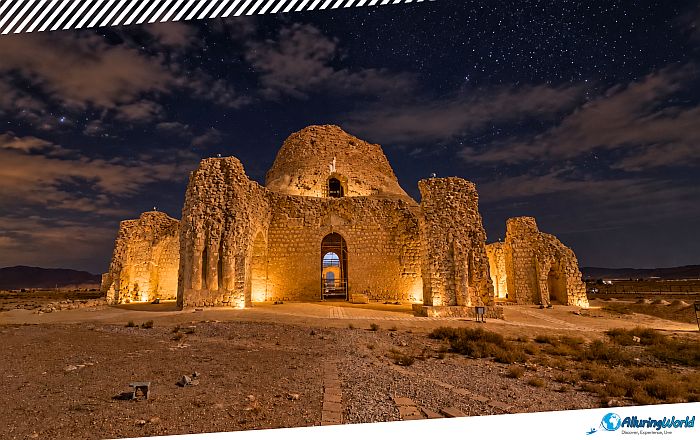
If you visit southern Iran, the palace will be one of the few opportunities that allow you to learn about the architectural breakthroughs that bridged pre-Islamic Persia and the golden age of Islamic design. As a key component of the UNESCO World Heritage-listed Sasanian Archaeological Landscape of Fars Region, Sarvestan Palace preserves the ingenuity of an empire that rivaled Rome and Byzantium. Whether you are an architecture enthusiast tracing the origins of the Persian dome or a cultural traveler seeking off-the-beaten-path historical sites near Shiraz, when you understand this solitary monument, you will be rewarded with a deeper appreciation of Iran’s layered past.
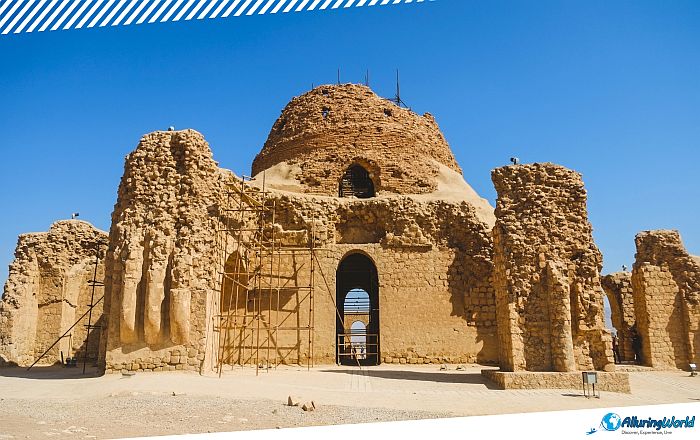
Sarvestan Palace stands in a vast, flat farmland area, surrounded by the steep slopes of the Zagros Mountains. Situated about 135 kilometers (84 miles) southeast of Persepolis and 900 kilometers (559 miles) south of the capital, Tehran, this site is located squarely in the center of the ancient home of the Sasanian dynasty, which ruled Persia from 224 CE to 651 CE. There is controversy regarding the date of construction and the use of the building, which remains a topic of discussion among scholars to this day. The conventionally believed construction date for this building was the 5th century CE, particularly when King Bahram V (420–438 CE) ruled the area and was renowned for being an avid hunter and a person who appreciated courtly love. Contemporary archaeological dating, on the other hand, places the structure as belonging to either the late Sasanian period (between the 6th and 7th centuries CE) or as a transitional early Islamic monument built by Sasanian craftsmen.
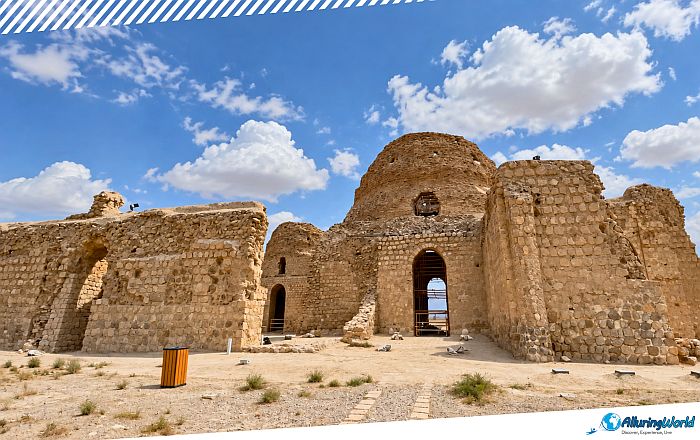
Noteworthy, too, is its purpose. Despite the long-held belief that it was a palace for the royals for hunting or as a summer retreat, architectural scholars, such as Lionel Bier, have maintained that the structure does not conform to any residential structure. Rather, the symmetry of the open halls and axial chambers indicates that it was a ceremonial reception hall, a place of administration for the old trade route from Shiraz to the Persian Gulf, or even a fire temple for Zoroastrians. Whatever its purpose, the site gained international prominence in 2018 when it was placed on the UNESCO World Heritage Site List together with seven others in Firuzabad and Bishapur. In understanding the Sarvestan Palace, you can see an important evolution in engineering architecture. This structure marks an important change in architectural style from previous Sasanian structures such as the Palace of Ardashir at Firuzabad that depended mainly on rubble stone construction and large amounts of plaster. In this structure, the architects used local stone materials, mortars, and burnt brick for the vaults constructed above. The building area was about 2,500 square meters (26,900 square feet).
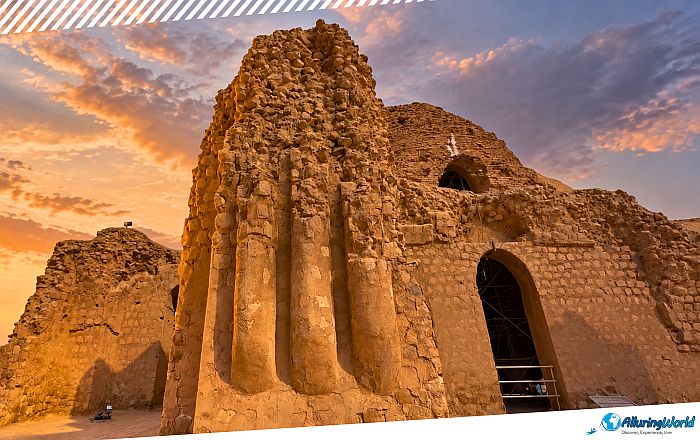
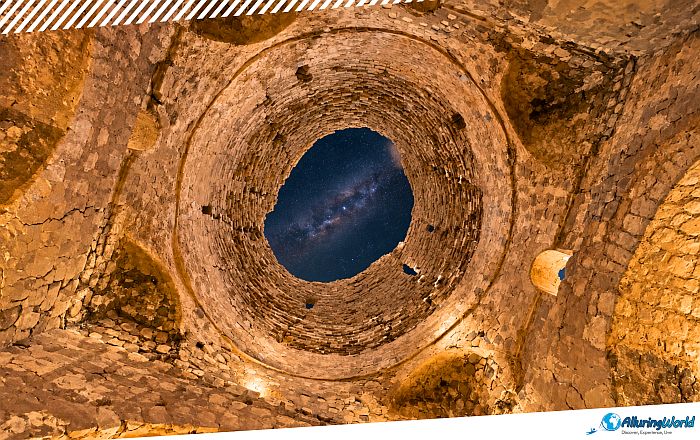
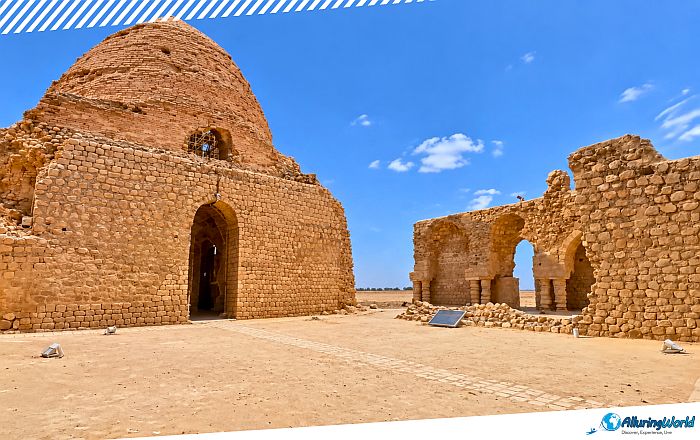
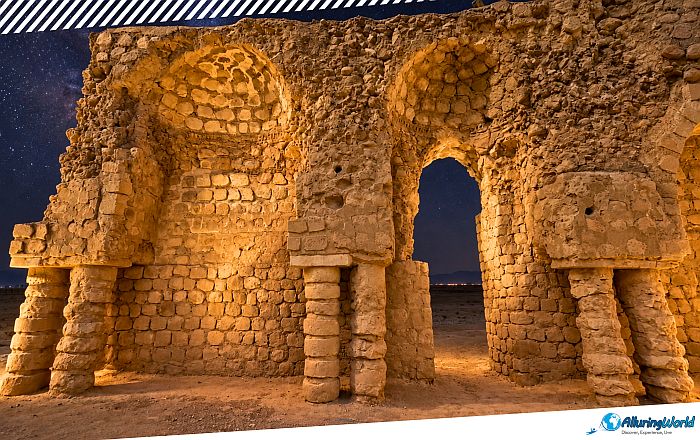
The key achievement in Sarvestan is the central domed chamber that forms the focal point of the palace. The dome itself, measuring approximately 13 meters (43 feet), is made of bricks and covers a square room without any gaps between them. Ancient builders managed to resolve the geometric conundrum of how to place a round dome over a square room by refining the technique of building squinches. These are small arches built across the upper sections of the square-shaped walls that help create an octagon, on which a dome can be placed. Surrounding the central domed hall are elongated barrel-vaulted galleries and iwans, which are grand arched openings having an open entrance on one side only. On the south side, there is a colonnaded walkway which has short, thick stone columns carrying longitudinal barrel vaults. The corridors thus provided shelter from hot winds, while they provided breezes which were directed into the interior of the building. As you move through the three-iwan façade, you feel how the architects had used lighting and air currents to cope with the severe climate of southern Iran.
ADVERTISEMENT
Sarvestan Palace does not come across as a well-maintained museum but rather an oasis found in the middle of the desert. Since it lies off the main path from Shiraz to Yazd, you are most likely going to have this 2,500-square-meter (26,900-square-foot) complex all to yourself except for the wind that blows through the plains. There are no tough hiking trails or steep staircases to climb to reach the main halls, making the flat dirt and gravel grounds relatively accessible for most visitors. However, exploring the outer perimeter entails walking over uneven, rocky terrain. Plan to spend about 45 to 60 minutes here, which gives you plenty of time to admire the brick squinches, walk through the vaulted galleries, and take photographs.
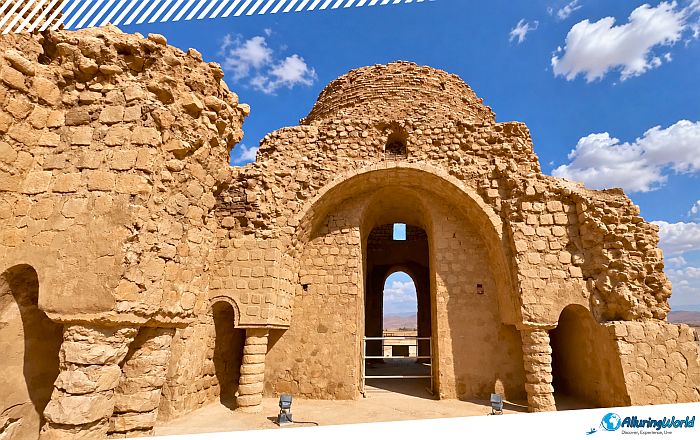
If you are a photographer, then the combination of the textures and geometrical shapes at the palace is an excellent subject for you, especially when taken against the backdrop of the remote Zagros mountains. Some helpful hints while shooting and visiting the site are as follows:
- Target the golden hours: It is best to either arrive at 08:00, just after opening, or stay until closing at 17:30 (18:30 during spring and summer). Sunlight is slanting in low rays onto the rugged masonry walls and highlighting the vaults and shadows in the central domed room.
- Respect preservation boundaries: The palace has been eroded by wind, thermal movement, and water throughout the ages. Please stay only on the paths at ground level and never attempt to climb on top of the stone walls or brick squinches. The structure is fragile, and it is prone to destruction when not taken care of.
- Pack for exposed conditions: There is little shade and few facilities at this archaeological park. Be sure to bring 1.5 liters (50 fluid ounces) of water per person, sun protection, and strong closed-toe footwear due to the rough ground near the perimeter.
Before arriving at the entrance booth, make sure you are carrying physical Iranian Rials to pay the small foreign visitor admission fee, as international credit and debit cards do not work in Iran. Additionally, while handheld photography is completely welcome, flying drones is strictly prohibited around Iranian heritage sites without special government permits. Fars Province experiences a semi-arid climate with dramatic seasonal swings, making timing crucial for an enjoyable visit. The ideal windows to explore Sarvestan Palace are spring, which runs between March and May, and autumn, which runs from September to November. During these months, daytime temperatures hover comfortably between 15°C and 30°C (59°F and 86°F), while the surrounding plains take on a brief flush of spring greenery, and clear skies provide crisp views of the mountains. Summer is characterized by scorching heat, which often rises above 40°C (104°F) by 11:00, and the stone ruins are like an oven. On the other hand, during the winter months from December to February, temperatures can be around 0°C (32°F), and it is better for exploration compared to the summertime.
In case you wish to go to the palace from Shiraz, it is relatively easy, as this city acts as the obvious starting point for the region. Since there is no public transportation available to the archaeological site, you will have to take a taxi, or you may opt for a day tour that begins from Shiraz. The drive takes approximately 1 hour and 15 minutes along Highway 86. Because English road signage near the rural turnoff is sparse, it is best to download offline maps in advance and search for the Persian name Kakh-e Sarvestan (coordinates: 29.1956° N, 53.2308° E). Since the archaeological site itself has no visitor center, restrooms, or cafes, make sure to stop 10 kilometers (6 miles) north in the town of Sarvestan for fuel, food, and facilities before heading out onto the plains. While in town, you can also browse local roadside stalls for Sarvestan’s renowned regional produce, particularly fresh pistachios and sun-dried figs, which make great road-trip snacks. Many travelers pair Sarvestan with a trip to Maharloo Lake, a seasonal pink salt lake located roughly 20 to 30 kilometers (12 to 19 miles) southeast of Shiraz along the same route, or continue further south toward Firuzabad to compare Sarvestan’s refined vaults with the massive, early-Sasanian Palace of Ardashir. If you start from Shiraz by 08:00, you can easily turn this into a full-day UNESCO Sasanian loop by driving roughly 2 hours southwest from Sarvestan to Firuzabad to also explore the hilltop fortress of Qal’eh Dokhtar (Maiden Castle) and the ancient circular city of Gur before returning north to Shiraz in the late afternoon.
When you are in the rural Fars Province, you need to observe the local cultural etiquette, as this will enhance your experience. Iran enforces a mandatory dress code for all visitors: women must wear a headscarf (hijab) along with loose-fitting clothing that covers the arms and legs down to the ankles, while men should wear long trousers rather than shorts. A polite greeting of Salaam to the site’s caretakers often opens the door to warm hospitality and local insights into the surrounding agricultural towns. Despite its isolated rural setting, Sarvestan Palace is calm, welcoming, and safe for solo and independent travelers, with on-site caretakers present during opening hours to watch over the grounds. Overall, Sarvestan Palace awaits those courageous enough to go past the most famous sites in Iran. While Persepolis highlights the pomp and power of the Achaemenid rulers, Sarvestan offers an experience of a culture caught halfway through development, trying out domes and vaulted spaces that would forever change the face of the region’s architecture. It was under the 1,500-year-old brick dome at Sarvestan that you could pinpoint the very blueprint for the later mosques of Isfahan and Shiraz.