
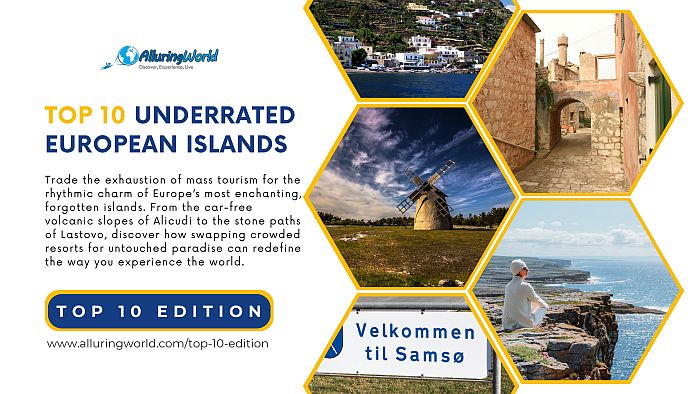
The modern travel scene is usually marked by the desire to cover certain sites, click-worthy photos, and complete busy itineraries, or in other words, fit your entire travel schedule within a week or so. Popular destinations in the Mediterranean and Atlantic areas have turned into crowded places because of mass tourism. What is slow travel? The concept of slow travel becomes the answer to such an exhausting form of holiday-making. It involves unpacking just once and embracing the natural pace of life in the particular destination.
This way of life is perfectly suited to islands since their geographical location makes them an ideal separation from the hustle of the mainland. Whereas popular islands such as Mallorca, Ibiza, and Capri attract crowds during summer vacation, there are other, less well-known islands on the continent of Europe that are pristine and untouched by civilization.
Selecting a forgotten island is about swapping giant resorts for family-owned guest houses, bright lights for starry nights, and tourist busloads for centuries-old donkey paths. Here are ten overlooked European islands that offer the perfect backdrop against which to rediscover how to explore intentionally and mindfully.
1. Lastovo, Croatia
Lastovo lies hidden amidst the depths of the Adriatic Sea and epitomizes the raw nature of Dalmatia. The fact that the island was used as a military base for many years during the time of Yugoslavia ensured that it was not open to tourists at all before 1989. This resulted in an incredibly well-preserved natural haven that now enjoys the status of being a Nature Park.
Slow travel on Lastovo revolves around the sensory experiences of dense pine forests, rugged limestone coastlines, and centuries-old stone villages. The main settlement, also named Lastovo, is built in an amphitheater shape on a steep hill facing away from the sea, and this was intended to protect the inhabitants from pirates. Walking through its narrow stone steps reveals fascinating Renaissance architecture and the island’s signature fumari: intricate, structurally unique chimneys that local families historically built to showcase their status and creativity.
The lifestyle here is very relaxed. The perfect way to spend days would be cycling down empty tree-lined roads, swimming in the crystal clear waters of Zaklopatica Bay, and having deliciously cooked dinners. The local taverns always have fresh grilled fish topped with olive oil produced on the farm and served with Maraština, a dry local white wine. Because of the lack of light pollution, at night the sky becomes covered with countless stars that one can just admire.
For you to get the maximum from this remote escape, make sure that you will be spending time in one of the old stone houses in the main village or renting an apartment by the sea in Lučica. During the morning hours, you will spend time collecting wild herbs or interacting with the olive farmers, while evenings will be spent watching constellations at the Helidrom, the highest point on the island.
2. Alicudi, Italy
If you interpret the terminology of slowing down as disconnecting completely from all the mechanical sounds of today, then Alicudi is your perfect hideaway. Situated as the most western and remote point of the Aeolian Islands chain in Sicily, Alicudi emerges abruptly from the deep waters of the Tyrrhenian Sea. Populated by fewer than one hundred people, the island does not have any cars, motorcycles, or even streets.
Upon arrival at the tiny pier, you enter a world governed by foot power and working pack mules, which locals use to carry luggage up the steep stone staircases. The entire human footprint on Alicudi consists of a cluster of whitewashed houses built in steep terraces directly onto the volcanic slopes. To go anywhere, whether to the local grocery shop, the tiny school, or the historic Church of San Bartolo, you must navigate a web of hand-carved lava stone steps.
This challenging terrain rewards you with an unmatched level of peace. Hikers can ascend the trail to the highest volcanic peak, Monte Filo dell’Arpa, to stand on the edge of an extinct crater surrounded by wild heather and spectacular open ocean vistas. Without the distraction of commercial entertainment, slow travel here means swimming off rocky, pebble beaches like Palomba, reading on panoramic terraces, and enjoying casual dinners cooked by local fishermen who open their homes to travelers.
It’s going to take some planning to stay here in a place where there are no cars, but you will be left with nothing but pure mental clarity. Make sure that you have sturdy walking shoes, as well as a flashlight, so that you can see where you’re going through the dark paths during the nighttime hours. You should prepare to base your daily routine entirely around the movement of the sun and the arrival of the local fishing boats.
3. Gozo, Malta
Though the main island of Malta has been well-regarded for its compact historic architecture and urban vigor, its twin island of Gozo presents a more peaceful rural setting. Linked to Malta by a quick ferry ride that only takes twenty minutes, Gozo provides an island filled with verdant hills, impressive limestone cliffs, and a farming-based economy.
Slow travel on Gozo allows you to dig deep into layers of ancient history. The island is home to the Ġgantija Temple complex, a UNESCO World Heritage site consisting of megalithic structures that predate both Stonehenge and the Egyptian pyramids. The capital city, Victoria, features a beautifully restored medieval Citadel perched high on a central hill, offering panoramic views across the patchwork fields below.
Beyond the historical sites, Gozo’s coastline invites unhurried exploration. You can watch artisans harvest sea salt at the 350-year-old Xwejni Salt Pans, where checkerboard rock-cut pans stretch along the northern edge of the coast. Divers and swimmers can spend slow afternoons at the inland sea of Dwejra or the red-sand bay of Ramla. Food is central to the Gozitan way of life; taking your time over a lunch of fresh gbejniet (sheep’s milk cheeselets), sun-dried tomatoes, and sourdough ftira bread is an essential daily ritual.
Basing yourself in a converted centuries-old stone farmhouse in one of the quiet inland villages, like Xagħra or Għarb, lets you experience local life intimately. You can easily spend an entire week doing nothing more than walking through wild thyme fields, exploring coastal limestone arches, and joining the locals for a slow evening drink in the village square.
ADVERTISEMENT
4. Samsø, Denmark
Samsø Island, which is situated in the Kattegat sea, represents an exemplary case of sustainable living without any harm to the environment and a perfect place for eco-travelers who appreciate taking their time to explore nature. The Danish island became world-famous when it managed to achieve full sustainability in terms of energy resources, using windmills, bioenergetic power plants, and solar panels owned by the local community.
The landscape of the island consists of a combination of hills, fjords, and traditional wood-frame towns that are beautifully decorated with the flower of the hollyhock. The island of Samsø is easily reached by bicycle through the entire network of smooth rural roads.
The culinary philosophy here is the epitome of the farm-to-table movement. Known as Denmark’s vegetable garden, Samsø produces highly sought-after early root vegetables, berries, and herbs. As you bike across the countryside, you will encounter numerous roadside honesty stands stacked with freshly harvested potatoes, strawberries, and homemade preserves. Travelers can pick up what they need, drop cash or an electronic payment into a secure box, and cook a hyper-local meal at their leisure.
In order to fully immerse yourself in the Danish culture of hygge, you can either rent a little sea cabin or a farm that has been converted into an ecological mill. Spend your time picking up food from the beaches, searching for the twisting trails of Nordby Bakker, and getting fresh produce from the local farmers.
5. Inis Meáin, Ireland
The Aran Islands are located at the mouth of the bay of Galway and boldly endure the rough waves of the Atlantic Ocean. While Inis Mór, the biggest island, lures thousands of tourists in summer, Inis Meáin, the middle one, preserves its tranquility and conservatism. Here, the main language is Irish, and the scenery resembles a living heritage museum.
The physical appearance of Inis Meáin is defined by a vast, intricate maze of dry-stone walls that crisscross grey limestone pavements, built over generations to shelter tiny plots of soil from biting Atlantic winds. Walking or cycling along these narrow paths brings you to dramatic, sheer cliffs and ancient ring forts like Dún Chonchúir, which sits proudly on the island’s highest ridge.
Slow travel in Inis Meáin is a way of getting used to the forces of nature. This means being able to watch waves smashing against the rock-studded coastline, hearing the sounds of old-time music in the only pub in the area, and knowing the rich history that lies behind the beautiful Aran wool knitted clothing.
If you want a true experience, then get a room in a local bed & breakfast or the renowned eco-lodge of the island, which pays tribute to the marriage of contemporary architecture with traditional building material. Pass your days heading to Synge’s Chair, a protected stone outlook located at the cliff’s edge that was the source of inspiration for the playwright J.M. Synge.
6. Graciosa, Azores, Portugal
Despite being famed for its verdant volcanic terrain, Graciosa Island is known to have a peaceful and tranquil charm compared to other islands of the Azores archipelago. Graciosa Island is famously known as the “White Island” owing to the existence of white-colored volcanic rocks on its coasts and the presence of buildings with white walls.
What makes the island unique is its geographical formation, called Caldeira, which is a huge volcanic crater where one can hike. Located deep in the volcanic crater is the impressive lava cave named Furna do Enxofre, which consists of an underground lake inside a dome-shaped volcanic roof.
Slow travel in Graciosa is a pleasant adventure. You can enjoy a dip in the warm and soothing water of the thermal baths located in Carapacho, pass by the picturesque red-domed windmills found all over the island, and explore the tranquil roads of the town of Santa Cruz da Graciosa. Graciosa is famous for its Pastel de Graciosa, a small pastry filled with a star-shaped custard, which makes a perfect accompaniment to the morning coffee in the bright sunshine of the town’s square.
It is an ideal setting for the week to come if you stay in a typical, renovated stone house on the coast. The week could be planned around leisurely dips into the lava rock pools, picturesque hikes along the coastal path with views over the offshore islands, and pleasant evenings sampling the local white wines.
7. Vis, Croatia
Further out in the more remote Adriatic than the much frequented Hvar and Brač, Vis remains a haven for true Mediterranean culture. Like Lastovo, Vis was a military outpost for the Yugoslav navy for decades, and this meant that it remained untouched by early mass tourism and the commercialization that followed. Today, it remains an oasis of sheer cliffs and secret coves, not to mention rich maritime history.
There are two historic towns on the island: the town of Vis, which boasts an exquisite stone coast and remnants of Roman history, as well as Komiža, a quaint fishing village located near the base of Mount Hum. Traveling slowly means embracing the pace of life called pomalo, which is essentially a philosophy of slow living. It is possible to spend your time strolling through the stone streets, exploring military tunnels in the mountains, or traveling by slow ferry to the small island of Biševo to see the blue light of the Blue Cave.
The culinary identity of Vis is exceptional. The island is covered in ancient vineyards growing Vugava and Plavac Mali grapes, while the local waters supply fresh seafood that has sustained the islanders for millennia. For an unforgettable evening, walk into a rural inland tavern to enjoy Peka, a traditional dish of octopus or lamb slow-cooked under a iron bell covered in live coals for hours.
ADVERTISEMENT
8. Ouessant (Ushant), France
Ushant marks the most northwesterly point of metropolitan France, as it lies at the intersection between the English Channel and the Atlantic Ocean. Famous for its rugged maritime atmosphere, this island of Brittany is encircled by the dramatic rocky cliffs, strong ocean currents, and a cluster of mythical lighthouses.
There is extremely restricted car access to visitors, leaving bicycles and walking shoes as the only means of transportation around. The inside of the island consists of extensive heathland, full of windswept areas of gorse and heather, which is home to tiny black sheep.
Slow travel on Ouessant is heavily influenced by the maritime weather and shifting ocean tides. Days are spent hiking the coastal trail to watch waves crash against the rocks at Pointe de Pern, visiting the museum of lighthouses, and watching the massive beacon of Phare du Creac’h sweep across the sea at night. After a day in the ocean breeze, you can warm up in a cozy village bistro in Lampaul with a traditional Breton galette (savory buckwheat crepe) and a carafe of local dry cider.
To get the complete maritime experience, rent an old stone cottage sheltered from the Atlantic winds. Dedicate your evenings to watching the lights of five different major lighthouses sweep across the dark ocean horizon, experiencing a deep sense of solitude on the edge of the European continent.
9. Fårö, Sweden
Fårö is an island situated to the north of Gotland, and the natural beauty and significance of its cultural heritage make it a place of stunning natural splendor. This island became well-known throughout the world as the birthplace and source of inspiration for the world-renowned film director, Ingmar Bergman, whose films were shot here.
The defining natural feature of Fårö is its raukar; monolithic, wind-sculpted limestone sea stacks that rise like ancient stone sentinels from the pebble beaches. The fields are bordered by traditional thatched-roof farmhouses and historic stone walls, creating a landscape that feels completely timeless.
For a slow traveler, Fårö offers an invitation to find beauty in simplicity. You can spend long afternoons walking among the limestone formations at Langhammars, exploring the white dunes of Sudersand beach, or stopping at Kutens Bensin, a legendary, eccentric local cultural hub and crêperie filled with vintage American cars and rockabilly memorabilia. The island encourages quiet reflection, artistic inspiration, and long, slow bike rides through fragrant pine forests.
An ideal stay here involves renting a minimalist timber cabin or a traditional farmhouse. Embrace the Swedish concept of fika by stopping at local artisan bakeries for cardamom buns, and spend your evenings walking along the silent, rocky coastlines under the soft light of the Baltic summer nights.
10. Belle-Île-en-Mer, France
As per its name, “Island of Beauty by the Sea,” the largest of all islands located off the coast of Brittany is none other than Belle-Île-en-Mer, whose striking contrasts between picturesque pastel-tinted harbors, green rolling hills, and rocky cliffs have always drawn many artists, among whom is the Impressionist artist Claude Monet.
The island provides a perfect blend of untouched natural beauty and elegant French countryside charm. Le Palais serves as the main access to the island, and the first thing one notices here is the huge stone fort known as Citadelle Vauban that was built in the 17th century. It provides spectacular panoramic views overlooking the harbor.
For the slow traveler in this place, put on your hiking shoes and explore some segments of the Sentier des Douaniers (“path of the customs officer”), which runs along the coastline. Go to Les Aiguilles de Port-Coton to view the tall rocks jutting out of the ocean, or find yourself a sheltered beach where you can take an afternoon dip. Spend the evenings at a local marketplace shopping for oysters, cheese, and salt butter caramel, indulging in the culinary delights of Brittany.
Basing yourself in a seaside cottage in Sauzon allows you to watch the boats drift in and out with the tides each day. Give yourself plenty of time to enjoy long meals at harbor bistros, bike through the green interior valleys, and watch the Atlantic sunset cast deep golden hues across the historic stone fortifications.
In conclusion, choosing to practice slow travel on Europe’s hidden gems is not simply an option for avoiding the throngs of tourists during your holiday break, but rather an intentional decision to shift your relationship with time. No matter whether your destination may be Alicudi, with its steep stone stairways, or Samsø, with its biking paths through the countryside, or even Vis, and its seaside life, these places demonstrate that the most rewarding experiences come from slowing down.
In leaving the beaten path of the tourist and opting for islands that care more about preservation than development, you will find a more enriching experience of exploring the world. Travel light and toss out your meticulously planned itinerary, and let the natural rhythm of life on these ten islands take you where you need to go. You do not need to wait any longer, book your trip and make sure that you will enjoy every single moment of your travels.