
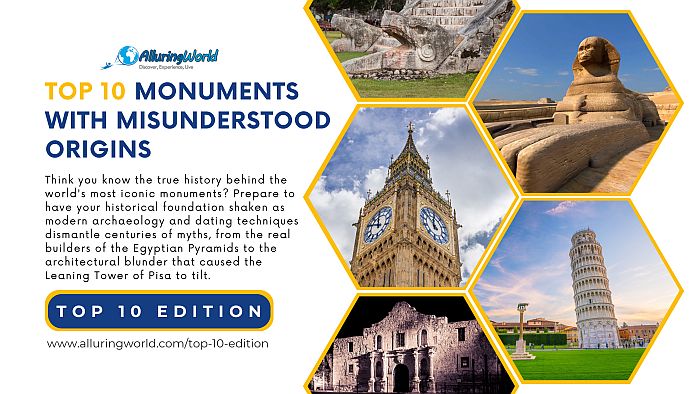
When we talk about the most famous landmarks across the globe, we view them in terms of a glorified mythology, movie drama, and architectural gossip through the ages. We believe that what was told to us in books or tour guides is pure stone-cold truth. Human history, however, is quite messy, and many of our greatest monuments were created in very different conditions, by very different people, and for opposite purposes than what we know now.
If you think you know who built the Pyramids, why the Leaning Tower of Pisa tilts, or what the Taj Mahal was supposed to look like, prepare to have your historical foundation shaken. Here are ten legendary monuments whose true origins have been utterly misunderstood by the masses.
1. The Great Pyramids of Giza (Egypt)
- The Misconception: Built by thousands of oppressed Jewish enslaved people under the whip of an autocratic Pharaoh.
- The Reality: For generations, popular culture and biblical epics have painted a grim picture of the Pyramids’ construction. But modern archaeology has completely dismantled this narrative. Archaeological evidence from worker settlements close to the Giza plateau has shown that these workers were actually paid and skilled workers from Egypt, and they were not enslaved people at all. They had contractual agreements for the season, lived in well-organized camps, were accorded high-quality medical treatment (including successful bone setting), and a well-balanced diet consisting of high-quality meat. The bodies of these workers, upon their deaths, were buried in tombs adjacent to the pyramids, an honor no enslaved person could ever get.
2. Stonehenge (United Kingdom)
- The Misconception: Built by the Celtic Druids as a mysterious site for sacrifices.
- The Reality: The image of druids wearing white robes congregating at Stonehenge to celebrate the summer solstice rituals is entrenched in British folklore. But such a scenario is historically impossible. Modern radiocarbon dating has shown that the first building of Stonehenge took place between 3000 BCE and 1600 BCE. It was only around the 3rd or 4th century BCE that Celtic Druids emerged as an important religious group in Britain, thousands of years after the last stone had been erected. There is no written evidence from the early Neolithic constructors who built the monument.
3. The Taj Mahal (India)
- The Misconception: Emperor Shah Jahan planned to build an identical “Black Taj Mahal” across the river as his own tomb.
- The Reality: One of the most romantic myths in architectural history claims that the white marble Taj Mahal was only half of the grand design. This amazing structure in India has a legend which states that Shah Jahan intended to construct a mirrored, black marble mausoleum on the opposite bank of the Yamuna River, but was overthrown by his son before construction could start. Extensive archaeological excavations of the site (the Mehtab Bagh garden) have yielded absolutely zero traces of black marble. The entire “Black Taj” myth likely originated from European travelers in the 17th century who misinterpreted the dark, heavily discolored reflection of the white monument in the river at dusk.
4. The Colosseum (Italy)
- The Misconception: The major location where thousands of early Christians were hunted down and thrown to the beasts of the arena.
- The Reality: Although the Flavian Amphitheater was certainly the site of many bloody entertainments and executions, there is no factual evidence of its use as the locus of mass Christian martyrdom. Early Christian writers kept detailed accounts of the persecutions, but not one ever mentioned the Colosseum as the primary site of execution. Emperor Nero did indeed execute Christians cruelly, but at the Appian Way and his gardens prior to the construction of the Colosseum. In fact, the Colosseum became a martyrium site much later, in the eighteenth century, as a very effective political gesture by Pope Benedict XIV that saved the structure from destruction.
5. Elizabeth Tower / “Big Ben” (United Kingdom)
- The Misconception: “Big Ben” is the name of the iconic neo-Gothic clock tower standing over the Houses of Parliament.
- The Reality: If you point at the majestic tower on the River Thames and call it Big Ben, a British historian will gently correct you. The tower itself was originally named the Clock Tower, and was officially renamed Elizabeth Tower in 2012 to honor Queen Elizabeth II’s Diamond Jubilee. “Big Ben” is strictly the nickname of the colossal, 13.7-ton striking bell hung inside the belfry. The famous moniker likely honors Sir Benjamin Hall, the immense, loud-voiced Commissioner of Works who oversaw its installation in 1859.
ADVERTISEMENT
6. The Great Sphinx of Giza (Egypt)
- The Misconception: Napoleon Bonaparte’s invading French troops used the Sphinx’s nose for target practice and shot it off.
- The Reality: This persistent rumor blames 18th-century French military hubris for damaging the face of the ancient world’s most famous statue. However, sketches of the Sphinx drawn by Danish explorer Frederic Louis Norden in 1737, decades before Napoleon was even born, plainly show the monument already missing its nose. Historical records from the 10th-century Arab historian Al-Maqrizi suggest the nose was actually pried off centuries earlier by a devout Sufi Muslim named Muhammad Sa’im al-Dahr, who was outraged by local peasants making religious offerings to the pagan idol.
7. The Leaning Tower of Pisa (Italy)
- The Misconception: It was intended that the tower would be built leaning to create a bold design in architecture.
- The Reality: Engineers excavated an extremely shallow foundation that had a depth of only 3 meters (10 feet) when construction began in 1173. Additionally, the soil selected for building the structure was very unstable and consisted of fine clay, sand, and silt. The construction of the third level caused the tower to lean southwards due to its heavy weight, made of marble. Luckily, a century-long delay caused by regional wars gave the unstable soil underneath time to compact and settle, which is the only reason the structure didn’t completely fall over.
8. The White House (United States)
- The Misconception: The executive mansion was painted white specifically to cover up the scorch marks left by British arsonists during the War of 1812.
- The Reality: It is a dramatic story: the British army burns Washington, D.C. in 1814, and resourceful Americans use white paint to hide the scars of defeat. However, the building was already white long before the British arrived. The porous sandstone exterior was first coated in a lime-based whitewash way back in 1798 to shield the stone from cracking during freezing winter weather. In fact, records show people were already casually referring to the building as “The White House” in letters written in 1811.
9. The Alamo (United States)
- The Misconception: A heroic battle fought by freedom-loving pioneers to secure Texas’s inclusion into the United States.
- The Reality: Although the 1836 battle remains a celebrated episode in American history, the truth is that the geopolitical situation was a lot more complex. Back then, Texas was a territory of Mexico and not of the United States. Moreover, the Texians rebelled against the centralist government of Mexico under the leadership of Santa Anna. It is significant to mention that a major driving force behind the revolution was Mexico’s strict abolition of slavery in 1829, which the settlers vehemently opposed. It is also noteworthy to point out that Texas did not immediately become a part of America after the war but rather declared itself an independent nation-state for almost a decade.
10. Chichen Itza’s El Castillo (Mexico)
- The Misconception: An intact Mayan pyramid built for the sole purpose of sacrificing people.
- The Reality: Although the huge step-pyramid may be an architectural marvel of the Mayans, its creation is a product of the fusion of two cultures. El Castillo got heavily influenced by the Toltecs, invaders or migrants from central Mexico who came in contact with the Mayans during the 10th century. In addition to this, the purpose of the pyramid was not that of a slaughterhouse but rather that of a complex physical calendar. The building contains four staircases with 91 steps each, which, when summed up with the single platform at the top, equals exactly 365 days. In the spring and autumn equinoxes, the play of sunlight casts shadows that make it appear as a feathered serpent coming down the building, all in honor of the god Kukulkan.
In conclusion, today’s global monuments, once stripped of all fiction, become much more interesting. From the paid craftsmen in Egypt to the mistakes in architecture in medieval Italy, the true stories behind these monuments demonstrate how ingenious humans were, how politics were played, and the flaws in the past that were only natural. The true history of these monuments does not make them any less impressive but, rather, adds to their realism and humanity.