
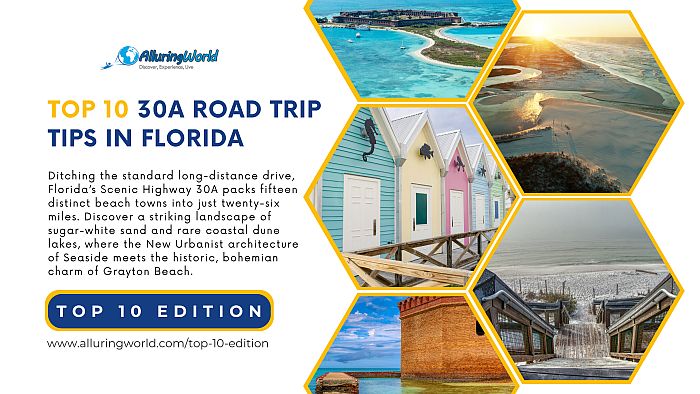
Most Florida road trips chase distance. The 30A version does the opposite. Forty-two kilometers or twenty-six miles, fifteen beach towns, sugar-white sand on one side and pine forest on the other.
Every few minutes, the architecture changes, the dining scene shifts, and the dune lake on your right becomes a different dune lake entirely. For travelers used to longer routes like the classic West Coast drive, 30A flips the formula. Below are the details for you to consider how to drive it end-to-end.
1. The Practical Framework: Route, Distance, and Timing
Scenic Route 30A Highway is an interesting journey that takes you through 42 kilometers (26 miles) from the eastern tip of Inlet Beach to Dune Allen Beach in the west. It will take you about 45 minutes to travel this distance, provided you do not make any stops. However, one day will not be sufficient to stop during your journey.
The obvious route would be from east to west. As it is near US-98, we get started with busy and well-developed cities and slowly transition into western ones. The convenience of being near 30Avenue’s restaurants and Camp Helen State Park makes Inlet Beach vacation rentals an ideal choice for a base.
The most ideal times are late April through early May and September through October.
2. Inlet Beach: The Eastern Gateway
Inlet Beach is located in the far east of 30A, where Walton County meets Bay County. Inlet Beach represents the most practical beginning for the corridor and one of its most underrated towns.
30Avenue, the open-air dining and shopping district just off US-98, is the obvious anchor. A few minutes south, Camp Helen State Park protects Lake Powell, one of Florida’s rare coastal dune lakes, along with a 1940s lodge that anchored the property’s earlier life as a company retreat.
Why visit: the easiest entry point to 30A, with the dining and beach access of a built-up town but none of Seaside’s foot traffic.
3. Rosemary Beach: Pastel Architecture and Town-Square Energy
Rosemary Beach has been conceived to create an ambiance of Europe, which the designers have successfully created. The buildings have a Dutch West Indies and West Indian Caribbean influence. The building exteriors feature pastels with deep courtyards and walking lanes leading to the Gulf of Mexico.
The town center is designed for people who enjoy lazy mornings, which involve enjoying Amavida Coffee. It consists of restaurants and boutique shops that surround a central green, and the design is the main attraction.
Why visit: coffee, courtyard, and a town center you’ll want to explore on foot.
4. Seacrest and WaterSound: The Quiet Stretch
These two resorts are located between the larger resorts and thus often go unnoticed, which makes them all the more worth checking out. The Seacrest Beach resort is family-friendly and features a resort-style pool measuring 1,115 sq m (12,000 sq ft). WaterSound lies to its west and is more secluded, with restricted access to beaches and Camp Creek Lake nearby.
Why visit: Gulf access and white sand without the parking-lot crowds of Seaside or Rosemary.
5. Seagrove and Seaside: The Heart of the Corridor
The first was Seagrove. It was founded in the 1940s, and it has old Florida-style cottages with an environment that seems more unplanned than what followed. Residents tend to reside there more.
But in addition to this, there’s Seaside as well. Planned in the early 1980s and one of the pioneers of the concept of New Urbanism, Seaside became the setting of The Truman Show movie, which many guests only discover upon arrival.
Provisioning is taken care of by Modica Market; the farmers market on Saturdays should be penciled into your schedule, and Airstream Row, a group of classic Airstreams located along 30A selling lobster rolls, wood-fired pizza, and fish tacos, is where everyone stops for lunch.
Why visit: the Saturday market, Airstream Row, and the strange experience of recognizing a town you have never been to.
ADVERTISEMENT
6. WaterColor: Resort-Scale Design and Dune Lake Country
WaterColor is a master-planned community built around Western Lake, one of the corridor’s larger coastal dune lakes. These lakes are rare globally, with only a handful of places on earth holding them. 30A has fifteen. Boathouse rentals on Western Lake make paddleboarding and kayaking easy, and the Gulf-side beaches are wide and uncrowded compared to neighboring Seaside.
Why visit: a sunset paddle on Western Lake, with the dunes on one side and the pine forest on the other.
7. Grayton Beach: The Original 30A Town
Grayton was founded in 1890, which makes it the oldest town on 30A by nearly a century. It has personality where the master-planned communities have polish. The unofficial town motto, painted on signs around town, is “Nice Dogs, Strange People.”
Grayton Beach State Park is frequently regarded as one of the greatest beach towns in America, and Western Lake lies adjacent to Grayton Beach State Park on the interior side. In addition, the Red Bar, which has been refurbished following its destruction in a fire in 2019, alongside some long-established local eateries, contributes to making dining feel like it has grown into place.
Why visit: old-Florida atmosphere and one of the top-rated state park beaches in the US.
8. Blue Mountain and Dune Allen: Where 30A Quiets Down
Blue Mountain Beach took its name from the blue lupine that once bloomed across its dunes. It also holds the highest elevation along 30A, which is not saying much in Florida, but still earns it the name.
Dune Allen Beach is the western terminus and the corridor’s quietest stretch. Three coastal dune lakes, including Oyster Lake, Allen Lake, and Stallworth Lake, sit within the town’s limits. Stinky’s Fish Camp, named ironically and run seriously, is the destination dinner reservation people drive in from other towns for.
Why visit: the part of 30A that still feels like a side road, with three dune lakes and the best fish camp on the corridor.
9. Stops Worth Pulling Over For
Some of the better 30A experiences are not in the towns themselves. The state parks are the obvious starting point: Grayton Beach, Camp Helen, Deer Lake, and Topsail Hill Preserve, the last of which holds more than 1,600 acres of protected coastal habitat.
Travelers drawn to Florida’s wilder sites like Dry Tortugas National Park will find a similar instinct here.
Walton County also maintains numbered Regional Beach Accesses between private rental stretches, useful for day visits. The Saturday farmers’ markets in Seaside and Rosemary Beach are worth a detour either way.
10. Traffic, Bikes, and When to Skip the Car
From Memorial Day through Labor Day, 30A traffic crawls. Saturdays are changeover days and the worst of the week. Sundays are not much better.
The fix is the Timpoochee Trail, a paved 19-mile multi-use path that runs alongside 30A through all of the towns. During peak season, a bike will often beat a car for short distances, and bike rentals are available in nearly every town.
When you finally pull back onto US-98 from the Dune Allen end, the contrast between the corridor’s pace and the standard Gulf Coast development is what lingers.
In conclusion, the 30A road trip rewards travelers who treat two-digit miles like they are three or more digits. As with longer drives such as the Ontario road trip loop, the appeal lies in the shifts rather than the distance. This option has a lot to offer to many people, and despite Florida being disliked usually during wintertime, if you decide to do a road trip, then consider this 30A option.
Inlet Beach makes the easiest base, Dune Allen the most underrated stop. Drive it slowly, and the corridor gives up the parts most travelers miss.