
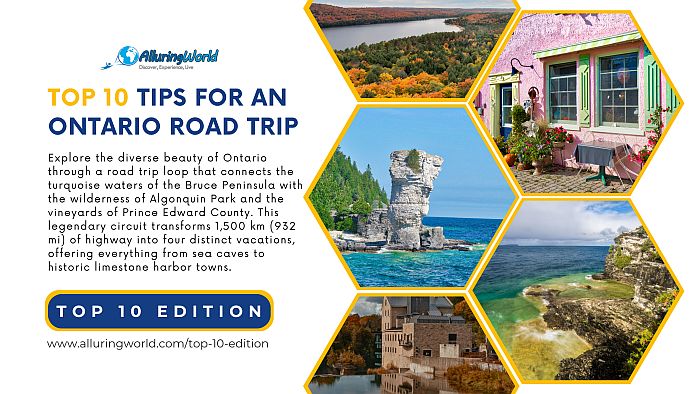
Ontario rewards travelers who slow down. The province holds four of the world’s most distinct warm-weather destinations within a few hours of Toronto, each one different enough from the others to feel like a separate trip entirely.
Strung together, the Thousand Islands, Prince Edward County, Algonquin Provincial Park, and the Bruce Peninsula form what could be considered one of the most varied road trip loops in the country. All of these amazing locations are mixing clear Georgian Bay water with vineyard backroads, paddle routes that stretch hundreds of kilometers, in addition to limestone harbor towns that stay in your memory long after you leave. If you are considering or have already decided to take your amazing Ontario road trip, then consider these ten tips we offer to you.
1. Getting Out of the City: The Practical Framework
When you consider planning the route, have in mind that the most logical routing loops east before turning north and then west. From Toronto, the drive to Kingston via Highway 401 takes roughly two and a half hours and drops you at the gateway to the Thousand Islands.
From Kingston, Prince Edward County sits about 45 minutes west along the Loyalist Parkway, with the free Glenora Ferry providing one of the more pleasant entry points to the peninsula. Algonquin’s West Gate on Highway 60 is about three hours north of Toronto, sitting at kilometer zero of the 56 km (36 mi) Highway 60 corridor that runs through the park’s southern portion.
The Bruce Peninsula, which is a premier Canadian national park, is another three and a half hours northwest of Toronto, putting Tobermory at roughly 300 km (186 mi) from the city. Running all four back-to-back takes seven to ten days at a reasonable pace. If you have this on your mind, then be aware that the best months for the full circuit are late June through early September, when the water temperatures are warm enough to swim, and park facilities are fully operational.
2. Kingston and the Thousand Islands: Boat Tours and Limestone Streets
Kingston anchors the eastern leg of this trip in a way few Ontario cities could. Once the capital of the Province of Canada, it is packed with 19th-century limestone architecture and a downtown waterfront that launches some of the best river experiences available anywhere in the province.
Kingston 1000 Islands Cruises operates from Crawford Wharf at 1 Brock Street, running sightseeing, dining, and shipwreck cruises from mid-April through October aboard three vessels: the Island Queen, the Island Belle, and the Island Star. The Thousand Islands themselves consist of 1,864 islands spread across 80 km (50 mi) of the St. Lawrence River between Canada and the US border.
To qualify as one of the islands, a piece of land must remain above water year-round and support a living tree. Boat tours from both Kingston and the Victorian town of Gananoque give visitors different perspectives on the archipelago, and the 2025 season introduced a new live-guided Shipwreck Cruise in partnership with the Great Lakes Museum.
3. Prince Edward County: Wine, Small Towns, and Sandbanks
Prince Edward County sits on a peninsula in Lake Ontario about 45 minutes west of Kingston, and the County has evolved into one of Ontario’s most compelling food and wine destinations over the past decade. The three towns worth building time around are Picton, Wellington, and Bloomfield, each offering art galleries, antique shops, and locally focused restaurants within a short drive of one another.
The County’s soil and climate support a growing wine scene, and cideries and breweries fill out the beverage landscape for visitors who want to taste their way through a weekend. Sandbanks Provincial Park anchors the natural side of the County with freshwater beach dunes and swimming that genuinely rivals any coastal beach in the province.
On a long-haul trip like this, you’ll probably have evenings where you simply crash at a lakeside cabin with a book or a film, and maybe scroll past the odd comparison page for Ontario online casinos in your feed, but the journeys people rave about later are almost always the ones where digital detours stay secondary to sunrise paddles, quiet main streets, and unplanned roadside stops. The free Glenora Ferry crossing from Adolphustown onto the peninsula is worth timing right for the views across the water.
4. Algonquin Provincial Park: Canoeing the Highway 60 Corridor
Algonquin is Canada’s oldest provincial park, established in 1893, and it is one of the most accessible wilderness destinations in the country for anyone based in Toronto. The Highway 60 corridor runs 56 km (35 mi) from the West Gate to the East Gate and holds nine campgrounds along its length, with Rock Lake and Tea Lake consistently rated the best balance of scenery and facilities for car campers.
The park’s canoe route network covers more than 2,100 km (1,305 mi) with over 2,400 lakes, and two outfitters on the corridor handle rentals: the Portage Store and Canoe Centre at kilometer 14.1, and the Opeongo Store and Canoe Centre located 6 km (4 mi) north of kilometer 46.3.
The most popular entry point for first-timers is Canoe Lake because it offers easy paddling with short portages and access to good backcountry campsites. In recent years, the reservation demand has surged, and bookings are opening five months in advance while prime sites are filling within minutes of opening. If you have concrete plans, then you should book as early as the system allows you to; otherwise, you might not be able to get your reservation if you are late and others have reserved their spots. July and August bring the best weather but the heaviest crowds; however, you can also consider mid-June and September because these months offer shorter queues and equally good paddling conditions.
5. The Bruce Peninsula: The Grotto, Flowerpot Island, and Tobermory
The Bruce Peninsula is where Ontario looks least like itself and most like somewhere you might see on a travel poster. The Grotto at Bruce Peninsula National Park is a sea cave formation on Georgian Bay where the water runs a deep, almost Caribbean blue against white limestone, and Indian Head Cove sits just a short hike away along the same Georgian Bay Trail from Cyprus Lake Campground.
Parking reservations for the Grotto are mandatory from 1 May through 31 October through the Parks Canada reservation system, and there are no first-come, first-served spots at Cyprus Lake during that window, so you must always book weeks in advance for July and August visits. The hiking from Cyprus Lake to the shoreline takes about 30 minutes at a solid pace. Flowerpot Island in Fathom Five National Marine Park sits 6.5 km (4 mi) offshore from Tobermory and is accessible only by boat.
Blue Heron Cruises, Bruce Anchor Cruises, and Tobermory Wave are the three main operators running glass-bottom boat tours that pass over 19th-century shipwrecks before docking at the island, where visitors can hike among the distinctive rock pillars that give the island its name. Tobermory itself is described as the freshwater scuba diving capital of the world, drawing divers to the same shipwreck sites the glass-bottom tours circle from above.
ADVERTISEMENT
6. Practical Notes on Camping and Timing
One of the most important parts for first-time visitors that is always underestimated is getting the reservations right. Ontario Parks handles Algonquin campground bookings and backcountry permits, but Parks Canada manages Bruce Peninsula and Fathom Five, and the two systems have different opening windows and rules.
For Algonquin, the five-month booking window means that anyone planning a July trip needs to be logging into the reservation portal in February. For the Bruce, day-use parking at the Grotto must be booked before you leave home. Both Flowerpot Island boat tours and Ontario Parks campsite reservations sell out weeks ahead for peak summer dates.
Late June through early July is often the sweet spot, offering warm enough water for swimming at Indian Head Cove, reliable canoeing weather in Algonquin, and vineyard season just getting underway in the County. While late August through September extends the swimming season, they are reducing the reservation pressure that defines mid-summer, so you have a bit more relaxed planning.
7. The Grey-Bruce Connection: Scenic Overlooks and Hidden Waterfalls
While you would expect that Tobermory would capture the headlines, keep in mind that the drive south through the rest of the Bruce Peninsula and into Grey County would reveal a more rugged, vertical side of the province. The Niagara Escarpment, which is a UNESCO World Biosphere Reserve, acts as the geological spine of this region, further creating dramatic cliffs that overlook the turquoise expanse of Georgian Bay.
If you are stopping in Lion’s Head, you will be offered a quieter alternative to the crowds of the Grotto, with hiking trails leading to some of the most spectacular limestone lookouts in Canada. Moving further south, the landscape softens into rolling farmland and a “waterfall capital” near Owen Sound. Inglis Falls and Jones Falls are easily accessible stops that should capture your attention because the escarpment’s height creates powerful cascades that are worthy of your time. This stretch of the trip highlights the sheer verticality of Ontario’s geography, providing a sharp contrast to the flat, sandy stretches of the earlier legs.
8. South Georgian Bay: Blue Mountain and the Apple Pie Trail
When you continue your loop and start turning back toward the Greater Toronto Area, South Georgian Bay offers a transition from wilderness back to refined leisure. The area surrounding Collingwood and The Blue Mountains serves as Ontario’s premier four-season resort destination. While famous for winter skiing, the summer months transform the ski hills into a massive playground for mountain biking and hiking.
The region is also the heart of Ontario’s apple-growing country. The “Apple Pie Trail” is a self-guided culinary route that links orchards, cideries, and bakeries across the Beaver Valley and Meaford. This is your perfect opportunity to stock up on local goods before the final leg of the drive. For a final moment of relaxation, the Scandinave Spa Blue Mountain offers an outdoor thermal bath experience nestled in a natural forest, providing a restorative pause after several days of hiking and paddling.
9. Small Town Detours: Elora and St. Jacobs
In case you have not had enough of your Ontario adventure and have a few spare days, then dipping slightly southwest into Wellington County adds a touch of European charm to your itinerary. The village of Elora is home to the Elora Gorge, where 22 m (72 ft) high limestone cliffs flank the Grand River. It is a hotspot for tubing and kayaking, but the town itself is equally compelling, filled with century-old stone buildings that have been converted into high-end boutiques and craft studios.
Nearby, the village of St. Jacobs offers a glimpse into Ontario’s Mennonite heritage. The St. Jacobs Farmers’ Market is the largest year-round market in Canada, and a Thursday or Saturday visit allows you to see the horse-drawn buggies and sample traditional treats like apple fritters. While these two stops might add extra days to your itinerary, they in fact will provide you with a cultural depth to the road trip, thus reminding you that Ontario’s identity is built as much on its historic agricultural communities as it is on its vast northern wilderness.
10. Returning to the Skyline: The Final Stretch
The final two hours of the loop involve merging back into the rhythmic flow of the 400-series highways. As the CN Tower begins to peak over the horizon, the transition from the silent pine forests of Algonquin or the limestone cliffs of the Bruce back to the urban sprawl can feel jarring. Most travelers find that the best way to handle the re-entry is to plan one final, leisurely meal in a town like Guelph or Milton to decompress before hitting the final stretch of suburban traffic.
Reflecting on the odometer, you’ll realize the circuit has covered roughly 1,200 to 1,500 km (746 to 932 mi). By the time you pull back into your driveway, the vehicle might be a little dustier and the gear a bit more worn, but the mental map of the province that you have created for yourself will have expanded significantly. You’ve crossed through distinct ecosystems and historical eras, proving that you don’t need a flight to experience a total change of scenery.
In conclusion, the beauty of an Ontario circuit lies in its lack of monotony. It is a journey defined by shifts in color, from the deep greens of the Algonquin backcountry to the shimmering whites of the Bruce Peninsula and the golden hues of the Prince Edward County vineyards. While the logistics of reservations and timing require a bit of heavy lifting in the planning stages, the payoff is a travel experience that feels expansive and deeply layered.
Ontario is often criticized for its vastness, but when you break it down into a loop of this caliber, that distance becomes an asset. When you spend each hour on the road, it feels like you are served as a palate cleanser, which is preparing you for a destination that looks and feels entirely different from the one you left three hours prior. One thing is for certain: whether you are swimming in the clear depths of Georgian Bay or watching a sunset over the St. Lawrence, the “Four Trips in One” loop remains the definitive way to see the best of the province in a single summer season.