
Read time ca. 6 minutes
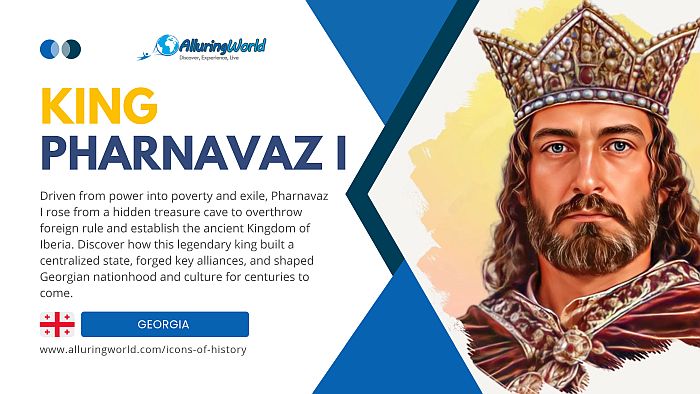
King Pharnavaz I (r. c. 299–234 BCE) plays a foundational role in the early history of Georgia, as he was the first monarch of the ancient Kingdom of Iberia, known as Kartli in the Georgian tradition. He is considered to be a state-builder, law-giver, and cultural creator, who was more than just a king; he is remembered as the founder of the Georgian monarchy and political nationhood. The period of Pharnavaz I’s reign, traditionally placed at the turn of the 3rd century BCE during the Macedonian period, marked the transition from a loose tribal confederation to a centralized monarchy in the eastern South Caucasus.
Early Life and Background:
According to the medieval Georgian chronicles, Kartlis Tskhovreba (The Life of Kartli), Pharnavaz was born into a noble family at a time when Kartli was under foreign rule, a period the chronicles link to the aftermath of Alexander the Great‘s campaigns. Born in Mtskheta to a Persian mother from Isfahan and a father from the ruling clan of Kartli, he belonged to the household of his uncle Samara, who served as the mamasakhlisi (tribal elder) of the city. His father, known as a leader among the nobles of Kartli, had been murdered in political turmoil, which rendered Pharnavaz homeless and threatened with danger. Living in poverty and anonymity, he spent some years of his life in seclusion, far removed from the privileges of aristocratic life.
This period of adversity had a profound influence on Pharnavaz’s personality. According to Georgian folklore, he was characterized by wisdom, fortitude, and a sharp mind, which helped him overcome the state of vulnerability and ascend to the throne. It is also claimed that he was granted a prophetic dream, which foretold his rise, thus symbolizing divine favor and destined leadership. In the chronicles, he first dreamed of anointing himself with sunlight in a dark room, and shortly afterward, while hunting a deer near Mtskheta, a sudden rainstorm led him into a stone-sealed cave containing an immense hidden hoard of gold and silver that funded his rebellion.
Rise to Power:
The rise of Pharnavaz was propelled by the combination of opportunism and calculation. Azon, who was associated with Macedonian influence, was governing Kartli at that time, but as the dissatisfaction of the nobles and ordinary people in Kartli was rising, this presented an opportunity for a rebellion. Alliances were struck up by Pharnavaz with the leaders of other Georgian regions and even with the neighboring Kingdom of Colchis to the west, securing military support for his cause. Specifically, he cemented an alliance with Kuji, the ruler of Colchis (Egrisi), by marrying his sister to him, while also securing warriors from North Caucasian mountain tribes such as the Durdzuks.
Through the uprising, Pharnavaz defeated Azon, a ruler described in Georgian tradition as a Macedonian appointee, though modern historians often view him as a local ruler backed by the Seleucid Empire, ending foreign domination in Kartli. The success was not only a replacement of leaders but rather a clear declaration of indigenous sovereignty. As a result of the victory, Pharnavaz became king, and thus the native Georgian dynasty came into being. During the campaign, a thousand cavalrymen defected from Azon’s ranks to join Pharnavaz, and after defeating Azon in Klarjeti, the new king elevated those loyal horsemen into a hereditary noble class known as the aznauri.
Establishment of the Monarchy:
In his capacity as a king, Pharnavaz worked towards consolidation of power and worked on creating Kartli as a structured state. One of the major accomplishments he achieved was creating a system of centralized monarchy with an administrative structure. The country was divided into zones that were ruled by officials appointed by him, who were known as eristavi. He established seven regional duchies (saeristavo), including Colchis, Kakheti, Klarjeti, and Samshvilde, while placing the central heartland of Inner Kartli under a supreme military commander called the spaspet. Their responsibilities included military, judicial, and economic functions, and this system balanced the royal authority with the governing of local matters, thus ensuring stability across diverse territories of the newly founded kingdom.
Pharnavaz created royal symbolism, which included ritual and regalia, strengthening the notion of kingship. Such changes introduced practices of governance that would continue to persist in Georgian political tradition for centuries to come.
ADVERTISEMENT
Legal and Administrative Reforms:
Early laws establishing legal norms governing social relationships, land ownership, and obligations to the king were introduced by Pharnavaz. Even though these laws were not written as a codex but were passed verbally, they constituted an important step towards institutional governance. The notion of justice was associated with the king, who served as the highest judge in cases of disputes.
Overall, his administrative reforms helped in collecting taxes and organizing the army, making it possible for the country to be self-sufficient economically and defend its borders. Through these reforms, the Kartli region was transformed from a loose confederation into a coherent political entity.
Cultural and Linguistic Legacy:
The long-lasting contribution of Pharnavaz is his connection with the Georgian language and writing system. Medieval Georgian tradition credits him with creating or reforming the Georgian script, though modern linguists and historians agree that the alphabet actually emerged centuries later, around the 4th or 5th century CE, alongside the spread of Christianity. Tradition specifically links him to Asomtavruli, the oldest monumental Georgian alphabet, and credits him with making Kartuli (the Georgian language) the sole official language of royal administration.
By encouraging the use of the Georgian language in the public administration and religion, Pharnavaz helped to foster a sense of cultural cohesion and protection against foreign influences, and elevate the Georgian language even further than it was during his reign. The language became a symbol of identity that tied the people to their government and their leader.
Religion and Spiritual Authority:
Pharnavaz reigned during the pre-Christian times when religion was based on native religions and natural and cosmic deities. Pharnavaz centralized religious worship by erecting a great idol to the supreme deity Armazi on a mountain overlooking his capital, Mtskheta, integrating state paganism directly into royal authority. Alongside the towering bronze and gold statue of Armazi on Mount Armazi, he also erected idols to the deities Gatsi and Gaim, turning the fortified sanctuary into the spiritual center of his kingdom. The temples and sanctuaries were patronized by the king, which helped to establish a relationship between religion and politics.
This fusion of religion and politics increased the legitimacy of the king, further making him a protector of his subjects and a guardian of religious sanctity.
Foreign Relations and Regional Influence:
Pharnavaz pursued a pragmatic approach in terms of diplomacy along with military readiness. The establishment of alliances with other neighboring countries allowed for border security and increased influence without being constantly engaged in war. He reinforced these ties through dynastic diplomacy, including his own marriage to a princess of the Durdzuks from the North Caucasus. This period saw the rise of Kartli as a recognized regional power in the Caucasus region, a power that was capable of negotiating with stronger neighbors while maintaining its well-deserved independence.
There were numerous trade routes that passed through the region, and this was very beneficial to Kartli, as it increased stability and contributed to economic growth and cultural exchange.
Death and Dynastic Continuity:
Pharnavaz reigned for quite some time, witnessing a time of consolidation and tranquility in a very turbulent region. According to the chronicles, he ruled for 65 years before dying at age 92 and being buried before the idol of Armazi, passing the crown peacefully to his son, Saurmag I. Upon his death, the throne was handed over to his descendants, thus assuring continuity in the dynasty. The royal house he established is known as the Pharnavazid Dynasty, through which his descendants ruled Iberia for centuries.
Conclusion:
In summary, King Pharnavaz I is undoubtedly an essential figure in Georgian history, being recognized as the creator of statehood, government, and culture. Using military skills, administrative innovations, and leadership qualities, he managed to turn Kartli into a kingdom with a strong connection to its own roots. This legacy has not only historical significance but also a symbolic one, because the king became the personification of sovereignty and the beginning of Georgia.