
Read time ca. 5 minutes
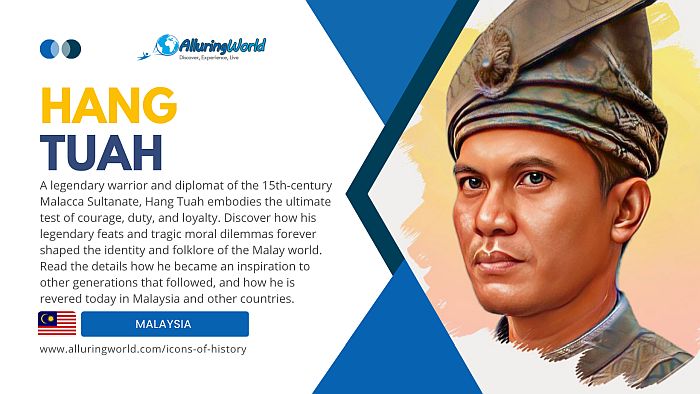
Hang Tuah is considered one of the most famous personalities in Malay folklore and history, as he is very well known for his loyalty, courage, and bravery that he showed throughout his lifetime. The story of Hang Tuah is a combination of fact and fiction, and he is known to be loyal to his Sultan and a great fighter for the Malay nation. Hang Tuah is known to be a perfect example of Malay values in the form of the quote “Takkan Melayu Hilang di Dunia,” meaning “Never shall the Malays vanish from the earth.” This story of Hang Tuah can be found in several classic stories, including Hikayat Hang Tuah and Sejarah Melayu (Malay Annals), and this article will serve to bring him closer to you so that you can get to know this part of Malaysian history.
Early Life and Background:
The precise details of Hang Tuah’s birth and early life remain shrouded in mystery, with most sources placing his origins in the early 15th century, during the golden age of the Malacca Sultanate. History reveals that historians believe him to have been born in the southern Malay Peninsula, maybe at Kampung Duyong or any other coastal village, during a time when the empire of Malacca had been rising fast to become a major force at sea. However, nobody knows for sure where Tuah was born.
Hang Tuah showed exceptional physical skills and an aptitude for martial arts right from his childhood, especially for silat, which is the Malay form of martial arts. As mentioned in the classic literature, he was tutored in this art by local masters along with his close friends, and this enabled him to hone his skills, strategy, and techniques in combat.
Service to the Malacca Sultanate:
The time during which Hang Tuah served the Sultanate corresponds to the period when Malacca was at its zenith in terms of influence. The role of Malacca at this juncture was something like a center for maritime trading in the Indian Ocean and Southeast Asia, which should not be underestimated. Overall, it can be certain that the loyalty of Hang Tuah was towards Sultan Mansur Shah.
With his unmatched skills with weaponry, especially the Keris dagger, which is a curved sword used by the Malays, Hang Tuah was both a military commander of the highest rank as well as a bodyguard of the king. He did not perform his duties only within the scope of war, but he often served as an ambassador traveling to foreign courts such as Majapahit, China, and Siam. Because of his qualities of being both a warrior and a diplomat, he stood out from other royal officials.
The Loyalty and Friendship of the Five Companions:
An important part of the story of Hang Tuah is the brotherhood he shared throughout his lifetime with four other warriors, namely Hang Jebat, Hang Kasturi, Hang Lekir, and Hang Lekiu, who together are referred to as the “Five Companions.”
Their friendship was put to the test through a moral conundrum which still forms an important part of the literature of the Malays. Hang Tuah, who had been wrongly accused of treachery by his envious court contemporaries, was exiled secretly by a sympathetic officer instead of being killed as ordered by the Sultan. Thinking his brother-in-arms had been wrongly executed, Hang Jebat rebelled against the Sultan out of anger.
When Hang Tuah was called back to defend the throne, he had to decide between his affection towards his brother and his obligation to the Sultan. Although they were very close friends, Hang Tuah fought and killed Hang Jebat. He made it clear that he would not falter from his loyalty. (Note: While the Hikayat Hang Tuah names Hang Jebat as the rebel, the Sejarah Melayu attributes this revolt to Hang Kasturi; a variation that highlights how his legend evolved across different historical records.)
ADVERTISEMENT
Military Prowess and Strategic Acumen:
Nevertheless, it is not only for his great devotion but for his great wisdom in strategy that Hang Tuah is still remembered today by the Malaysians and other countries in South East Asia. He led many naval and land battles in order to protect Malacca’s sea trade from its enemies, and he was greatly successful in his dedication to the Sultanate of Malacca.
He is said to be a commander who excelled in both the tactics of open sea battle as well as guerrilla warfare, having a knack for adjusting to varying terrains and conditions of warfare. His profound understanding of logistics, morale of the troops, and naval warfare helped him to overcome the challenges posed by larger armies. Although the later epics may symbolize his battles with the first waves of European invaders, the dates suggest that he was an active commander in the middle to late 15th century.
Legacy in Malay Literature and Culture:
The story of Hang Tuah has largely been kept alive by means of two main works of literature: the Hikayat Hang Tuah, which is a heroic tale mixing history, folktales, and philosophy, and the Sejarah Melayu, which offers the larger picture of events at court.
Throughout history, the legend of Hang Tuah has contributed significantly to Malay culture and identity. Hang Tuah’s story has been portrayed in traditional drama and poetry, as well as in modern movies, and his story is part of the curriculum in Malaysia and Singapore, where it is taught as a subject in history and as an ethic.
Symbolism and Moral Lessons:
Hang Tuah is not only known as a warrior from history, but he is also considered a philosopher to this day. The story of Hang Tuah reflects a very complicated moral dilemma which has been discussed in philosophical circles to this day: the issue of loyalty vs. justice.
This tension in philosophy turns his tale into one that reflects on the nature of government and citizenship. In contrast, it is a common practice for modern philosophers to discuss this very tension in order to examine the changing relationship between tradition, the state, and individual ethics.
Conclusion:
In conclusion, the life of Hang Tuah has portrayed the values of courage, diplomacy, and loyalty, whether you consider them historically or literarily. The man has served as a significant figure in the golden era of the Malacca Sultanate, acting as an army commander, diplomat, and a cultural icon that is still respected today. His lasting legacy is not merely in his legendary feats, but also in the moral issues that his life poses to this day, and he will continue to be seen as a great example for future generations to be more like him.