
Read time ca. 5 minutes
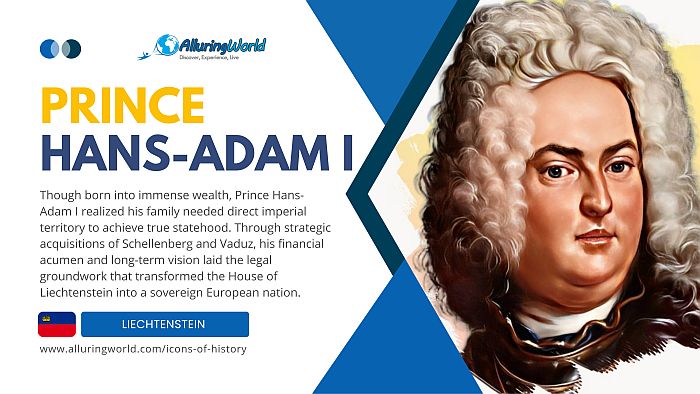
Hans-Adam I, Prince of Liechtenstein, who was born on 16 February 1657 in Vienna, is considered a proactive prince and head of his house whose political acumen and monetary sense paved the way for the present-day Principality of Liechtenstein. Leading his house in a period in which the standing of any noble family was determined not only by land and wealth but primarily by its legal status, Hans-Adam I understood that sovereignty in the Holy Roman Empire would require a lot of foresight. The leadership of Prince Hans-Adam I is considered to be a turning point in the history of the House of Liechtenstein, thus transforming the powerful noble family into a sovereign one.
Early Life and Education:
Born in the highly influential House of Liechtenstein, a very rich and politically powerful family in Central Europe, Hans-Adam I grew up in the imperial city of Vienna. Diplomacy, law, and court politics were the elements of education in the lives of young aristocrats who lived in Vienna during that time, and he was among other aristocrats who studied politics and diplomacy. Early on, he was trained in matters relating to governance, economy, military, and laws, and throughout his life, he managed to apply everything he learned during his life in Vienna.
Overall, the education he received focused on effective administration and fiscal responsibility. His familiarity with the workings of an imperial government provided Hans-Adam I with insight into the workings of power in the Holy Roman Empire and the significance of having a relationship directly with the empire.
Ascension and Dynastic Ambitions:
Hans-Adam I of Liechtenstein was conferred the title of Prince of Liechtenstein in 1684, inheriting vast estates stretching across Austria, Bohemia, and Moravia. In spite of all this wealth, what the Liechtenstein dynasty was missing out on was an immediate territory, which would have been under the direct sovereignty of the emperor.
This was something that Hans-Adam I realized; hence, he adopted a long-term policy which aimed at securing sovereignty for his dynasty. It was not about the issue of wealth, because he already had wealth, but about gaining a territory. Considering Europe was having its borders shaped every few decades, Hans-Adam I knew that this would take time, negotiations, and money, which he had in plenty.
Acquisition of Liechtenstein Territory:
The defining achievement of Hans-Adam I’s tenure as head of the house was the acquisition of the territories that would become what we know today as the Principality of Liechtenstein. In 1699, he purchased the Lordship of Schellenberg, followed by the County of Vaduz in 1712. These territories, located along the Rhine Valley, were purchased due to their legal status as reichsfrei (immediate imperial fiefs), which allowed the family to gain direct allegiance to the Holy Roman Emperor and a vote in the Imperial Diet.
Through the purchase of these lands, Hans-Adam I was able to ensure that the family had land that fell under the jurisdiction of the Holy Roman Emperor, laying the legal groundwork for his dynasty’s future elevation to sovereign rulers. With this legal difference in place, it became possible for sovereignty to be recognized, but even though Hans-Adam I never lived to see his goal achieved, he made it inevitable.
Economic Policy and Financial Expertise:
Hans-Adam I was renowned for his economic wisdom and management skills. He handled with great prudence one of the biggest private economies in Europe and invested his wealth in land, agriculture, and infrastructure. Economic management was his area of expertise, and he did it systematically and sustainably, expanding his family’s fortune and ensuring the financial stability that supported their long-term political ambitions.
He reorganized estate management within his domains by streamlining processes, increasing profits, and keeping his tenant farmers satisfied. On the other hand, his fiscal policies gave him enough funds for further territorial expansion while ensuring that he did not jeopardize the future of his family’s lands. This combination of boldness and prudence made him one of the most progressive rulers of his time, and secured his place in Liechtenstein history.
Relationship with the Holy Roman Empire:
Hans-Adam I had a practical and loyal connection with the Habsburg emperors. Although he was interested in obtaining independence for his family, he realized the importance of working with the emperor; thus, his loyalty during times of war and political strife helped him gain favor at the royal court.
He served in several advisory capacities and was known to be a dependable and competent noble. His status guaranteed that he was not challenged regarding his claims, which would later play a key role in establishing Liechtenstein as an independent principality.
ADVERTISEMENT
Personal Character and Leadership Style:
In modern descriptions, Hans-Adam I is depicted as a disciplined, reserved, and intellectually rigorous prince. He was someone who planned everything in detail and appreciated precision in all administrative procedures. His way of governing was a result of his conviction that order, consistency, and strong institutions were important.
While he never actually lived within the lands which would eventually carry the family name, the choices he made showed his dedication to his duty as an heir to the dynasty. For him, the concept of ruling was not about himself but rather about the responsibilities he had to future generations.
Death and Posthumous Recognition:
Hans-Adam I passed away in Vienna on 16 June 1712, just a few months after buying the County of Vaduz. Seven years later, in 1719, Emperor Charles VI joined Schellenberg and Vaduz to form the Principality of Liechtenstein, which was named after the ruling family. The formation of Liechtenstein marked the fulfillment of Hans-Adam I’s dream and proved his role as the true founder of the Principality of Liechtenstein.
Although he never ruled Liechtenstein in the modern sense as we know it today, his strategic decisions ensured the final creation and survival of the small principality that is tucked in the Alps. As his legacy was carried by his successors, all of them benefited from the legal and political foundations Hans-Adam I established.
Legacy and Historical Importance:
The legacy of Hans-Adam I continues today, as he is the person who started the Liechtenstein story, and his forward thinking made it possible to turn dynastic aspirations into true statehood.
His life exemplifies the need for long-range planning in leaders, and other leaders should also consider his way of ruling and allow time to show how they can leave their mark in the world. Because he put his emphasis on legitimacy over power, Hans-Adam I ensured that there would be a future for his dynasty, which is still alive today, over three hundred years later. Overall, the Principality of Liechtenstein is an example of how smart and patient Hans-Adam I was.
Conclusion:
In conclusion, Prince Hans-Adam I of Liechtenstein was a visionary leader who used his strategic foresight and financial prowess to establish one of the tiniest, but nowadays most resilient and richest countries in all of Europe. By making intelligent purchases, practicing diplomatic integrity, and ruling wisely, he elevated the position of his family in the Holy Roman Empire, thus guaranteeing their independence far into the future. Without him, there would not be a Liechtenstein today.