
Read time ca. 6 minutes
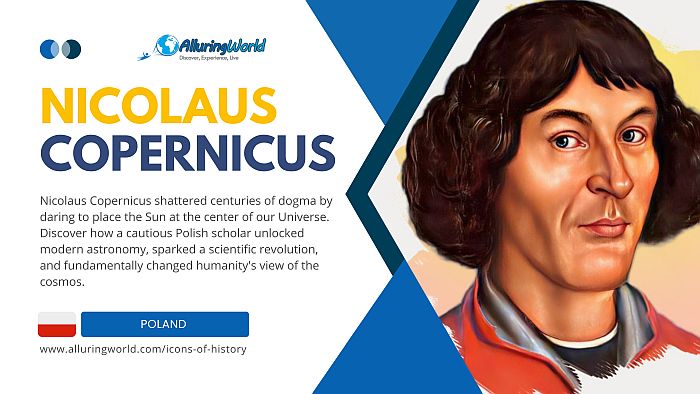
Nicolaus Copernicus was born on 19 February 1473 in Toruń, a city that at the time was part of the Kingdom of Poland (present-day Poland), and he is widely considered one of the most important personalities in the history of science. His theories concerning the structure of the solar system revolutionized the knowledge that humanity had about the Universe and became the foundation of contemporary astronomy. As an astronomer, mathematician, physician, economist, and canon of the Catholic Church, Nicolaus Copernicus made great contributions to science.
Early Life and Education:
Nicolaus Copernicus came from a family of German and Polish origin; his father, who was a trader, passed away when Nicolaus was 10 years old, leaving the young man under the guardianship of his maternal uncle, Lucas Watzenrode, who was a church official of high rank. His uncle saw the intellectual capacity of the young Nicolaus and gave him a sound education.
Copernicus studied at the University of Kraków from 1491, where his areas of study included mathematics, astronomy, and the liberal arts. At Kraków, Copernicus was exposed to the Ptolemaic theory, which is the geocentric theory that placed the Earth at the center of the Universe, along with the works of classical mathematicians and astronomers. It was in these early years that Copernicus developed his love for the stars and the movement of the planets.
Having completed his education in Kraków, Copernicus went to Italy to continue his studies, where he enrolled for higher studies. He joined the University of Bologna and studied the principles of canon law, but in addition to this, he also joined the University of Padua to study medicine. He also studied at the University of Ferrara and obtained his doctorate degree in the principles of canon law, and this gave him a broad base of knowledge that helped him approach scientific problems using mathematics and practical reasoning.
Early Observations and Intellectual Development:
Even though he was studying and performing religious duties at the time, Copernicus remained interested in astronomy throughout his life. He would study the motion of planets and make observations about celestial bodies in an attempt to find out what did not add up regarding the Ptolemaic model of the Universe. What set him apart from his peers was that he noticed that this system had too many circles within circles, so he went to investigate this further and develop his own theories.
By the beginning of the 1510s, Copernicus was working on the concept of the heliocentric model, which suggested that the center of the Universe was the Sun, instead of what was previously considered: that the whole Universe was centered around the Earth. Copernicus hypothesized that the Earth revolved around its axis and also around the Sun every year, thus explaining the movement of the planets that were observable and known at that time. It was a simpler way to explain the phenomena observed in astronomy, as he could not think of a different theory.
Publication of De Revolutionibus Orbium Coelestium:
After spending many years in research and improvement, Copernicus was still reluctant to make his discoveries public because he knew that the theories went against religious as well as scientific dogmas, and he could be ridiculed by his peers, get harsh criticism from fellow academic astronomers, and even face institutional skepticism. In 1543, when he passed away, his work was published by his friends and students, as they arranged the printing while he was dying. His most important work, “De Revolutionibus Orbium Coelestium” (On the Revolutions of the Celestial Spheres), contained a complete description of a heliocentric theory, which was backed by mathematical equations, astronomy, and theoretical arguments.
The book De Revolutionibus was revolutionary in its scope and method, because there was nothing similar published by then. Copernicus used observational data with geometrical modeling, demonstrating that the planets’ apparent retrograde motion could be explained naturally by the Earth’s rotation and orbit. Although he incorporated some elements of the classics, like the circular movements of the planets, his model was a revolution compared to the geocentric approach that prevailed for many centuries. His work was initially met with cautious attention, rather than controversy, since it was mainly aimed at scholars and mathematically inclined people, who would understand his writings.
Impact on Science and Astronomy:
The heliocentric theory proposed by Copernicus formed the basis of the scientific revolution. By placing the Sun at the center of the Universe, he went against the grain of established knowledge. He encouraged astronomers to think and research, instead of relying on what was served to them from previous generations. Other scientists, like Johannes Kepler, Galileo Galilei, and Isaac Newton, followed his example and developed theories about ellipses, telescope observations, and motion and gravitation laws.
While Copernicus himself was quite cautious, being more interested in the mathematical aspects of his ideas than their physical side, his discovery had very serious consequences. Showing that it was possible to use empirical data and rational analysis in order to prove something that was considered true at the moment, he laid down the basics of the modern scientific method.
ADVERTISEMENT
Other Contributions and Intellectual Pursuits:
Apart from his contribution to astronomy, Copernicus also made valuable contributions to economics, medicine, and church governance. He wrote Monetae Cudendae Ratio, a treatise on monetary reform, which revealed his skills in economic analysis and use of quantitative thinking in economics, aside from astronomy. His expertise in medicine, acquired during his studies in Padua, enabled him to act as a doctor. At the same time, his position as a canon in the cathedral of Frombork allowed him to unite scholarly and church activities.
Apart from this, he made contributions to the field of cartography and chronology through the design of instruments used in the observation of celestial bodies and also helped improve the calendar. This shows how Copernicus approached knowledge as a well-rounded subject, and it can be said that he was really a Jack of all trades.
Personal Life and Character:
The life of Copernicus was rather simple, but his life overall can be summarized as a relatively modest and disciplined life. He never married, was dedicated to studying, and was a man of faith as well as a scientist. He was famous for his intellect, patience, and thoroughness, but as he was occupied with several affairs at once: clerical, scientific, and administrative, he managed to do all this with research in mind. He managed to accomplish something that others could not, and in a way reshape the world we live in today.
The circumspect attitude on his part was because he was aware of the possible controversy that could come from his ideas, but while people like Galileo would take their arguments head-on and be controversial later on, Copernicus was circumspect and tried to prove his arguments mathematically, as he did not try to antagonize the church and other leaders.
Legacy:
Nicolaus Copernicus died on 24 May 1543, in Frombork, Poland, just after the release of his book ‘De revolutionibus ’; however, what remained behind was an explosion of his legacy in the ensuing years. His revolutionary theory regarding the heliocentric model was to change the face of man’s perspective about the Universe forever, and in a way would be the basis for modern astronomy today.
The life of Copernicus is a perfect example of the combination of all three of these elements: courage, keen observations, and ingenuity. Through his questioning of the existing truth and introducing a new system of the universe, showing how a person should look at the world, he contributed to the further development of astronomy and made it possible to have astronomy as we do today.
Conclusion:
Nicolaus Copernicus, in conclusion, was a remarkable scientist whose theory changed the field of astronomy and our understanding of our place within the Universe, which set the track for other astronomers to discover the cosmos. Copernicus used his keen observation of the Universe, mathematics, and ability to question established traditions and assumptions to make scientific history, setting an example of the importance of scientific curiosity and critical thought for future generations of scientists.