
Read time ca. 5 minutes
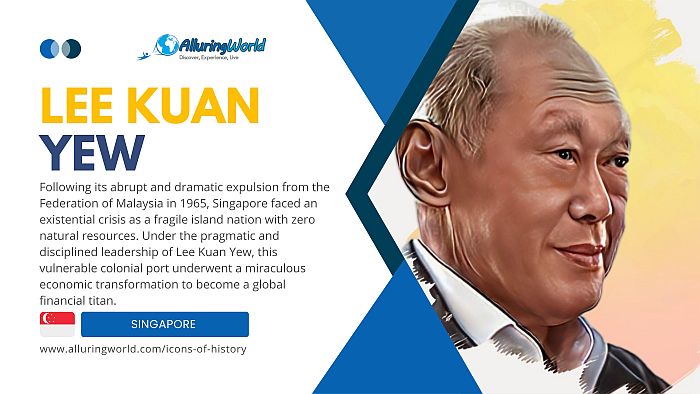
Lee Kuan Yew, who was born in Singapore on 16 September 1923, was one of the most prominent political leaders of the 20th century and the first Prime Minister of the Republic of Singapore. He served as Prime Minister from 5 June 1959 to 28 November 1990, when he led a small country with few resources and without any significant economic advantages from being merely a colonial port into becoming one of the wealthiest and best-governed countries in the world.
Early Life and Education:
Lee Kuan Yew grew up in a prosperous Chinese Peranakan family under the British colonial regime. The diverse environment in Singapore, consisting of influences from China, Malaysia, India, and the West, played an important role in his upbringing, although Lee received an excellent education in the English language. He initially studied at the Telok Kurau English School, then at the Raffles Institution, which allowed him to understand the politics of Singapore better than other politicians.
Singapore’s occupation by Japan on 15 February 1942 greatly shaped the outlook of Lee. It instilled within him the notion that having control of politics was important for survival and respect, so after the war ended, he left for the UK to study law. He attended Fitzwilliam College, Cambridge, earning top academic distinctions in 1947. This clearly indicated that Lee had a disciplined mind as well as sharp analytical skills that he would later showcase in his political career.
Lee joined the legal profession and actively participated in politics when he returned to Singapore, where he represented various labor unions and nationalistic movements. Through these experiences, Lee developed an awareness of social injustice, as well as of the colonial government and its systems.
Entry into Politics and Rise to Leadership:
The formation of the People’s Action Party (PAP) was made by Lee Kuan Yew on 21 November 1954 as a multi-racial movement against colonialism, advocating for self-government, social justice, and economic development. It is his capability of mobilizing people while negotiating that makes it possible for the PAP to enjoy broad acceptance with the general public.
In the general elections held in 1959, the PAP emerged victorious and made Lee the first prime minister of Singapore within internal self-government. Back then, the country was characterized by rampant unemployment, bad housing facilities, communal disharmony, and a lack of natural resources. As a leader, Lee believed in urgency and was concerned with discipline and meritocracy.
Separation from Malaysia and the Struggle for Survival:
Singapore was incorporated into the Federation of Malaysia back in 1963 to guarantee stability on the grounds of economic and political unity. Yet, due to ideological differences, economic and racial tensions, this union did not last long. On 9 August 1965, Singapore was forced out of Malaysia to become an independent state unwillingly, and the main reason for this was the irreconcilable differences between the ruling parties of Singapore (PAP) and Malaysia (UMNO).
It is at this time that Lee Kuan Yew experienced one of the crucial turning points in his life. The independence of Singapore, which at the time was a small and fragile country with no natural resources, had been thrust into the limelight in such a way that the country’s existence would depend on Lee’s leadership skills.
ADVERTISEMENT
Economic Transformation and State-Building:
The biggest success of Lee Kuan Yew is the economic revolution of Singapore. He did not adhere to any ideology and adopted policies that suited Singapore. He understood that the country needed to attract foreign investments and thus adopted an approach that was friendly towards businesses with minimal corruption.
During his leadership, Singapore made considerable investments in education, infrastructure, and housing. The housing was made affordable by the Housing Development Board to the majority of the people in Singapore. This resulted in peace and stability within the society due to a feeling of belonging. Singapore became a manufacturing and financial capital because of an industrialization policy, which made it appealing to multinational companies.
Another important policy of Lee was meritocracy. Meritocracy means promotion on the basis of competence, irrespective of one’s race or background.
Governance, Law, and Social Discipline:
Although Lee Kuan Yew was seen as an authoritarian leader, to him, a powerful government was crucial in ensuring the country’s development and success. The leader placed high importance on law and regulations as well as their strict implementation. He enforced strict laws against public offenses, drug abuse, and corruption since, according to him, social discipline is vital for the nation’s progress.
The government severely controlled both freedom of speech and political opposition, and Western commentators often criticized this policy. Despite these criticisms, Lee justified the authoritarian rule based on the cultural background, societal harmony, and prevention of ethnic unrest. Throughout his career, Lee repeatedly stated that Western liberal approaches could not be universally applied to the Asian social context, because the societies are different, and what might work in one place cannot work once implemented in another.
Foreign Policy and Global Influence:
With regard to international relations, Lee Kuan Yew established Singapore as a non-aligned but trustworthy country of significant strategic importance. Lee was able to maintain good relations with great powers such as the US, China, and the other Southeast Asian nations. Lee’s push for regional cooperation was instrumental in the formation of the Association of South East Asian Nations (ASEAN), which had the effect of keeping peace within the region.
Overall, Lee was known for his international perspective, and he was often sought out by world leaders for advice on issues such as economic growth, governance, and geopolitics, considering the success he was showing in his home country, Singapore. Throughout his political career, he had a profound understanding of China’s growing influence, Asian modernity, and changing global power dynamics.
Later Years and Enduring Influence:
Although Lee resigned from the position of Prime Minister in 1990, he continued to be actively involved in government affairs as a Senior Minister and subsequently a Minister Mentor. Despite his retirement from public office, he managed to further coordinate with future governments and offer his opinions as they have continued to influence discussions and decision-making. His main preoccupations have included demographic trends, economic competition, and national unity.
Lee Kuan Yew died on 23 March 2015, causing sorrow both within the country and overseas. His death was seen as a symbolic end of an era in Singapore and the Southeast Asia region, although his influence is immortalized by what Singapore stands for, and it is well-known today.
Conclusion:
In conclusion, Lee Kuan Yew was an outstanding nation builder. He was able to change Singapore from a weak colonial territory into a thriving nation through effective governance and policy-making, as well as his determination to protect the country from extinction. Although he may still stir controversy due to some of his strategies, he has undoubtedly been one of the most influential political leaders in modern times.