
Read time ca. 5 minutes
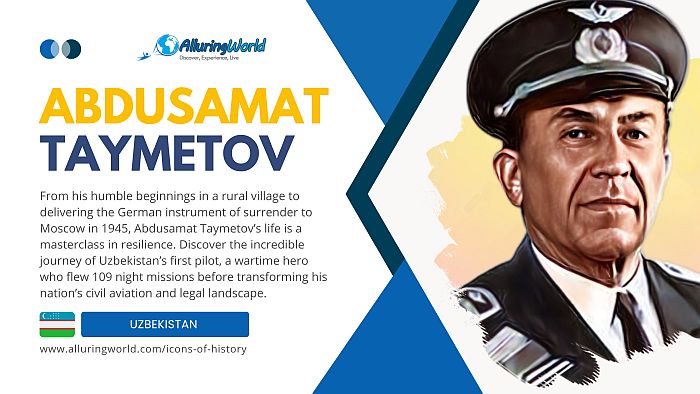
Abdusamat Taymetov, who was born on 9 January 1909, holds an iconic status in the history of Uzbekistan and the Soviet Union as a pilot, pioneering in his field and working both as a civilian and a wartime pilot before retiring as the leader in the aviation administration. The biography of this individual personifies the idea of rising from nothing to become a prominent figure in the history of Uzbekistan and Central Asian aviation.
Early Life and Formative Years:
Taymetov Abdusamat was born in the village of Chernak, Syr-Darya Oblast of Russia, coming from a poor Uzbek family. His mother died in 1911, followed by his father’s death in 1914, so as such, he and his brothers and sisters were raised by his cousin Baymet. Despite all the difficulties, Taymetov did not neglect his education, but rather dedicated time and effort to it. In 1919, he started going to a Soviet school in the morning, and at the same time, attended the religious maktab in the evening.
In 1922, Taymetov became a member of the Komsomol, which was an organization of young people from ages 14 to 28, serving mainly as a political apparatus through which Communist propaganda would be disseminated to develop members for the future Communist Party. Taymetov participated in literacy drives against illiteracy in rural areas. During the period of collectivization of agriculture in the late 1920s, he acted as a secretary for the village council, and at that time, this was a distinguished position considering his limited formal schooling. After this, he then took up courses in agrochemistry in Tashkent and afterward an industrial school. In 1932, during the summer season, he was sent to the Tajik SSR along with some Komsomol members to help quell any rebellion.
Entry into Aviation:
Initially, Taymetov became acquainted with flying through Osoaviahim, a paramilitary organization in the Soviet Union dedicated to fostering aviation and other talents. In 1932, he underwent training in a glider school at night while studying in the morning. Although Taymetov received criticism for engaging in gliding activities rather than being on factory duty in 1933, this did not discourage him from pursuing his dreams or stop him from making progress. During that year, he enrolled at Balashov Aviation School, where out of over 2,000 pupils, he was the sole Uzbek cadet.
It did not come without challenges as Taymetov did not have perfect mastery of the Russian language, which is the medium of teaching, and sometimes found himself having trouble comprehending technical terms, especially those for aircraft parts. Nevertheless, he showed tenacity and talent that helped him successfully go through theoretical and practical training under the tutelage of qualified teachers such as Konstantin Kartashov, who is a skilled Russian pilot and an expert in the Uzbek language.
Pre‑War Civil Aviation:
During the period from 1935 to 1941, Taymetov proved to be an excellent pilot capable of flying various aircraft. For instance, he worked as an aviation club instructor from 1936 to 1937, teaching new pilots, including the first Uzbek women parachutists, such as Bibiniso Boltaboyeva, who eventually became his wife. In addition to this, he flew regional flights that connected the Uzbek SSR with other republics, namely Kyrgyzstan, Tajikistan, Turkmenistan, and Kazakhstan, thus contributing to the creation of airfields and postal services. As of 1940, Taymetov had extensive experience in flying various aircraft, from trainer and utility aircraft, such as U-2 and UT-2, to multi-purpose aircraft, including Yak-12 and Stal-3.
ADVERTISEMENT
World War II Service:
After Nazi Germany invaded the Soviet Union in 1941, Taymetov applied for combat duty but was initially assigned to be a flight instructor, where he trained 71 pilots during 1941-42. Later, he served as a pilot on the Li-2, which is the Soviet version of the famous American plane Douglas DC-3 that is commonly used for transport purposes. In February 1944, he was posted to the frontline at the 10th Guards Aviation Division, where he flew 109 nighttime missions transporting supplies to frontline troops as well as performing reconnaissance.
In early 1945, Taymetov was transferred to the 19th Special-Purpose Civil Aviation Regiment, executing tasks in Poland to help partisans who individuals like Sergey Pritytsky commanded. For his exceptional military service during this period, he was bestowed with various Soviet decorations, among which were the Order of Patriotic War and Order of the Red Banner, as well as the Polish decoration of Virtuti Militari.
Overall, among his most remarkable achievements from his military career, it is possible to mention his flight operation on 9 May 1945. On this day, he delivered the document of unconditional surrender of Nazi Germany and the Soviet banner of victory to Moscow, thus symbolically signaling the end of World War II in Europe.
Post‑War Career and Leadership:
Following the war, Taymetov returned to the ranks of the Civil Air Fleet and reached the position of commander of the 161st Squadron. He then became the chief of Tashkent airport, where he played an important role in the development of civil aviation facilities throughout the country. Despite becoming the chief, he did not stop flying, and by 1963, Taymetov had gained over 6,185 flying hours.
In a marked career change, Taymetov studied law at the age of 56 years and graduated from the Faculty of Law at the Tashkent State University. He later used his knowledge in law by serving as the chief legal adviser of the Uzbek Civil Aviation Administration, where he combined his technical skills with administrative functions. The most important detail of Taymetov’s life is that he did not stop, but rather continued to participate in the development of Uzbek aviation until he died in Tashkent on 8 July 1981. There are no official records that state how he died, except that he was buried in Tashkent, and to this day, he is revered as a great Uzbek national icon.
Legacy and Recognition:
The achievements of Abdusamat Taymetov are numerous as well. First of all, this is the man who became the first Uzbek pilot. Furthermore, he worked hard training future pilots, and he was not afraid of participating in the war when he had to fly dangerous missions in order to help the Red Army and partisans. After the end of the war, Abdusamat worked on developing the aviation industry of Uzbekistan.
Lately, the works of this great person have been immortalized through movies and other forms of memorials, but some of the documentaries that he has featured in include “Taymetov. Herald of Victory” and “Taymetov. G‘alaba Parvozi,” which have received acclaim in different international events. The purpose is to celebrate him for his role and contributions in history, as well as his success as a national hero.
Conclusion:
In summary, the life of Abdusamat Taymetov is an excellent representation of the development of aviation technology during the Soviet era and the appearance of Uzbek contributions to world history. Starting his career in his village and going on to fly record-setting missions towards the end of World War II has put him in the history books. Overall, his surviving the war and then continuing to be involved in civil aviation in Uzbekistan after the war shows his exceptional willpower, talent, and devotion that somehow made it possible for Uzbekistan to get involved in aviation and not depend on other countries.