
Read time ca. 6 minutes
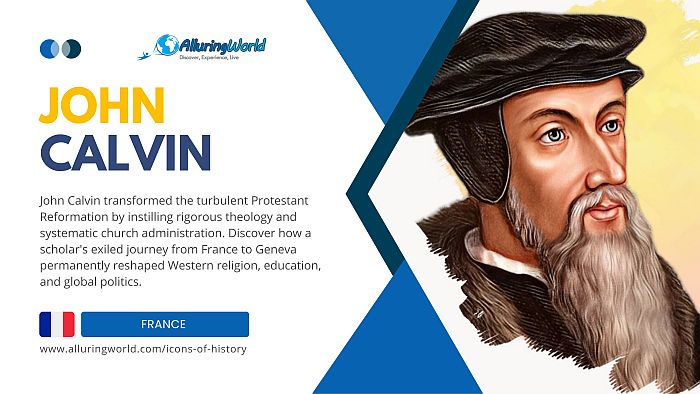
One of the most important personalities in the Protestant Reformation is John Calvin, who had a great impact on religion throughout his time and well into subsequent periods. The teachings of John Calvin were very instrumental in shaping religion in Europe and North America in the centuries to come. Still, he was not only a religious reformer, but also a very disciplined scholar and administrator.
John Calvin became prominent at a time of great religious turmoil, during which the foundations of Western Christianity were being put into question and sometimes considered to be heavily reorganized. He contributed greatly to formulating a systematic approach to Protestant theology, emphasizing the absolute sovereignty of God, the authority of the Scriptures, and the self-discipline of Christians. His contributions ensured the long-term survival of the Reformation through its intellectualization and institutionalization.
Early Life and Education:
Jehan Calvin, who later became John Calvin, was born on 10 July 1509 in Noyon, a small French town in the northeastern part of France. The father of Calvin was Gérard Cauvin, who was a cathedral administrator as well as a legal notary, which gave Calvin’s family some social status and education. As a child, Jehan Calvin showed intelligence, and his father directed him toward law because of a financial dispute with the cathedral chapter at Noyon, combined with the belief that law would be more lucrative than theology.
Calvin had his primary education in the Collège de la Marche in Paris, where he studied Latin under the guidance of Mathurin Cordier, an eminent teacher. He then joined the Collège de Montaigu, which was a college that had a reputation for strict discipline and scholastic education. In the formative years of Calvin, he came in contact with humanism that stressed classical learning.
Under the instruction of his father, he moved from studying theology to law, and he enrolled in the universities of Orléans and Bourges. Law helped him develop a logical mind. Even though this was done under the pretense of preparing for a layperson career, Calvin developed intellectual ability that was fundamental to his reform movement later on in life.
Religious Conversion and Intellectual Awakening:
Sometime during the early 1530s, there was a spiritual experience in Calvin’s life that radically changed the course of his life. It was something that he described as a conversion experience in which God subdues a reluctant heart. This spiritual experience placed him in line with the Protestant movement that was seeking reforms based on Scripture.
The religious atmosphere in France was gradually becoming unfriendly towards the concepts of the Protestants, so as a result of this, Calvin withdrew from active life and became more concerned with studies. In 1536, he published the first version of his Institutes of the Christian Religion, a brief but eloquent description of Protestant doctrine. Originally written to defend French Protestants, it was soon appreciated for its lucidity and organization.
Arrival in Geneva and Early Challenges:
In the latter part of 1536, Calvin passed through the city of Geneva, which had already converted to the Reformation cause. There, he met Guillaume Farel, a fervent reformer who convinced him to stay and help organize the religion in the city. Despite his reluctance, Calvin agreed, thus starting an interesting but at times contentious association with Geneva.
Calvin attempted to create an orderly society with a Christian community that operated on the basis of the Bible. His demands for reform, order within the church, and doctrinal consistency made him unpopular in Geneva, as many people did not appreciate close supervision. In the end, the political opposition led to their expulsion from Geneva in 1538.
Exile in Strasbourg and Pastoral Development:
Calvin’s years in exile were spent in Strasbourg, where he was minister to a group of French exiles. These years were important for him since he got a chance to develop his style of pastoral work and theology in an environment that was more supportive. He was also giving lectures on Scripture.
In Strasbourg, the Institutes were enlarged and elaborated on to become an extensive theological doctrine which would be even more accepted than it was by then. In addition to this, in August 1540 Calvin got married to Idelette de Bure, and this marriage gave him peace of mind through an association based on equality of faith. These were the years during which Calvin’s confidence grew and became clearer, so he was more confident to return to Geneva.
ADVERTISEMENT
Return to Geneva and Systematic Reform:
The return was possible in 1541 when the city of Geneva called Calvin back due to the city’s realization of the need for a capable leader. Calvin came back this time around with much more patience and organization. He instituted ecclesiastical ordinances that provided a form of church administration.
The Consistory was an important aspect of the Calvinist vision in that it ensured the righteousness of the actions of the people. Even though it was labeled as an authoritarian institution, Calvin saw it as a way to foster community and ethics.
Theological Contributions:
The core elements of Calvinist theology include the supremacy of God, utter dependency of man on the grace of God, and the supremacy of Scripture in the foundation of faith. Predestination, although misconstrued, was used by Calvin to show the initiative of God in salvation.
Education was another matter that he gave much thought to, for it was his conviction that education helped to create informed believers who would help the church and society, and would guide these institutions into a better life. As a result of his leadership, Geneva came to be recognized as a hub of Protestant education where students from all over Europe flocked to study.
Influence Beyond Geneva:
The reach of Calvin was far beyond Geneva through his network of correspondence, his writings, and educated ministers. His teachings had an influence on the emergence of Reformed churches in France, the Netherlands, Scotland, and even in parts of Germany. In the rest of the world, his theology made a significant impact in England, and subsequently in North America, as it impacted Protestantism, politics, and education.
By establishing the Genevan Academy in 1559, he helped mold future leaders who would carry on his doctrines and organizational structure beyond Geneva, and would shape the world for future generations. His institution made sure that his beliefs would be passed on from one generation to another within Protestantism, and his work will be remembered for centuries to come.
Final Years and Death:
Calvin was a person who never stopped working, and he preached, taught, and wrote up to the point of his death in spite of ill health. He was always suffering from chronic ailments but still kept a work schedule dictated by his feeling of being called to serve. His last years saw him caring for the people whom he had molded.
John Calvin passed away on 27 May 1564 in Geneva. True to his last wishes, John Calvin was laid to rest in a grave without any marking, which is an indication of his humility before God and not men, and today he is believed to be buried in an unmarked grave at the Cimetière des Rois (Cemetery of Kings) in Geneva, Switzerland.
Conclusion:
To sum it up, John Calvin is one of the figures who have made the most influential contribution to the history of Christianity. It was in fact John Calvin who introduced theology and order into the process of the Reformation through his systematic study of religion, his work as a pastor, and his efforts in church reform. The legacy of John Calvin lives on even today, and it continues to affect religion, politics, and education throughout the world.