
Read time ca. 6 minutes
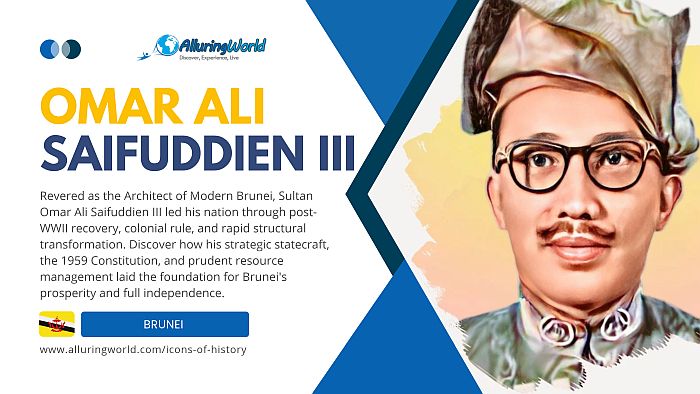
Sultan Omar Ali Saifuddien III, who is revered as the Architect of Modern Brunei (Arkitek Brunei Moden), is one of the most transformative monarchs in Southeast Asian history. His reign lasted from June 1950 to October 1967, when he voluntarily renounced his throne, and marked a pivotal transition for the nation. He led the country during a period when it had to contend with the problems of rebuilding the country after World War II, the rule of the country by British colonial powers, and changes in its geopolitical environment.
The rule of Omar Ali Saifuddien III had one defining feature, namely statecraft of an extremely high level involving the development of infrastructure at a fast pace while preserving Brunei’s Malay Islamic Monarchy (Melayu Islam Beraja) legacy. In this case, he managed to establish a constitution, secure domestic autonomy, as well as strategically invest oil revenues into social infrastructure, which became crucial. Overall, he laid the fundamental blueprint for Brunei’s modern prosperity, stability, and eventual complete independence.
Early Life and Education:
Omar Ali Saifuddien III was born as Pengiran Muda Omar Ali Saifuddien on 23 September 1914 in Brunei Town (nowadays known as Bandar Seri Begawan). He was the son of Sultan Muhammad Jamalul Alam II and Raja Isteri Pengiran Anak Siti Fatimah. As a young man in the royal court, he grew up with the old traditions, diplomacy, and religious scholarship that made up the cultural heritage of the sultanate.
Education-wise, his education combined traditional Islamic teachings with modern academic disciplines, right on time when the early 20th century was transforming into the modern age we know of today. His basic education was obtained in Brunei, but he attended the Malay College Kuala Kangsar (MCKK) located in Perak, Malaysia, where future leaders and administrators were schooled. His subjects while in college included law, public administration, modern government, and English, and he was well prepared to lead the small nation in Southeast Asia.
Prior to being on the throne, he gained administrative experience from his service in various governmental agencies such as the Forestry Department and the Judiciary. His practical experience in the government agencies helped him to learn about the workings of villages, administration, and civil service, thus preparing him for future difficulties in governance.
Ascension to the Throne:
The reign of Sultan Omar Ali Saifuddien III commenced when he became the ruler after the unexpected passing of his brother Sultan Ahmad Tajuddin. His coronation as the 28th Sultan took place on 31 May 1951 in the Lapau of Brunei Town. He assumed the reins of power in the midst of an era of recovery from World War II and under a political system of a British Resident who wielded considerable control over the internal affairs of the state.
Realizing the limitations of this dependence, Sultan Omar Ali Saifuddien III took measures to implement systematic reforms in order to empower the local governing system as well as ensure the sovereignty of the monarchy. He entered into diplomatic negotiations with the British authorities in order to change the dynamics of the protectorate system. With his diplomacy, administrative vision, and legal wisdom, he started the process of bringing the internal governing process back into the hands of local systems.
Modernization and Infrastructure Development:
One of the most important pillars of his rule was his focus on full structural modernization of the nation. Following his lead, Brunei developed its first national development plan (1953 – 1958), a large-scale government project worth 100 million Malayan dollars. This project converted Brunei from a backward and isolated area into a well-structured modern country.
Education, as one of the most important parts of a person’s life, was the foundation of all his social reforms. The Sultan set up public schools from primary to secondary levels in the whole nation, created curriculum programs for secular and religious education, and sent Brunei students to study overseas in the United Kingdom and in other parts of Asia. Concurrently, infrastructure development expanded rapidly:
- Public Works: The entire country saw the construction of roads, deep-water ports, land transport networks, and telecommunications, as these allowed isolated communities from the interior of the country to be linked to the capital.
- Healthcare & Utilities: The Sultan built modern hospitals, rural healthcare clinics, clean water distribution systems, and electrical grids throughout the whole nation, thereby dramatically improving public health and life expectancy for its citizens.
- Urban Development: The modernization of public housing and administrative facilities transformed Brunei Town, which was once a backward, third-world city, into a functional civic center.
Political Reforms and the Constitution:
The political highlight of Sultan Omar Ali Saifuddien III’s reign was the development of the Brunei Constitution of 1959. The historic document, signed on 29 September 1959 in Brunei Town together with the British, laid out a constitution for self-governance. The main outcomes of the 1959 Constitution included:
- Internal Autonomy: The British Resident system was officially abolished, and the resident was replaced with a High Commissioner, thus restoring internal administrative authority to the Sultan and his appointed Executive, Legislative, and Privy Councils.
- Official Status of Islam and Language: Because Brunei was a British protectorate, it did not have an official religion, so Islam was formally established as the official religion of the state, and Malay was designated as the official language.
- Monarchical Sovereignty: It protected the traditional executive powers of the crown while introducing structured legislative processes.
His political diplomacy was further tested in the 1960s during the regional talks about the formation of the Federation of Malaysia. Even though there were great pressures from the outside world and internal disturbances during the 1962 Brunei Revolt, Sultan Omar Ali Saifuddien III decided not to be part of the Federation when it formed in 1963. This wise decision enabled Brunei to retain full sovereignty over its resources and financial income, and it helped the country develop into the country we know of today.
ADVERTISEMENT
Economic Development and Resource Management:
Although there were known oil reserves for commercial use found in Seria since 1929, before he ascended the throne, Sultan Omar Ali Saifuddien III took a significant part in transforming Brunei’s energy policies and methods of wealth management. While on the throne, the country reached certain revenue-sharing contracts with foreign oil companies and thus ensured that a significant share of profits stayed in the state budget.
Instead of letting their wealth lie dormant and idle, the Sultan created financial reserves within their structure and allocated funds directly toward the welfare of citizens, infrastructure development, free healthcare, and subsidizing education. It was this fiscally sound management that helped build the foundation of the tax-free welfare state of today’s Brunei. As a result, it insulated them against any external economic crises until full-fledged diplomatic relations could be established.
Cultural Preservation and Religious Leadership:
In his endeavors in administration and political modernization, the Sultan was committed to safeguarding the Islamic and Malay identity of the country. He developed religious structures, established Islamic courts, the Department of Religious Affairs, and made sure that his policies adhered to the traditional moral values in accordance with Islam.
His commitment to the construction of buildings that reflect both cultural and religious aspects is exemplified by the Sultan Omar Ali Saifuddien Mosque, which was built in 1958 in the heart of the capital city, Bandar Seri Begawan. The mosque was designed with a combination of Mughal and Italian architecture, complete with a gold dome, marble minarets, and a lagoon that houses a 16th-century royal barge known as Mahligai. Overall, this is one of the best-known religious structures from the small nation and is regarded as an amazing architectural piece in this part of the world.
Abdication and Later Life:
Sultan Omar Ali Saifuddien III took the voluntary decision to abdicate from the throne in favor of his eldest son, Crown Prince Hassanal Bolkiah, on 4 October 1967. After abdicating, he took up the royal title of Paduka Seri Begawan Sultan and continued to be an advisor to the new Sultan.
After he stepped down from power, he also served as the Minister of Defense at the time when Brunei gained complete political independence from the United Kingdom on 1 January 1984. He was instrumental in making sure that the change of administration went smoothly in the last phases of the process of gaining national status. Sultan Omar Ali Saifuddien III died on 7 September 1986, leaving behind a stable, prosperous nation built upon the foundations he laid.
Conclusion:
In summary, Sultan Omar Ali Saifuddien III was a pivotal leader whose rule changed the course of modern Brunei. With a blend of good governance, economic sense, and diplomatic constitution, he was able to navigate his nation through the period of colonial transition into prosperity, while he managed at the same time to show great reverence for Islamic and Malay heritage. His lasting influence is evident in the sovereignty of Brunei, especially in the socio-economic framework that can be seen today, as well as the national identity, thus cementing his place as one of the most revered leaders in Southeast Asia and the visionary who transformed a small nation into an oil-wealthy, self-governing Malay Islamic Monarchy.