
Read time ca. 8 minutes
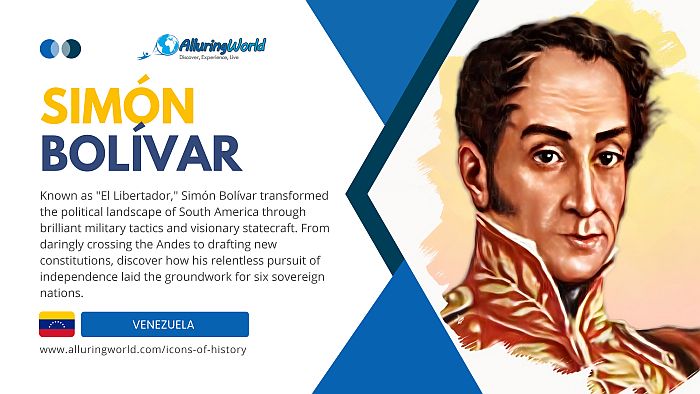
Simón Bolívar, known as “The Liberator” or “El Libertador”, is today one of the most celebrated personalities in Latin American history. Bolívar’s skills as a leader, his vision, and his fight for freedom changed the political map of the continent, thus giving him the image of being the founding father of multiple nations across South America and the Isthmus of Panama. The life of Simón Bolívar was distinguished by brilliant military strategies, ambition in politics, and loyalty to the principles of freedom and independence.
Bolívar’s significance can be understood through the rare synthesis of military tactics, politics, and philosophy that he achieved throughout his life. While he certainly fought for independence against Spanish colonialism, his vision went well beyond mere liberation, and it was far more than just being independent. Bolívar not only fought wars, but he also planned constitutions and systems of government for the countries that had just won their independence and needed to stabilize and sustain their liberty.
Early Life and Education:
Simón Bolívar was born on 24 July 1783 in Caracas, which at that time was under Spanish domination within the Captaincy General of Venezuela. Bolívar came from a privileged background, as he was the son of a very rich aristocrat named Juan Vicente Bolívar and his mother, María de la Concepción Palacios. Unfortunately for young Bolívar, tragedy became an early experience in his life as he lost both of his parents when he was only nine years old, leaving him orphaned and under the guardianship of relatives. These early experiences instilled in him a profound sense of responsibility and a desire to assert his destiny, so he made it his mission to be the best version he could be.
Bolívar received a formal education which was a combination of classical learning, philosophy, and languages. Bolívar had the advantage of being introduced to the ideas of the Enlightenment through the readings of Jean-Jacques Rousseau, Voltaire, and Montesquieu, thereby helping him understand the issues of governance, liberty, and human rights. During his youth, Bolívar visited Europe, during which he got a first-hand view of the coronation of Napoleon Bonaparte in 1805.
Early Political Involvement and Revolutionary Ideals:
The political awakening of Simón Bolívar took place during the time of revolutionary movements all around America. He returned to Venezuela in 1807, and there he saw an environment of uprising against Spanish colonial rule. Since Bolívar was influenced by the ideas of the Enlightenment and the success of revolutions in America and France, he began thinking about liberating his land from the Spanish Empire that ruled the vast majority of the region at that time.
Bolívar entered into the revolutionary activities in Venezuela in 1810, after the expulsion of the Spanish Governor from power. In a short time, Bolívar managed to establish himself as a good organizer and strategist, so he took control of certain activities that put him in a leadership position. The first revolutionary activities conducted by Bolívar had many difficulties: there was no unity among revolutionary organizations, a lack of money, and opposition from loyalist groups. Nonetheless, despite these major obstacles, Bolívar succeeded in surviving in this difficult situation, and he managed to organize a movement that successfully rebelled against the Spanish Empire.
Military Campaigns and Liberation Efforts:
The military career of Bolívar is distinguished by both boldness and genius. Bolívar knew the significance of uniting people, forming alliances, and keeping discipline among his soldiers, and he knew that these were the key points if they were to succeed in building new nations. The military strategy of Bolívar was based on daring moves, fast marches through difficult terrain, and unconventional tactics, which enabled small revolutionary groups to defeat larger and more equipped Spanish forces.
A campaign that was led by him and worth mentioning here is his campaign of crossing the Andes in 1819, leading to the famous Battle of Boyacá. The triumph of this battle was crucial for the liberation of New Granada, or present-day Colombia, and thus made Bolívar a great military commander. His other campaigns were conducted through Ecuador, Peru, and Bolivia, and he coordinated multi-front operations and unified diverse revolutionary forces under a common purpose: liberating the people from Spanish colonial rule.
Bolívar’s military successes went hand in hand with his capacity to instill loyalty and trust among the troops and civilians, and he proved to be one of the best leaders the region has seen in a very long time. Bolívar always made mention of the ideas of justice, equality, and freedom. He always made his revolutionary fight moral and ethical and did so through his speeches and declarations to create a common identity for the free nations.
Political Vision and Nation-Building:
Outside of his military campaigns, Bolívar played an active role in politics and constitution-making. Bolívar understood that winning wars alone would not guarantee independence; he believed that the nations needed to have systems of governance and laws in place, and he strongly believed in establishing stable republican governance and uniting the newly independent nations under a strong central authority.
Bolívar was one of the principal drafters of the constitutions in the new republics, such as Gran Colombia, which consisted of present-day Colombia, Venezuela, Ecuador, and Panama. In particular, Bolívar had a vision of the state that would have an effective central government to maintain unity amid diversity. The political ideology of Bolívar was shaped by Enlightenment philosophy, as well as classical republicanism and contemporary European political models.
Even with his vision, there were many difficulties for Bolívar to turn his vision into reality. Since the region was vast, there were rivalries between regions, political power struggles, and social rifts that worked against any attempts to form a solid government structure, thus making Bolívar’s work even harder than it appeared. Bolívar’s leadership would be continually challenged by rebellions and secessionism, thus forcing him to balance ideals with pragmatic decision-making.
ADVERTISEMENT
Challenges and Controversies:
Nevertheless, Bolívar did have a number of controversies during his career. For example, his growing use of power and belief in an authoritative executive were seen negatively by some people. The disintegration of Gran Colombia in 1830 was due to several factors, including the problems of uniting such diverse territories and the lack of influence that Bolívar had politically. The decade-old republic was split into three independent nations: Venezuela, Ecuador, and New Granada (modern-day Colombia and Panama), and despite this event, even his critics acknowledged his dedication, intelligence, and visionary leadership that he put towards the building of Gran Colombia.
Social and racial hierarchies that were prevalent in colonial times were another issue that Bolívar addressed. Bolívar hoped to promote equal treatment before the law for people, eliminate certain types of discrimination against certain groups of people, and incorporate those people into the newly formed republics. While progress was uneven, Bolívar’s efforts represented a significant departure from the rigid stratification of colonial rule.
Personal Life and Character:
Simón Bolívar was characterized by his charm, intellect, and firm dedication to his ideals. He was contemplative, often documenting his thoughts in numerous letters and political writings, but overall, his writings do portray a man who is aware of his duties, keenly aware of the cost of being a leader, and who knows the potentialities and limitations of politics.
Bolívar, despite his fame in the world, had to go through many difficulties personally, such as the death of his family members, stresses of prolonged military campaigns, and political isolation in the latter stages of his life. His determination and commitment to the revolutionary struggle, despite all these challenges, reflect the strength of his character and prove that he is a great leader during tumultuous times when the region was undergoing significant changes.
Later Years and Death:
Bolívar’s political power was already declining by 1830, and the break-up of Gran Colombia was indicative of how hard it was to maintain unity within the new independent regions. Bolívar felt disillusioned and was very tired from all his efforts, which caused him to resign from his position and plan to leave for Europe.
Bolívar passed away on 17 December 1830 when he was just 47 years old in Santa Marta, present-day Colombia. The passing of Simón Bolívar marks the end of his life full of ups and downs, leaving behind a legacy that continues to inspire Latin America and the broader world.
Legacy:
The accomplishments of Simón Bolívar go well beyond his achievements on the battlefield. Simón Bolívar is celebrated as an embodiment of independence, unity, and the fight for human rights by numerous countries in the Latin world. The dream of Simón Bolívar about the unity and sovereignty of Latin America has had a major impact on political thought and nationalism ever since, especially throughout the 19th and 20th centuries.
His life has much to teach about leadership, perseverance, and the ethical dilemmas of power, especially to leaders who are leading countries today. Comprehensively, Bolívar was a man who used his strategic skills in combination with his moral principles, striving to balance military necessity with political and social ideals. Today, his legacy continues to live on in the countries that sometimes refer to themselves as the Bolivarian countries due to his foundational role in their independence from the Spanish Empire. These countries are:
- Venezuela: This is his birthplace, which named its currency the bolívar, and Simón Bolívar’s name is even included in the country’s official name as the Bolivarian Republic of Venezuela.
- Colombia: This is the country where he served as its first president, and today central plaza squares like Bogotá’s Plaza Bolívar bear his name.
- Ecuador: A nation liberated through the joint efforts of Bolívar and his key general, Antonio José de Sucre, incorporating Quito and Guayaquil into Gran Colombia.
- Peru: This is the country where he served as dictator and led key independence campaigns. He was named the Dictator of Peru in 1824 to help secure and stabilize the region’s independence
- Bolivia: This is the only country that truly bears his name, and it is named directly in his honor after he helped to establish the republic.
- Panama: This is a country that was historically part of Gran Colombia, and it was liberated through his campaigns.
Conclusion:
In summary, Simón Bolívar was the leader who brought changes in the politics of the South American continent through his involvement in the liberation wars, his dedication to democratic ideals, and his vision that the nations must become united and independent. His outstanding skills as a military leader and politician, coupled with his dedication to liberty, made him one of the most influential people in world history, and he continues to be celebrated by the people who live today in the free and independent republics of the Latin world.