
Read time ca. 5 minutes
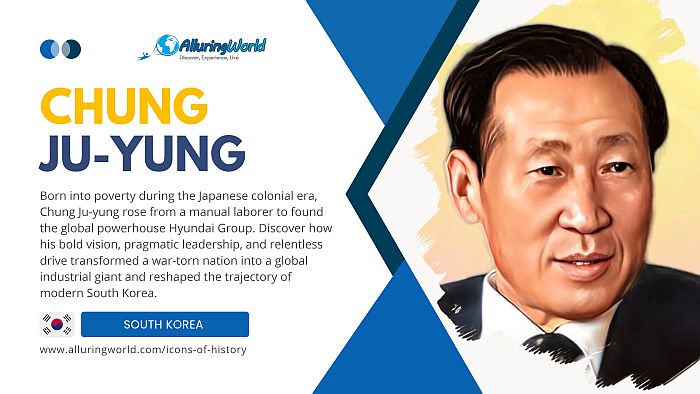
Chung Ju-yung, born on 25 November 1915 in Tongchon County, Gangwon Province, Korea, is celebrated as one of South Korea’s most influential industrialists and entrepreneurs. As the founder of the Hyundai Group, Chung played a pivotal role in transforming South Korea from a war-torn, economically struggling nation into a global industrial power. His visionary leadership, creative strategy, and persistence not only helped build the Hyundai Corporation into the giant that we know of today, but also played a vital role in the economic development of South Korea during the latter part of the 20th century.
Early Life and Background:
Born in a poor farming family during the Japanese colonial era, the life of Chung Ju-yung has been characterized by struggles. The tough conditions that he had to go through in his childhood helped him to develop a strong sense of ambition and determination. Although he did not receive much formal education, his hardworking nature led him to take up several manual jobs, thus displaying an exceptional work ethic.
Chung showed a lot of business acumen right from a young age. He was able to understand the dynamics of business, construction, and market forces, and this allowed him to gain practical knowledge based on which he would later practice his business strategies. He developed numerous skills that would be helpful in his business operations due to the environment he grew up in, but overall, it was the rural setting that pushed him to develop more because there was not much that was happening in terms of development.
Founding Hyundai and Early Ventures:
In 1947, just when Korea had been liberated from Japanese colonial rule, Chung Ju-yung established Hyundai, which, when translated from Korean to English, means “Modernity.” His intention in running Hyundai as a firm was to specialize in construction, and it started with small-scale construction, from which Chung expanded rapidly in post-war South Korea by taking up large civil engineering projects. More importantly, the aim of Chung was not simply to make a profit for himself, but rather to make the Republic of Korea a modern nation.
The Hyundai Construction company was known during this period for its efficiency, reliability, and innovative nature in handling its projects. The reason for this is because of the way Chung planned; he stressed long-term strategies, cost effectiveness, and workforce discipline. This strategy allowed the company to land important contracts that were given to it by the government, therefore giving the company a good reputation among the Korean people. It was through him that Hyundai started expanding into different industries.
Expansion into Automotive Industry:
However, the most significant accomplishment of Chung Ju-yung came when he established the Hyundai Motor Company in 1967. At a time when South Korea did not have adequate industrial capability, his dream was to create a domestic automobile industry that would be capable of competing with international businesses and other reputable automotive companies. His dream was not just a desire, but it went beyond the mere success of his company, as he envisioned a broader goal of national industrial self-reliance.
The Hyundai Motor Company had many difficulties in the early stages of its business, such as technological shortages, lack of funds, and lack of experience in building cars. To cope with these difficulties, Chung made agreements with well-known foreign manufacturers, gained technology, and introduced strict quality control. As a result of his effective leadership, Hyundai in the end managed to manufacture cars that complied with both national and international standards.
ADVERTISEMENT
Globalization and Industrial Influence:
Under Chung’s leadership, Hyundai quickly grew into an international business. In the 1980s and 1990s, Hyundai became the representation of South Korea’s industrial prowess, supplying cars to all corners of the globe. The strategy adopted by Chung was that of offering competitive prices, mass production, and improvements in technology and design, and it positioned Hyundai as a major player in the global automotive industry.
Other than cars, Chung expanded the Hyundai Group into several other industries such as ships, heavy machinery, banking, and construction. It became an integral part of the industrialization of South Korea, generating employment, improving technological expertise, and playing an essential role in the development of the South Korean economy. The philosophy of self-reliance and competitiveness that he emphasized was a reflection of his own values and dreams.
Leadership Style and Philosophy:
The leadership style of Chung Ju-yung was one that had pragmatic approaches, which were characterized by decisiveness and result orientation. Overall, this was a leader who would participate actively in projects, including engaging with workers, partners, and government institutions. This was because of his capacity to encourage the workers to give their best in their work, while at the same time maintaining discipline; generally, Chung fostered loyalty and high performance within the company.
Social responsibility and the wider influence of business on the country’s development were also important to Chung. In other words, he saw Hyundai not just as a profit-making company, but as an instrument of economic modernization, technological development, and social progress. The philosophy of Chung stressed the connection between the success of the company and the success of the country. Broadly speaking, Chung’s dedication was reflected through his patriotic commitment to Korea’s growth.
Challenges and Controversies:
Despite all his accomplishments, Chung Ju-yung had many challenges to overcome, including economic downturns, worker strikes, and competition in the international marketplace. The boldness of his aggressive company’s expansion at times made it susceptible to accusations of financial risk-taking.
Nonetheless, it is important to note that despite all these difficulties, the perseverance, strategic vision, and flexibility of Chung helped him to overcome them. He did not abandon innovation, strategic thinking, and development of his employees, but he remained committed to these goals and made sure each set target would be properly met.
Later Years and Legacy:
Chung Ju-yung retired from active management in the late 1990s but continued to be an important personality in South Korean industry and politics until his death on 21 March 2001. His legacy is evident not only in the international success of Hyundai but also in the emergence of South Korea as an industrialized and technologically advanced country after a long and devastating colonial era.
Even as Chung’s success story is usually quoted as a perfect example of what determination, vision, and entrepreneurship can do, it is usually noted that he did have a very modest beginning and was able to create a very large and successful conglomerate across the globe. On the whole, he personified how individual effort, planning, and dedication can lead to national development.
Conclusion:
To conclude, the life of Chung Ju-yung is an embodiment of the power of visionary leadership and entrepreneurship. He was an instrumental figure in the growth of Hyundai and the subsequent development of South Korea through industrialization and economic globalization. His devotion to innovation, discipline, and national development continues to motivate business leaders and entrepreneurs, making Chung Ju-yung a pivotal figure in the economic history of South Korea.