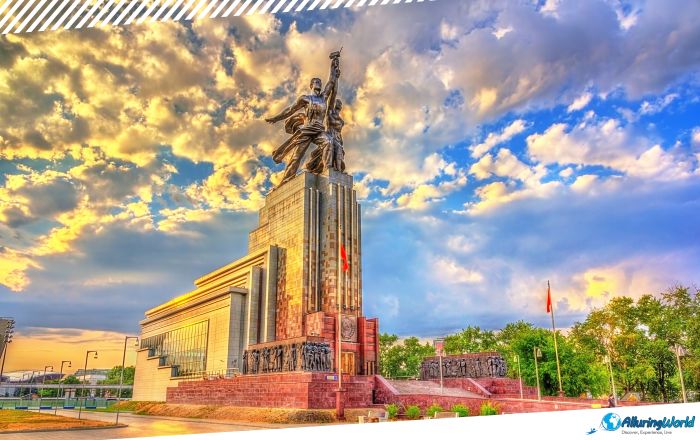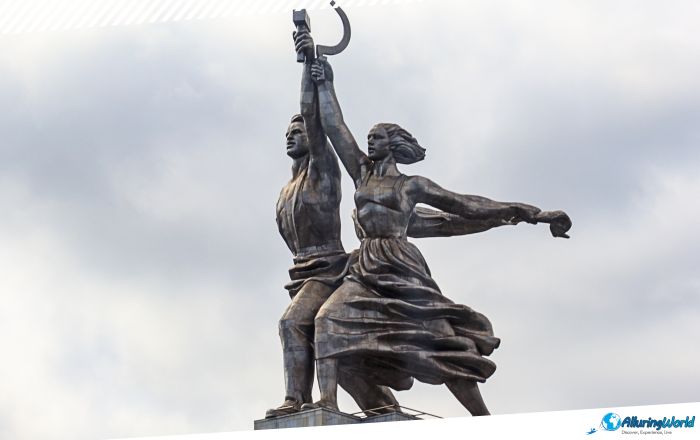
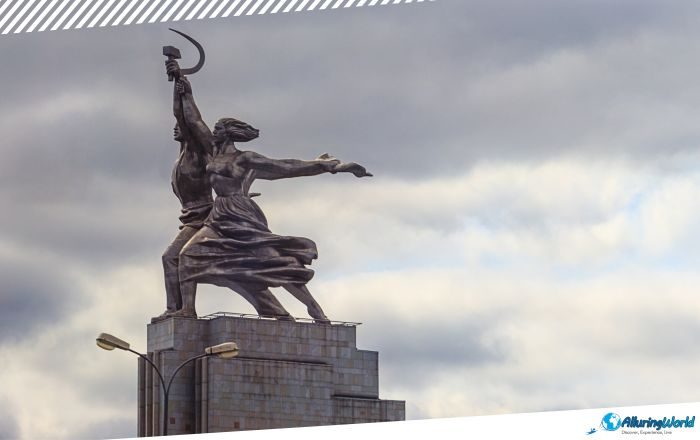
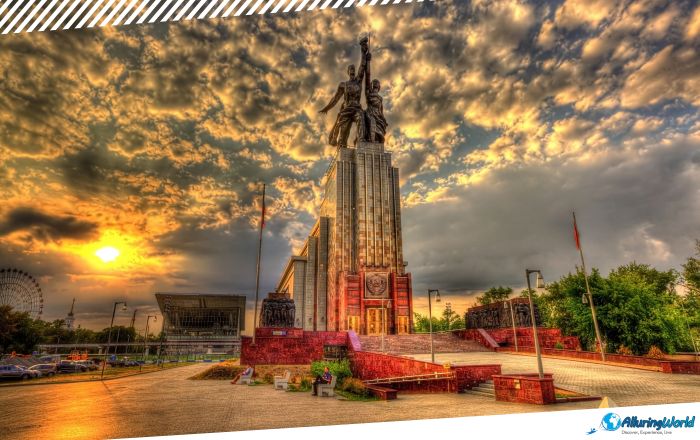
Worker and Kolkhoz Woman, also known as Rabochiy i Kolkhoznitsa, is a large two-figure sculpture that is located in the capital city of the Russian Federation, Moscow. This sculpture is a great symbol of the Soviet times, as it shows two people who are charging towards the work, and both together symbolize the unity of the working class and peasantry.
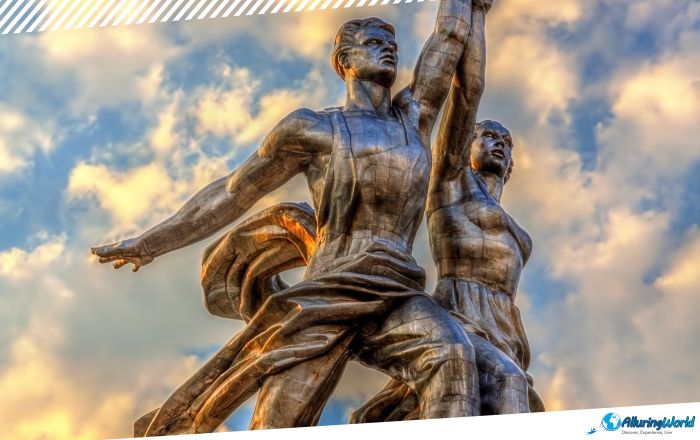
Both people are built out of stainless steel, and the man is holding a hammer in its left hand, while the woman is presented with a sickle in her right hand, with both raised over their heads. It was designed for the purpose of the 1937 World’s Fair in Paris, France, so that it would crown the Soviet pavilion; however, due to its imposing stature, it was later moved to the capital so that the Soviet people would be glancing at it and be reminded of the Soviet ideals.
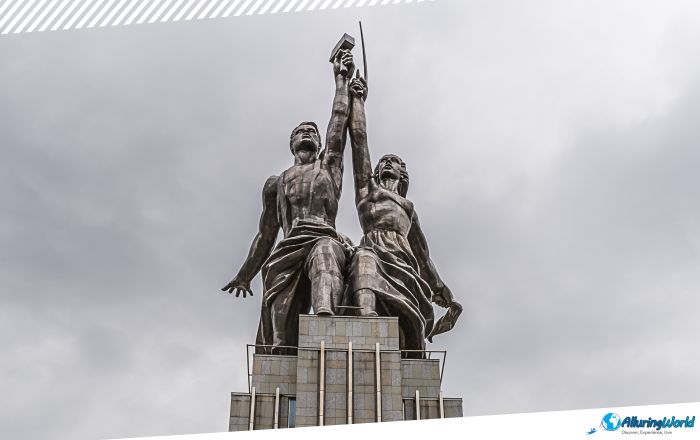
It was designed by the prominent Soviet sculptor Vera Mukhina, who got her inspiration from the Arc de Triomphe in France, but even though the initial idea was to be bigger, it was, in the end, made half the height of the arc. Overall, the Worker and Kolkhoz Woman statue is 24.5 meters (80 ft) high, but as soon as the World’s Fair in Paris finished, the enormous sculpture was taken back to Moscow, and it was placed on a 10 meters (33 ft) tall pedestal to meet the guests of the All-Russia Exhibition Center’s North Gate.
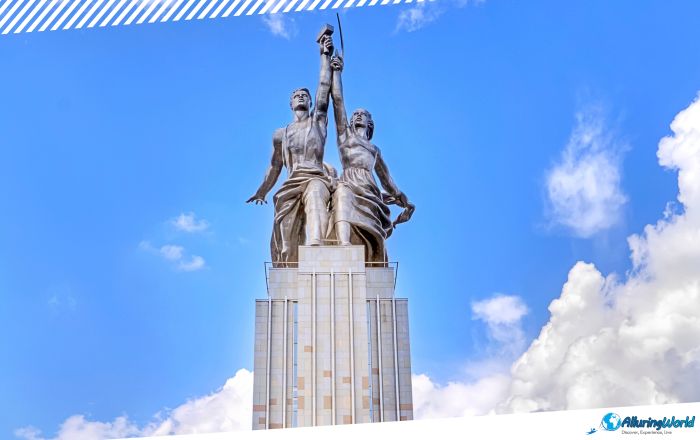
It stayed there until 2003, when there was a plan to restore it and return it in 2005. However, the plans for housing the World’s Fair were awarded to Shanghai, but the plans were changed due to financial problems. The sculpture was disassembled, restored, and then returned in 2009, but this time it got its place, which it really deserves. Ever since then, it has enjoyed the attention of people who are mesmerized by its grandeur and are inspired by the ideas that the Soviet times brought in terms of architecture.
ADVERTISEMENT
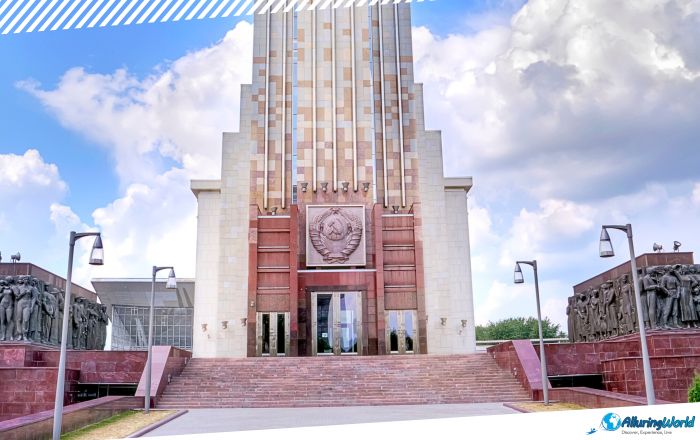
The Worker and Kolkhoz Woman was placed on a new pavilion that serves as a large pedestal, whose height is increased to 60 meters (197 ft), and it is triple the size when compared to the previous one. Still giving the breathtaking mirage it had in the past, it was used in the media as a symbol for some societies, but it will certainly continue to be used for future promotional materials.
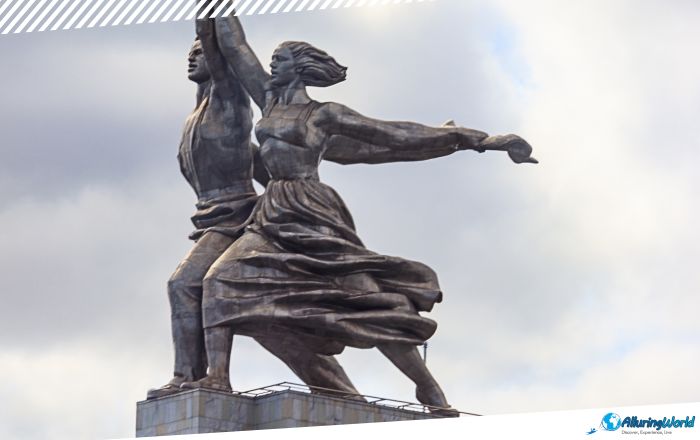
The Worker and Kolkhoz Woman serves as a potent visual shorthand for the monumentalism and collective energy of a bygone era, connecting the historical propaganda and modern pop culture. For example, its inclusion in the 2014 Winter Olympics in Sochi acted as a grand nostalgic tribute to the industrial and social heritage of the Soviet period, thus framing the statue as a symbol of national pride and historical continuity for the region.
Conversely, its appearance in Harry Potter and the Deathly Hallows – Part 1 uses the same heroic aesthetic to signal a shift toward an authoritarian and ideologically driven regime, where the “Magic is Might” monument mirrors the statue’s original intent of projecting strength and unity to mask a more complex and oppressive reality.
Overall, if you are visiting the Russian capital, then a visit to the Worker and Kolkhoz Woman statue is something that you should definitely consider because this is something that people should see once in their lifetime and be reminded of the, as per some people, harsh times when the Soviet Union was following the communist-socialist system and everyone had to contribute to the Soviet society.