
Read time ca. 6 minutes
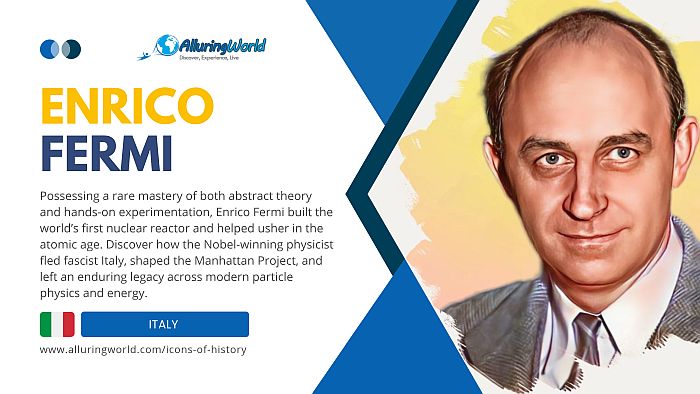
Enrico Fermi, considered to be one of the greatest physicists of the 20th century, is acclaimed for his path-breaking work in the field of nuclear physics and quantum mechanics. His work spanned theoretical and experimental aspects and led to the development of the first nuclear reactor and laid the foundations of atomic energy and modern particle physics. The career of Fermi was marked by brilliance, practical genius, and application of scientific theories to practical problems, thus leaving an enduring impact on physics, engineering, and global history.
What made Fermi such a remarkable figure was his rare mastery of both theoretical physics and hands-on experimentation, allowing him to turn abstract equations into working physical systems. He contributed substantially to the study of processes like beta decay and neutron physics, as well as made important advances in the field of statistical mechanics. His research not only changed the scientific world but affected geopolitics, medicine, and business, furthermore establishing him as a central figure in the nuclear age.
Early Life and Education:
Enrico Fermi was born in Rome, Italy, on 29 September 1901 to Alberto Fermi and Ida de Gattis. His father was a railway official who instilled in him a love of education and encouraged him to do his best, while his mother nurtured his intellectual curiosity. It was evident even at a young age that Fermi had exceptional mathematical skills and loved mechanics and physics, since he was solving complex problems with ease at an early age. Largely self-taught in his youth, he mastered advanced calculus and classical physics from secondhand textbooks he found in Rome’s Campo de’ Fiori market before even entering university.
Fermi became a member of the Scuola Normale Superiore in Pisa, where he pursued studies in physics and mathematics. He obtained his degree in 1922, and he was good at both theoretical and practical physics. Fermi was familiar with current achievements in the areas of quantum mechanics and atomic theory, which would be very important to his work, as they would form the foundation for his later groundbreaking work.
Early Career and Scientific Contributions:
After graduating, Fermi began his career in academia and worked at various universities in Italy. His initial works were in statistical mechanics, quantum mechanics, and atomic structure. His contributions to the statistical mechanics of particles led to what is currently known as Fermi-Dirac statistics, which explains how identical, indistinguishable particles with half-integer spin, called fermions (such as electrons, protons, and neutrons), distribute themselves across energy states in thermal equilibrium while obeying the Pauli exclusion principle.
The contributions made to this field by Fermi laid the foundation for explaining how the electrons behaved within solids, the behavior of the neutrons during nuclear reactions, and the structure of matter at the most basic level possible. This gave him the reputation of being among the greatest physicists of that era. During this period, he also formulated his landmark theory of beta decay in 1933, proposing the existence of the weak nuclear force and incorporating Wolfgang Pauli’s neutrino to explain how radioactive nuclei emit electrons.
Experiments with Neutrons and Nuclear Reactions:
The neutron research conducted by Fermi represented a breakthrough in nuclear science. Fermi studied the interaction between neutrons and atomic nuclei in the first half of the 1930s and found out that slow-moving neutrons could stimulate nuclear reactions very efficiently. This discovery later proved essential for triggering nuclear fission efficiently and making a controlled nuclear chain reaction possible.
By 1934, Fermi and his team in Rome had bombarded uranium with neutrons to produce a series of new radioactive substances. Although Fermi mistakenly believed he had created new elements heavier than uranium, not realizing he had actually split the uranium atom, these experiments laid the groundwork for nuclear energy and weaponry.
ADVERTISEMENT
Migration to the United States and the Manhattan Project:
In the 1930s, as fascism was gaining momentum in Italy, Fermi, whose wife was Jewish, found himself in greater danger both politically and personally. In 1938, he immigrated to America, taking up a job at Columbia University in New York. Rather than returning to Italy after traveling to Stockholm to accept his Nobel Prize in December 1938, Fermi sailed directly with his family to New York to escape Mussolini’s newly enacted racial laws. His move enabled him to continue his work in a more secure environment, without the fear of the authorities taking him or his wife, as well as to make contributions to the swiftly developing science of nuclear physics.
Enrico Fermi was a central figure during the Second World War in relation to the Manhattan Project, since the Allied forces worked to develop atomic weapons. In December 1942, at the University of Chicago, Fermi led the team that would inevitably lead to the creation of the world’s first self-sustaining nuclear chain reaction, which was achieved by using uranium and graphite in a reactor called Chicago Pile 1. This achievement proved that a nuclear chain reaction could be deliberately initiated, controlled, and sustained, marking a monumental milestone in science and engineering. Later in the war, Fermi served as a senior advisor at the Los Alamos Laboratory in New Mexico, where he witnessed the Trinity nuclear test in July 1945 and famously estimated the bomb’s explosive yield within seconds by dropping scraps of paper into the passing shockwave.
Postwar Contributions and Legacy:
After World War II, Fermi returned to the University of Chicago, where he educated a new generation of physicists and focused his research on particle accelerators, cosmic rays, and high-energy nuclear reactions. This work was crucial for the establishment of the laws of modern particle physics, and it also allowed the understanding of fundamental interactions between subatomic particles.
Nevertheless, the influence Fermi had was not confined only to physics. The techniques and principles that he developed in connection with the design of reactors and nuclear chain reactions form the basis of nuclear energy production, the use of isotopes in medicine, and other applications in research and industry. It can be undoubtedly stated that his approach combined rigorous theoretical understanding with practical engineering, thus emphasizing the importance of experimentation and observation.
Personal Life and Character:
Though Fermi was famous for his outstanding contributions, in his personal life, he was recognized as humble, thorough in everything, and methodical in solving problems. His peers recognized his talent for simplifying complex matters, his pragmatic approach to experiments, and his dedication to teaching young researchers. This gift gave rise to “Fermi problems,” his famous method of making rapid, accurate back-of-the-envelope estimates from minimal data, as well as the famous “Fermi paradox,” his 1950 question asking why humanity has found no evidence of extraterrestrial civilizations despite the vast age and scale of the universe. In 1928, Fermi got married to Laura Capon, and that marriage gave him a family that was blessed with numerous years of stability and support.
Fermi’s personal philosophy emphasized curiosity, perseverance, and the moral obligation of scientists to apply their knowledge responsibly and make sure that humanity will benefit from the work that they are doing. He had a brilliant intellect combined with sensibility and common sense, therefore balancing abstract theory with tangible, real-world applications.
Recognition and Honors:
Fermi was honored with many awards for his accomplishments, most notably the 1938 Nobel Prize in Physics for demonstrating new radioactive elements produced by neutron irradiation and discovering nuclear reactions brought about by slow neutrons. He was regarded as one of the most versatile physicists of his era, having attained global recognition not only for his theoretical knowledge but also for his experimental discoveries. Fermi died of stomach cancer in Chicago on 28 November 1954 at the age of 53, leaving behind a legacy etched into modern science through the particle class known as fermions, the synthetic element fermium (atomic number 100), the U.S. government’s Enrico Fermi Award, and the Fermi National Accelerator Laboratory (Fermilab) in Illinois.
Conclusion:
Overall, Enrico Fermi changed the landscape of physics and technology with the help of his groundbreaking work in nuclear physics, quantum physics, and particle physics. His formulation of Fermi-Dirac statistics, his theory of beta decay, and his creation of the first controlled nuclear reactor were the direct result of his unique blend of theoretical insight and practical skill. Not only did the work of Fermi contribute to science, but it also changed the face of medicine, energy, and industry, leaving an enduring legacy as one of the most influential scientists of the 20th century.