
Read time ca. 6 minutes
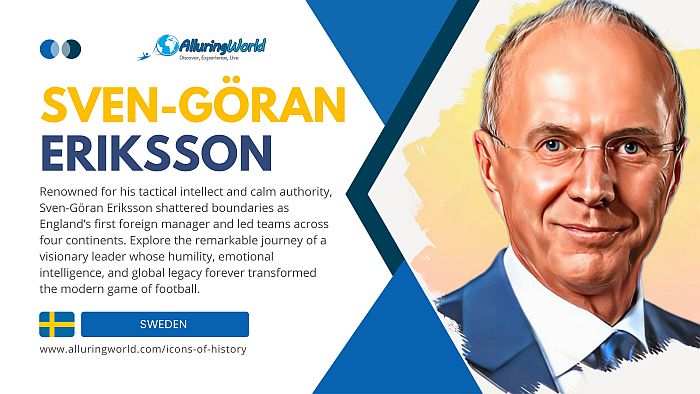
Sven-Göran Eriksson was one of the most influential football managers of the modern era, renowned for his tactical intelligence, calm authority, and unprecedented international career. As the first foreign manager of the England national team, he redefined the standards of leadership in the upper echelons of football and showed that professionalism, flexibility, and cultural sensitivity need not be limited by nationality. His career in football touched the four corners of the world, the different tournaments, and the different eras.
Early Life and Introduction to Football:
Born on 5 February 1948, Sven-Göran Eriksson hails from the small town of Sunne in Värmland, Sweden. He came from a humble family that emphasized hard work, humility, and perseverance, but football was also something he became acquainted with from childhood, thanks to the presence of football clubs in the community where he lived. Unlike most accomplished managers, Sven-Göran Eriksson had a poor playing career, and he played as a right-back during his time as an amateur and semi-professional player.
Aware very early on of the fact that he was more gifted in terms of leadership and strategy rather than sports, Eriksson got himself educated as a coach and pursued a career as a football coach rather than a footballer. He took courses on physical education and coaching techniques to develop an intellectual approach to football management, so that he would be properly prepared for the coaching career he envisioned in front of him.
Early Coaching Career in Sweden:
Eriksson entered the realm of management with Degerfors IF in the mid-1970s, and his tactics and organizational skills were instantly apparent. The fact that he achieved success despite having very few resources brought him to IFK Göteborg in 1979. This marked a turning point for both Eriksson and Swedish football, as both started making significant successes that would be noticed throughout the football world.
The success that IFK Göteborg enjoyed under his tutelage is best represented by its win in the UEFA Cup in 1982, which marked a historic feat since no other Scandinavian team had ever won against European giants before. Such success helped Sven Eriksson gain a worldwide reputation and fame, and his style of coaching revolved around team effort, good defending, and efficient use of space.
Breakthrough in European Club Football:
Having succeeded in Sweden, Eriksson then went on to work in Portugal, where he coached the club Benfica from 1982. He won several titles with the team and established himself as an experienced manager who could succeed even when working outside his native country.
Eriksson’s reputation was further enhanced when he was coaching AS Roma, Fiorentina, but especially SS Lazio. The period under Eriksson at Lazio is regarded as one of the most fruitful in the club’s history because Eriksson was able to win the championship of Serie A in the 1999-2000 season, as well as the Coppa Italia and the UEFA Cup Winners’ Cup. His Lazio team combined defensive discipline with creative attacking play, reflecting his belief in balance and tactical flexibility.
England National Team:
Eriksson became the manager of the England National Team in 2001. This was a landmark occasion, as he became the first non-British person to assume the managerial role, so he was expected to show better results than his predecessors. Interestingly, this occasion was met with a lot of media attention. Still, despite the numerous media reports and published news, Eriksson stayed calm and worked towards modernizing the tactics of England.
Among Eriksson’s greatest successes with England, none made a greater impact than the legendary 5-1 win over Germany in Munich during the World Cup Qualifying campaign of September 2001. It came as a huge surprise for European football and immediately confirmed the effectiveness of Eriksson’s tactics in the most important tournament. His tactics were noticed by other coaches, so others started working similarly to his already successful work.
Under Eriksson’s stewardship, England participated in the FIFA World Cup 2002, the UEFA European Championship 2004, and the FIFA World Cup 2006. The quality of the teams he coached was such that they made it to the quarter-finals of all three competitions. Eriksson coached a talented generation of players, stressing professionalism and psychological stability, which in the end brought excellent results for the country’s team.
Eriksson had the responsibility of leading England’s “Golden Generation,” as referred to by the media in Britain, which comprised the best players, including such names as David Beckham, Steven Gerrard, Frank Lampard, Paul Scholes, and Wayne Rooney. The enormous pressures that such big names bring to the table, both in terms of tactics and media attention, make it essential for a manager to have very high levels of emotional intelligence.
Despite England failing to win a major tournament, the era of Eriksson in charge is generally viewed as an era of sustained success for the national side, and people do have fond memories of it. Eriksson stepped down from his position in 2006 after leaving a legacy in the way the game was managed in England.
ADVERTISEMENT
Later International Career:
Eriksson embarked on the journey of being an entirely global manager after he departed from England. In this regard, Eriksson worked in Europe, Asia, Africa, and the Middle East, and the assignments that Eriksson was given include working in Mexico, Ivory Coast, the Philippines, and also some Chinese club sides and the Middle East.
Being the coach of the Ivory Coast, he guided the team through the FIFA World Cup in 2010, thus becoming one of the few coaches in these tournaments to represent two nations in the same competition. It was in the latter part of his career that the focus was less on winning tournaments but on mentoring, development of infrastructure, and professionalism so that future generations would be able to repeat the success he managed to have.
Personal Character and Leadership Style:
Eriksson’s strengths included his ability to maintain his composure under pressure and conduct himself with a high level of discipline and respect in the heat of the moment. In the football world, this is rarely seen, as everyone is running high on emotions, but he managed to always show a peaceful manner and excellent composure. Overall, he was an advocate of building up the player through inspiration, not intimidation.
However, even during the times when he was involved in personal controversy and caught up in the media storm, Eriksson remained dignified and professional. He always stressed that the ability to learn, adaptability, and culture were the most important factors in one’s success.
Final Years and Passing:
Later in life, Eriksson continued to stay engaged in advising and commenting on the sport as well as serving as a diplomat in its development. In 2024, he openly admitted to suffering from a terminal illness, demonstrating a remarkable degree of calmness in dealing with the matter. Sven-Göran Eriksson died on 26 August 2024.
His death marked the end of an extraordinary football journey that transcended national borders and managerial conventions, and it is seen as one of the greatest examples of how a coach should coordinate with the team and make sure success will follow with a proper and clear guidance.
Legacy:
The legacy of Sven-Göran Eriksson includes more than just trophies and competitions. He proved through his actions that leadership, knowledge, and respect can overcome any cultural barrier and alter expectations forever. The man was one of the first examples of a foreign coach managing a major national team and acted as a role model across continents.
Conclusion:
In summary, Sven-Göran Eriksson was not just a successful football manager, but he was rather seen as an ambassador for the sport on a global scale; not just for his Swedish coaching part, but for the worldwide work he has done. As some would say that he was following the Law of Jante, he was practicing discipline, humility, and intelligence, thus helping build teams, shape countries, and motivate upcoming managers. His career is proof of how adaptability, professionalism, and subtle power can make someone influential.