
Read time ca. 6 minutes
The Toblerone Affair, sometimes known as Tobleroneaffären in Swedish, is the name given to one of the major scandals that occurred in Swedish politics in the mid-1990s, involving a prominent member of the Social Democratic Party, Mona Sahlin. Despite the humorous-sounding name of the scandal, which makes people think about a light and entertaining story, the affair actually caused serious damage to the politician’s career, as well as to the politics in the country. Ever since then, the Toblerone Affair has been used in politics to describe politicians’ mistakes that are related to private misuse of public funds.
Background: Who Was Mona Sahlin?
Mona Sahlin entered politics early in her life. She became a member of the Social Democrats in her youth and rapidly made her way up the ladder, securing positions in the Swedish Parliament and as a minister. In the mid-1990s, Mona Sahlin was the Deputy Prime Minister of Sweden and one of the frontrunners in terms of succeeding Ingvar Carlsson, the incumbent prime minister of Sweden.
Due to her high profile in the Swedish political scene and the likelihood of becoming a future leader, she was a prominent individual in her political party and the political arena overall. Being such a prominent person, she was likely to receive much attention in cases of misconduct, so the media and people would definitely pay more attention to any allegations of impropriety.
The Affair Emerges: Misuse of a Government Credit Card
This issue came into focus in October 1995 when Expressen, one of Sweden’s most reputable newspapers, brought out the story about the improper use of a government credit card by Sahlin for personal expenditures. In accordance with regulations, this card was meant only for official purposes related to her responsibilities as a minister, and yet, the media exposed the fact that the minister charged her private expenditures with this card.
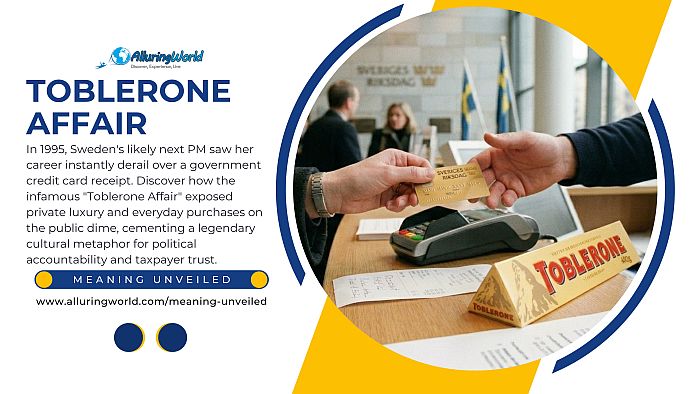
But the list of purchases did not end there. Some of the items included everyday things like diapers, tobacco, rental cars, and even two blocks of Toblerone chocolate. Despite the fact that the total cost of the personal expenditure was relatively small compared to national budgets, it was approximately 53,000 Swedish kronor (€6,000 / $7,200 adjusted for 1995), the symbolic value of buying the chocolate became an important part of the scandal’s name.
Since then, the name Toblerone Affair shows that even minor aspects of a political scandal can affect how people perceive it. The connection with the famous chocolate is one example of how the media portrayed the scandal as a misuse of privilege, resonating well with the Swedish population.
Legal and Ethical Consequences:
Following the press revelations, prosecutors opened a preliminary investigation to determine whether Sahlin’s actions constituted a criminal offense. Nevertheless, the investigation was eventually closed without charges being filed, in part because Sahlin repaid the state for the private expenditures as well as an additional amount related to administrative delays, but the question remains: If Sahlin was not found guilty of misappropriation of government funds, would she have returned the money to the country’s budget?
From a legal perspective, the case ended with her being acquitted of any wrongdoing; however, other repercussions could not be overlooked. In Sweden, the degree of trust that citizens have in their politicians depends very much on how they conduct themselves. Charging personal expenses using her government/parliamentary credit card while traveling for official purposes was completely unacceptable behavior for a politician in such a country.
Media outlets and political opponents presented it as an issue of ethics. In a country where public corruption is considered a serious offense, the Toblerone Affair became symbolic of what many citizens felt was arrogance or carelessness with public money.
ADVERTISEMENT
Political Fallout and Resignation:
Though there were in the end no charges brought against her, there were severe political consequences that soon followed. Under heavy public pressure and scrutiny, Sahlin was forced to resign from all governmental positions she held at that time. Because she was slated to take the mantle to become the head of the Social Democratic Party of Sweden, this move prevented her from doing that.
Her resignation highlighted the extent to which political standards of accountability in Sweden go beyond just being guilty of a crime. It became evident that it was not only necessary to be legally innocent but also morally above reproach. Several commentators pointed out that the Swedish public and media have very high expectations of politicians, such that even small transgressions could lead to career-ending results.
Media Role and Public Perception:
It is interesting that the case of the Toblerone Affair also showcased the important influence of the media in the formation of political discourse. In this case, the media played an important role in investigating what seemed like trivial credit card accounts of individuals involved in politics, but this is indicative of the overall atmosphere in Sweden, where the media watches over officials and their deeds.
The political culture in Sweden, which may be associated with expectations of transparency and equality, played a role in the meaning of such details as buying sweets with government credit cards. The image of the case in media coverage may be seen as one reason for the assumption that Sahlin acted in a morally unacceptable way despite the modest value of his purchases.
Polls taken after this incident showed that a number of Swedes had lost faith in Sahlin as a legitimate contender for more powerful positions in government, consequently illustrating the way in which questions of personal character can damage political reputations.
Long‑Term Impact and Legacy:
Since 1995, the event has continued to be a benchmark issue within the Swedish political arena. It has been brought up during political discussions relating to accountability and the standards expected from the individuals holding political positions. Many politicians belonging to different political parties have utilized the term as part of their criticism against certain unethical behavior demonstrated by other politicians. For example, the Christian Democratic politician Mats Odell made use of the term “Tobleronepolitik.”
This episode shows that political scandals may acquire cultural significance well beyond the context in which they arose. Toblerone bars, which have little relevance to anything by themselves, were transformed into a metaphor for political corruption, and this metaphor has survived in the vocabulary of Swedish politics and remains relevant at times of political scandal.
For Sahlin herself, this scandal was undoubtedly a significant blow to her political career, which set her back considerably. She did, however, re-enter politics at a later stage, as she took some ministerial posts, but she ultimately was selected as the first woman to lead the Social Democratic Party in 2007, something that she had been destined to be in the late 1990s. Overall, the Toblerone Affair has been a defining feature of her political persona ever since.
Cultural Reflection on Ethics and Trust:
The importance of the Toblerone Affair lies in more than just the facts themselves. It is important for what it tells us about the political culture of Sweden. In countries such as Sweden, where very high standards for integrity are expected of politicians, even minor lapses in integrity can carry a lot of weight in the political arena.
In comparison with other political cultures, observers have noted that financial impropriety often weighs more heavily in Swedish politics than other types of scandals common elsewhere. As one commentary put it, Swedish society is particularly sensitive to how taxpayers’ money is used, and this sensitivity helps explain why a matter involving something as mundane as chocolate could become nationally significant.
Conclusion:
In summary, what transpired during the mid-1990s in Sweden can be viewed as a unique case in the political history of the country. What originally started out as a story related to the private use of government credit cards by a prominent politician turned out to be a discussion on ethics, responsibility, and accountability in Sweden. The decision to resign by Mona Sahlin can be seen in the context of the high expectations in Sweden when it comes to ethics.
Toblerone Affair is not merely an interesting name associated with a chocolate bar, but it continues to serve as an example of political accountability and how actions can lead to political ramifications in terms of one’s private life and activities. In Sweden, this nowadays well-known scandal has become a means of comparing other political scandals.