
Read time ca. 5 minutes
The Standard of Cyrus the Great is a powerful symbol representing one of the greatest historical figures. Also known as Cyrus II of Persia or Cyrus the Great, Achaemenid Empire’s founder around the 6th century BC, Cyrus the Great was not only a skilled warrior who conquered many lands but was equally renowned for his administrative, diplomatic, and cultural practices. Thus, the Standard of Cyrus the Great should be perceived not as an ordinary flag but rather as a powerful symbol of authority and leadership. To comprehend what the Standard means, it is vital to examine it from different angles.
Historical Context of Cyrus the Great:
Cyrus rose to power in 550 BC, leading the Medes and Persians. His victories against Lydia, Babylon, and other territories allowed him to form the Persian Empire, which was then the biggest Empire in the history of humanity, spreading from the Aegean Sea to the river Indus.
The Standard of Cyrus the Great was a symbol used to identify the emperor and show his supremacy at times of battle and other ceremonies. The use of such a symbol during an era where many people were not literate made it one of the instruments of communication and control that announced the arrival of the king. Another reason behind the usage of this instrument was to unite different peoples into one kingdom, which was a strategy of imperial unity that Alexander the Great later admired and adopted when he conquered the Persian Empire nearly two centuries after Cyrus’s death.
Design and Structure of the Standard:
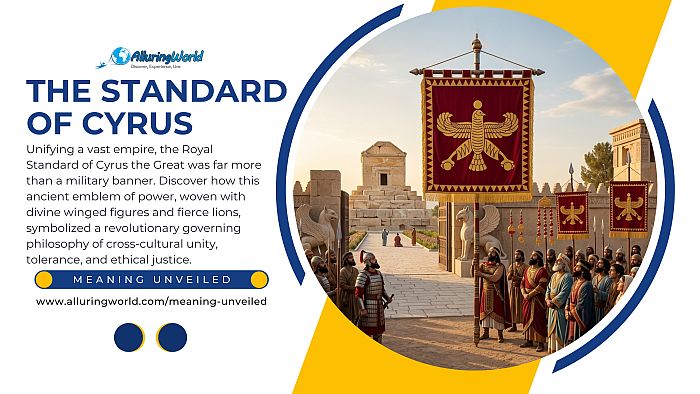
Although there may not be many records on the exact design of Cyrus’ Standard, ancient accounts have shown that the Standard probably included artistic elements representing royal majesty and divine approval. There could certainly have been several variations to the Standard, but they were always centered around the same principle. According to the ancient historian Xenophon, the Standard was a golden eagle or falcon with outspread wings mounted upon a long spear-shaft, rather than a mix of various geometric or astronomical shapes. Although usually described as a mere military standard, the Standard of Cyrus the Great was actually a reflection of the Persian soul.
- Winged Figures: The incorporation of a majestic golden bird of prey signified royal majesty and cosmic protection, though it should not be confused with the human-faced winged discs found on later palace reliefs.
- Animal Motifs: The depiction of a golden eagle or falcon (known as the Shahbaz) with outspread wings signified royal power, protection, and military bravery, as Cyrus did not use lions on his personal Standard.
- Colors and Materials: Precious metals, costly fabrics, and bright dyes may have been used, stressing richness, status, and the wealth of the Empire. Such materials would have made it easy for the Standard to stand out in battle and in processions.
Overall, every design element was thoughtfully selected to signify political power, moral correctness, and spiritual authenticity over the masses, and the Standard is thus an amalgamation of visual, symbolic, and practical importance.
ADVERTISEMENT
Symbolism of the Standard:
The Standard of Cyrus the Great was no ordinary symbol of power; rather, it had profound significance related to the Persian Empire’s governing philosophy:
- Unity of the Empire: Through the use of one Standard, Cyrus indicated the unity of peoples who came from varied backgrounds. This was a way to express that individuals belonging to distinct tribes, languages, and religions could co-exist in a united state.
- Divine Mandate: While later Persian kings heavily emphasized the Zoroastrian religion and the Zoroastrian god Ahura Mazda, Cyrus pragmatically adapted his religious messaging; on the famous Cyrus Cylinder, he actually attributes his royal legitimacy and victories to the local Babylonian god Marduk.
- Military and Civic Authority: The Standard acted both as an insignia and a military standard, reflecting the dual aspects of leadership: protection of the realm and administration of justice.
The symbolism of the Standard reinforced the perception that Cyrus’s rule was both legitimate and morally grounded, an essential factor in maintaining the stability of a rapidly expanding empire.
Cyrus’s Leadership and Ethical Governance:
Cyrus the Great is famous for his liberal policy and his moral leadership, symbolized by the Standard. Unlike most of his contemporaries, he was tolerant of the cultures of those whom he conquered and allowed their local traditions and languages to remain. The edict permitting the Jewish people to rebuild their temple at Jerusalem, described on the Cyrus Cylinder, is an example of this.
It is evident that the Standard was a representation of justice, equality, and diversity, as well as military prowess. Said in other words, the Standard conveyed a message to the people that the king was concerned with the ethics of governance through the exercise of prudence.
Cultural and Historical Legacy:
In addition to being a historically significant artifact, the Standard of Cyrus the Great has had an impact that transcends its own times. The Standard was used as the template for other Persian symbols of power and served as an example for regional monarchs to emulate by developing their own symbols, much like Cyrus’ Standard.
Also, the Standard remains an emblem of Persian identity and culture that is featured in contemporary cultural allusions, museum displays, and scholarly research. The Standard is not just an artifact, but it is something more than that. The Standard is one of the great symbols that embodies the ideals of unity, ethical leadership, and legitimacy that Cyrus himself espoused.
Modern Interpretations:
In modern-day academia and popular media, the Standard of Cyrus is seen as a representation of visionary leadership and statecraft. These are some ways historians view this historical artifact:
- The use of visual representations to legitimize political power.
- Moral and ethical implications of leadership where power is used together with justice.
- Religious, cultural, and political interconnections in early civilizations.
The artists and historians still analyze the Standard for being the basis on which they can study symbol usage in conveying complex ideas within various groups of people.
Conclusion:
Since we have to wrap up our discussion on this Standard, we would like to say that the Standard of Cyrus the Great is much more than just an old flag. In other words, the Standard is a symbol of power, morality, and unity. By including images such as winged people, animals, and geometrical shapes, the creators expressed their ideas about divine endorsement, military might, and moral politics, which helped Cyrus to create a powerful empire. In this respect, this Standard does not merely refer to the historical events of that time but represents a set of values of a leader who could unite might and right. Consequently, the Standard can help us understand the importance of symbols and their meanings related to the concept of authority, morality, and culture.