
Read time ca. 6 minutes
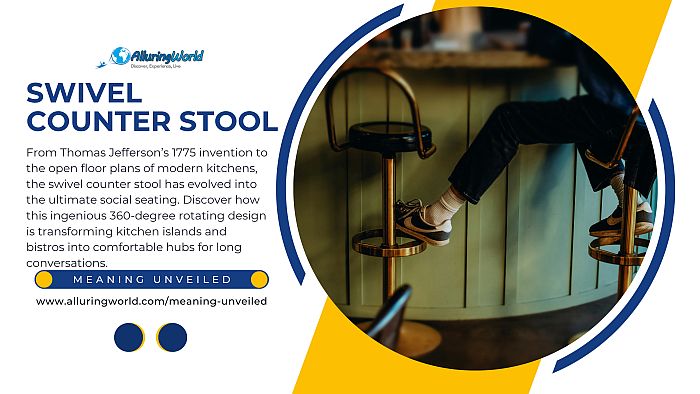
Swivel counter stool is a unique form of seating chair that is especially made for counter seats, which have a height of about 89-94 cm (35-37 in). The key element of this particular type of stool is the ability to swivel the sitting area at an angle of up to 360 degrees, without having to move the entire stool itself or make any scratches on the floor. Such a characteristic makes it very convenient to enter and leave the stool easily, along with engaging in conversations, since the person can easily change the direction of his gaze from working space to conversing space.
When you walk into a newly opened bistro restaurant and observe what is going on by the counter, you will see how a client comes up, turns a stool towards his companion without moving it around, leans into its supportive design, and sits. This movement says that a trend cycle has started to come around, and it is catching up faster than designers expected.
During a period in the latter years of the 2010s, the perch without a back was king of hospitality counters. This chair appeared very tidy in pictures and fit neatly behind the bar counter, with comfort being secondary to the look. The time is changing, and the area is becoming softer once more. The swivel counter stools with backs are leading the charge in the new design trend, and they are the revolving ones that once seemed excessive in their design to business owners.
The History of the Swivel Counter Stools with Backs:
The swivel counter stool with a back is an ingenious merger of two unique ideas from history: the swivel mechanism that emerged in the 18th century and the 20th-century culinary movement from America. The idea of using the swivel for a chair was initially mentioned in the writings of the German nobleman Martin Löffelholz von Kolberg in 1505. Still, it was Thomas Jefferson who implemented the idea and invented the swivel chair in 1775. Jefferson designed the chair by installing an iron spindle between the upper and lower parts of the chair and using the window sash rollers for rotation. With this amazing invention, he could switch between writing and reading the reference material to create the Declaration of Independence of the United States. In the next century, this durable swivel technology would be applied extensively in industrial and office draftsmanship, though only to chairs and not stools.
The actual development of the “modern swivel counter stool with back” took place in the middle of the 20th century, when there were drastic changes in architecture and restaurant business practices. Traditionally, in order to accommodate as many customers as possible and discourage them from lingering too long, bars and taverns had been using non-swinging, low-back stools. After World War II, however, famous architects such as Frank Lloyd Wright introduced the idea of “open floor plans,” where the kitchen would become part of the house’s central meeting place. As a result, kitchens became equipped with islands featuring countertop tables. In order to provide for convenient seating around those tables, furniture manufacturers started installing backs on the stools to create more comfortable seats. The addition of Jefferson’s swivel mechanism made it easy to rotate one’s seat from the cooking area to the living room without scratching the floor or having to lift the stool’s entire frame.
The Height That Makes the Counter Work:
The resurgence is built on a concept that hasn’t altered much. Counter height stools rest somewhere between 61 and 66 cm (24 and 26 in), in conjunction with the standard 86 to 91 cm (34 to 36 in) counters found on most kitchens’ islands and service counters. This results in about a foot of space beneath the stool, allowing someone to get in and out without difficulty.
This is also the height at which people are most comfortable. It’s lower than that of a bar, but it comfortably accommodates older customers and kids who’d need a lift. It is the height for which the furniture in our homes of the year 2026 is designed, for extended periods of sitting that will take place on the sofa or in front of a television.
Why the Back Came Back:
Remove the back of a stool, and you send a silent message that you shouldn’t rest there, which is not something that business owners would like their place to feel like. This method works when the counter is a place where one stops quickly for an espresso, for example, in the Italian coffee shops. Today, this strategy fights a very obvious trend towards warmth, coziness, and hospitality over the coldness of simplicity.
The addition of a back transforms the equation of the chair. It supports the spine, serves the second drink, and suggests that the room wants people to linger. Those designers looking to capture the soft and tactile quality of the year are turning to backed seating because an unbaked stool conveys a transactional quality, which is precisely what interiors of 2026 want to shed.
ADVERTISEMENT
The Swivel Earns Its Keep:
It is not nostalgia, but something that actually improves things by solving a very real traffic problem. By having a swivel counter stool chair, one can face other people talking, look into the room, or even turn towards the aisle, without moving the whole seat back into the path of the server.
Ergonomically speaking, there’s a rationale here as well. The motion makes for less twist and stretch in the human body when compared to a static seat, which goes well with ergonomics, according to which a chair should move with the human body, not against it. Combining the rotation function with a footrest at about 43-48 cm (17–19 in) from the seat will result in comfortable sitting positions for several hours. Flexibility means comfort.
What Forward-Looking Operators Are Specifying:
Picture building out a counter that will see use through the next five years instead of the previous five. The program is changing, and the intelligent specs fall into some distinct categories:
- A back support for the lower back during hour-long visits, not five-minute ones.
- A rotating system capable of holding up to the commercial standard, making sure the action withstands constant use.
- Seat heights between 61 and 66 cm (24 and 26 in) with counters ranging from 86 to 91 cm (34 to 36 in) high.
- An adjustable footrest that will relieve pressure from suspended feet.
- Soft finishes, rounded edges, and textures that speak comfort.
Each item points the same way, and that is the counter is becoming a place to gather, and the seating has to earn the time guests are now willing to spend there.
Where the Counter Goes From Here:
The cool, austere minimalism that made backs and pivots go out of style is becoming increasingly outdated, and is giving way to curved lines, warmth from wood, and an unashamed emphasis on comfort. This new design aesthetic is evident in the countertop chair, and the swivel chair with back is its definitive embodiment.
Those who read the room early will be specifying those chairs not as something that looks like nostalgia, but rather as a sign of things to come. This counter is no longer simply somewhere you stand while waiting to get a seat. This counter is now going to become the social focal point of the space, the place where people sit around and talk, and the seat where your back gets supported as you turn to face your friend.
Conclusion:
In essence, the re-emergence of the backed swivel counter stool is a radical change from places of transitory business to spaces for lingering and socializing. Through the use of 360-degree rotation and ergonomic design, not only are these chairs capable of fitting the guest comfortably, but they also encourage them to linger and even invite people to come back to the business again. With such designs becoming increasingly popular due to the inclusion of warmth and coziness into the environment design, the type of chair selected becomes very significant.