
Read time ca. 7 minutes
Japanese traditional houses, known as minka (民家), reflect centuries of cultural, environmental, and architectural evolution. These structures are more than mere dwellings; they embody the philosophy, aesthetics, and lifestyle of Japanese society. From the arrangement of rooms to the choice of materials, every element of a traditional Japanese house serves a functional, cultural, and symbolic purpose. Understanding these houses provides insight into the Japanese way of life, their relationship with nature, and the values that have shaped both urban and rural living over centuries.
The architecture of houses in Japan is based on the concept of functionality, minimalism, and unity with nature. Houses in Japan are characterized by the use of natural materials, adaptable space, and change according to the seasons of the year. By analyzing layout, techniques of construction, and traditions of culture, you can understand the complex principles of the architecture of Japanese houses.
I. Historical Background of Japanese Houses
Early Influences:
The development of Japanese homes was affected by both indigenous practices and those from outside. The early homes that were constructed in Japan were made of wood, which dated back to the Yayoi Period (300 BCE – 300 CE) and the Kofun Period (250 – 538 CE), taking into account the agricultural nature of its dwellers.
With the advent of Buddhist influence and architectural ideas from China during the Asuka period (538 – 710 CE) and Nara period (710 – 794 CE), Japanese houses started using more advanced building techniques like roof tiles, room arrangements, and sliding doors (fusuma) and paper screens (shoji). The result was an architectural design that is uniquely Japanese.
The Edo Period and the Rise of Minka:
In the Edo period (1603-1868), there was peace and stability in Japan, providing an opportunity for residential architecture to develop. Traditional rural houses or minka gained popularity, especially among farmers, artisans, and traders. The designs of these homes had a practical aspect and also incorporated beauty in simple architecture.
Houses within cities such as Kyoto and Edo (modern-day Tokyo) had less space but were beautifully made, and this is a proof that the architectural traditions could be adapted in different locations, so that the Japanese house would serve a proper use for its tenants.
II. Structural Features of Japanese Traditional Houses
Wood and Natural Materials:
Wood is the main building material for traditional Japanese houses. Types of wood that may be used include cypress, cedar, pine, and bamboo due to their availability, sturdiness, and adaptability. The structure of the house is constructed of wood by building frames and beams, whereas clay, straw, and paper are utilized to make the walls and to put the floors.
The use of natural material gives the building the ability to “breathe” as well as regulate air flow and moisture balance. Considering the climate in Japan is very moist, humid, and hot during the summer, this was an excellent choice for a house, so that its inhabitants would feel as comfortable as possible. In addition, it integrates the living area with the environment, adhering to the idea of wabi-sabi in Japanese culture.
Raised Floors and Tatami Mats:
The traditional design of a house in Japan has the floor built on a wooden platform that stands above the surface of the ground. The area near the ground is called the doma. Raising the floors makes it possible to protect the space from moisture, insects, and cold air coming from the ground. The area that is not raised is for laborious and cooking purposes.
The interior of rooms is fitted with tatami mats, which are made from rice straw and rush grass. The size of tatami mats is uniform, and it was because of this feature that the dimensions of rooms were determined. Tatami mats have insulating properties and provide a comfortable feeling, with the smell creating a peaceful environment. Furthermore, they determine etiquette, where some areas are meant for certain people.
ADVERTISEMENT
III. Room Layout and Spatial Organization
Flexible and Modular Spaces:
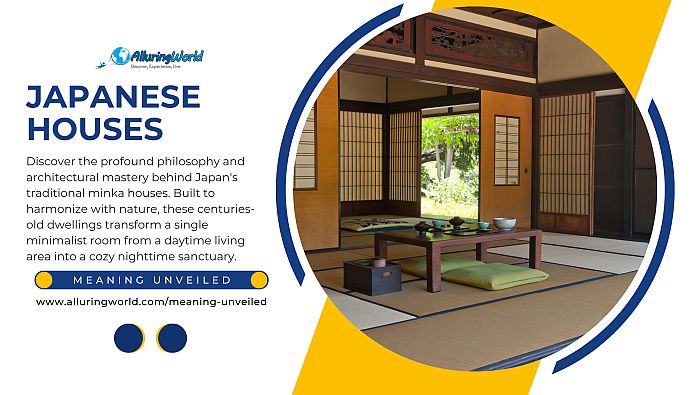
Modular design is typical for traditional Japanese houses. Room divisions usually consist of movable paper partitions called shoji or fusuma, and this type of design enables rooms to change their purpose and be adapted to whatever the inhabitants require at that time. For example, one room may be used as a living area during the daytime, a sleeping area at nighttime, and a dining area while eating.
This modular approach is the perfect reflection of the Japanese preference for multifunctionality and minimalism, so having the flexibility is something that is well sought in traditional Japanese houses. Furniture is generally low and movable, thus further enhancing the adaptability of each space.
Core Areas of the House:
- Genkan (Entrance Hall): Genkan refers to the place from which visitors take off their footwear to enter the main part of the building. The genkan acts as a transition between the outside world and the inside, which is considered to be clean. Usually, the genkan is a little lower than the level of the street.
- Washitsu (Tatami Rooms): These rooms have tatami floors and are used for sleeping, entertaining guests, and tea ceremonies. The simplicity and the use of natural materials in the washitsu make it a tranquil place.
- Engawa (Veranda): Engawa is a wooden verandah that runs around the outside of the house. This section serves as an intermediary link between the inside and outside of the house, enabling people to appreciate the garden and nature while being protected.
- Doma (Earthen Floor): Domas were usually found close to the kitchen or workshop zone because they were used for cooking, making things, or keeping the tools. It has an earthen floor that is opposite to the elevated tatami floor.
- Tokonoma (Alcove): Tokonoma refers to an alcove located within a tatami room that functions as an art display area. Art displayed in the tokonoma includes ikebana (flower arranging) or calligraphy.
IV. Roofs and Exterior Design
Thatched and Tiled Roofs:
The Japanese roof is one of the most unique parts of the Japanese house. For the rural areas of Japan, there is the thatched roof known as the kayabuki roof, and these were the most common ones to be seen throughout the rural areas. The tiled roofs, known as kawara, are mostly seen in urban buildings and temples.
Roof slopes are usually steep for the purpose of ensuring rain and snow readily flow off the roofs to avoid any form of damage caused by water. The roofs usually project beyond the walls, forming wide eaves.
Integration with Nature:
In Japan, houses are constructed in a way that they complement the environment around them, rather than being placed simply to exist in a place. The inclusion of gardens, ponds, and bamboo fences helps in enhancing the beauty of nature. This construction of houses is done in a manner that makes use of sunlight and air effectively.
V. Cultural and Social Aspects
Etiquette and Social Hierarchy:
The structure of a Japanese home is influenced by the social etiquette of Japan. This influence is because even in seating, the position occupied by each individual in a tatami room represents one’s status in society.
The tokonoma is an example of a place that strengthens cultural values through the promotion of an appreciation of arts and literature, as well as the decorations according to the season. The home is not just a living place but also a cultural place.
Minimalism and Simplicity:
One of the main characteristics of traditional houses in Japan is minimalism, and this is very important to this day for Japanese people. There are not many pieces of furniture in them, and they serve several purposes at once, further highlighting the simplicity and the spaciousness. The style itself forces people slightly to think, meditate, and reflect more on their lives.
Overall, it can be said that minimalism is connected with practicality, as the houses in Japan were quite small, so there had to be an effective use of the limited space.
VI. Modern Influence and Adaptation
Preservation and Restoration:
Many old-style Japanese homes have remained intact and are considered historical landmarks or are used as part of the cultural tourism industry. Places like Shirakawa-go and Gokayama have intact examples of minka, which provide information about life in the countryside during the Edo period.
Incorporation into Contemporary Architecture:
Features of the conventional Japanese house still have an impact on modern architectural designs. Sliding screens, openness, tatami flooring, and connection with nature form part of the contemporary design. There are many architects around the world who get ideas from such designs, and they try to implement some of them in their designs, or sometimes try to better the design for our modern times.
Challenges and Adaptation:
Some of the issues that confront modern houses in Japan include high urban density, earthquakes, and shifting ways of life. The traditional use of wood in constructing buildings has been modified to fit into current standards for building safety, like reinforced beams and insulated walls.
ADVERTISEMENT
VII. Seasonal Design and Environmental Considerations
Adapting to Climate:
Houses in Japan have been constructed in consideration of seasonal differences. In the summer, there is proper ventilation through the use of sliding screens, making the interior rooms cool and airy. In the winter season, the use of tatami mats, shoji screens, and heavy wooden panels serves as insulators, thus giving comfort and adaptability to the inhabitants who live in such amazing structures.
This flexibility results from an intimate knowledge of local climate conditions and an intention to coexist peacefully with nature rather than struggle against it. It results from using passive architecture as opposed to active architectural techniques.
Connection to Natural Rhythms:
The gardens, ponds, and courtyard areas of traditional Japanese homes promote awareness of changing seasons. Flowers in the springtime, the leaves in autumn, and the snowy landscapes of winter are all part of the experience of living within the home. The house becomes a framework through which to see the beauty of nature.
VIII. Conclusion
In conclusion, the Japanese traditional homes are noteworthy not just because of the engineering prowess employed in their construction but also because of the philosophies that have been woven into their creation. Everything in the house, the tatami mats, sliding doors, thatched roofs, and even the tokonoma alcove, all have a function.
This type of housing is evidence of how people have adapted to the environment throughout generations and shows how an approach to life characterized by simplicity, harmony, and awareness is achieved. As much as contemporary architecture is changing, the fundamentals of the Japanese house have continued to inspire architects to date.
Through the study of such structures, there is an enhanced understanding of the relationship between culture, environment, and human ingenuity. The Japanese traditional houses are not only dwellings but enduring symbols of philosophy and artistry as well as a way of life that respects humans and nature alike.