
Read time ca. 6 minutes
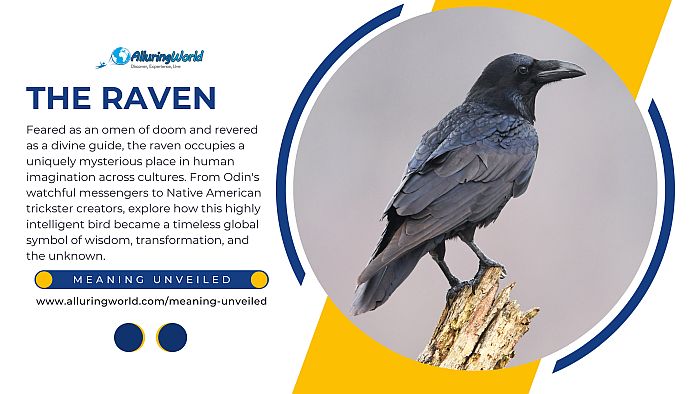
The raven is perhaps the most interesting and mysterious creature of human imagination. It has found its way into myths, folklore, and religious beliefs throughout time, and as a result, there are many symbolic meanings behind this intriguing bird. The raven has black feathers, and it is often associated with wisdom, prophecy, doom, and much more throughout the entire world. The high intelligence level and mysterious nature of this creature make it a powerful symbol for stories and rituals.
The investigation of the symbolism of the raven gives an understanding of the interpretation by different people and how the symbolic archetypes of animals have been incorporated in the spiritual and ethical perspective of man. In many cultures, the raven is simultaneously feared and admired, representing the dualism of life.
Ravens in Ancient Mythologies:
Norse Mythology:
In the Norse pantheon, the raven holds a significant place as it is linked to Odin, the All-Father god of wisdom, war, and death. Odin possessed two ravens: Huginn and Muninn, whose names mean thoughts and memories, respectively. Every day, they circled the world and returned to whisper wisdom into the ears of their master.
Also, Huginn and Muninn stand for the intellect of man, the ability to think and reason about his surroundings. The inclusion of these two in Norse mythology shows how the raven is linked with wisdom, forethought, and the enigmas of life and death. The raven thus becomes not only a divine messenger but also an embodiment of the quest for knowledge in an uncertain universe.
Celtic Mythology:
Ravens in the Celtic mythology usually symbolize creatures that are linked with war, death, and transformation. In most of the stories about Morrigan, who is a goddess of sovereignty, fate, and war, ravens usually accompany her on the battlefield. Ravens also have the power to give omens to the warriors on the battlefield.
In the Celtic view, the raven represents an entity that is between the realms of life and death, between the world of matter and spirit. The presence of the raven in myths and legends in this mythology illustrates the concept of prediction, protection, and the cycle of life.
Ravens in Native American Folklore:
In a lot of Native American cultures, the raven is seen as both a creator and a trickster. In many Pacific Northwest Indian tribes, the raven serves as an integral part of the creation story, which involves the raven bringing light into the world, creating rivers, and forming the landscape.
The two-sidedness of the raven, as a sly trickster and at the same time as a beneficent creator, indicates the complex symbolism of this bird. Ravens symbolize shrewdness, flexibility, and an ability to cope with chaos, stressing the belief that being wise implies creating as well as destroying something. Ravens in Native American stories tell people how to behave and what the outcomes of their deeds may be.
Ravens in East Asian Traditions:
China and Japan:
The raven holds greater symbolism within the East Asian culture. In Chinese mythology, for example, the three-legged crow or Sanzuzu Wuu is an emblem for the sun, depicting the presence of divinity and energy associated with the sun. The raven symbolizes the sun, where it was thought that ravens resided. This is far different from the depiction of the raven in the West, which signifies death.
In the folklore of Japan, the raven or Yatagarasu is a three-footed crow that serves as a messenger and divine guide between humanity and the gods. Yatagarasu is associated with guidance, wisdom, and interference in human affairs. The raven is portrayed in these civilizations not in an ominous manner but as a mediator between man and God.
Symbolism in European Folklore:
During medieval and early modern Europe, ravens symbolized death, bad omens, and prophesies. Ravens were mostly linked to war sites, dead bodies, and witchcraft. The black feathers and scavenging nature of ravens played a role in making people associate ravens with life and death, an idea commonly expressed in both literature and folklore.
The famous poem “The Raven” by Edgar Allan Poe is an example of a bird being a symbol of mourning, remembrance, and the mystical. In this particular case, the raven is a carrier of existential contemplation because of the inevitability of death and man’s quest for understanding the unseen realm.
ADVERTISEMENT
The Raven as a Trickster and Teacher:
Intelligent ravens have been depicted in different cultures as tricksters who engage in activities that involve deceit and transformation in their attempt to challenge the status quo. The bird plays the trickster character more prominently in stories from Native American and Celtic cultures.
In fact, this element makes the character symbolize something else; for wisdom does not come from rigidity but adaptability, ingenuity, and dealing with uncertainties. The craftiness of the raven is an educational one since it shows that survival demands intelligence and adaptability in order to perform a good job.
Raven Symbolism in Literature and Art:
The raven’s cultural importance has been widely acknowledged through literature, art, and contemporary forms of media. The artists and the writers have traditionally used the raven to denote elements of mystery, wisdom, and change. The use of the raven in the visual arts has taken advantage of the contrast between its physical characteristics and its symbolic meanings.
Symbolism in literature tends to portray the raven either as a messenger, an embodiment of death, or a guide into darkness. The frequent occurrence of this motif in different forms of media goes to show how relevant and versatile this symbol is.
Psychological and Archetypal Interpretations:
Psychologically speaking, the raven stands for the archetypes of shadow, transformation, and insight. The raven and other animal archetypes have been pointed out by Carl Jung and other analysts as having some attributes associated with the unconscious, which are intelligence and mysteriousness. The raven, when seen through the eyes of dreaming and personal symbology, can be seen as a way of saying that one must face one’s fears or gain knowledge that is beneath the surface. The duality of the raven in being both a trickster and a guide points to the connection between these two concepts.
Ravens as Symbols of Transformation and Guidance:
Transformation is one of the most prevalent themes surrounding the symbolism of the raven. In most mythologies, the raven is described as a liminal being that exists between life and death, the profane and the sacred. The liminal state makes the raven a messenger and a mediator of change.
No matter if they deliver cosmic messages, guide heroes, or teach morals, ravens reflect people’s love for mystery and ability to transform. Being depicted in myths and legends, ravens become a symbol that reminds us that it is important to have intelligence, adaptability, and thoughtfulness.
Modern Cultural Significance:
The raven continues to fascinate the world today, having been portrayed in movies, literature, and the arts as a symbol of intelligence, mystery, and spiritual perception. Ravens are mostly symbolic of environmental consciousness and the interconnectedness of all forms of life.
In our present-day symbolism, the raven could be called upon to represent guidance, change, or death. This creature’s persistence in mythology and culture reflects the common tendency of humans to bestow animals with meaning and employ them as a means through which to convey ethics, spirituality, and philosophy. The raven is even considered one of the most important birds in Bhutan, locally known as jarog. It holds a sacred and prominent position in the country’s national identity, as it even appears directly on the Raven Crown worn by the Kings of Bhutan.
Conclusion:
In conclusion, amongst mythical and folkloric creatures, there is perhaps no animal that has so many meanings as the raven. This is due to its ability to be a messenger, a trickster, a guide, and an indicator of change, which highlights the intricacy of man’s attempt to comprehend his surroundings. In myths from Norse, Celtic, Native American, East Asian, and European cultures, the raven represents intelligence, divination, transformation, and thresholds of life and death.
By comprehending the symbolism of the raven, you can realize the intricate connection that exists among nature, culture, and the human psyche. Raven’s presence in myths, rituals, and arts becomes like a mirror through which humans see their own thirst for understanding, fascination, fear, and awe of life’s enigmas. Lessons of flexibility, wisdom, and perspective become a part of human culture through the symbolism of the raven.