
Read time ca. 11 minutes
No other medieval text has provoked so much praise and discussion or played such a significant role in the culture of its time as “The Tale of Igor’s Campaign.” It was written in the Old East Slavic language and called “Slovo o polku Igoreve,” which translates to “The Word about Igor’s Regiment.” This extraordinary literary masterpiece holds a unique position in the history of Eastern Europe. While it is more than just an account of a failed campaign, the text deals with many issues like leadership, unity, loyalty, bravery, and the fatal outcome of division. Despite the events depicted in the story occurring 800 years ago, its message continues to be relevant until today.
Unlike many other medieval chronicles, which record the events that took place and those who ruled during those times, The Tale of Igor’s Campaign blends history with poetic language, vivid imagery, folklore, and symbolism of nature. The tale does not portray war just as a battle of two sides; rather, it is a morality tale of what happens when princes do not cooperate because of their individual greed. The work continues to be widely analyzed even today as one of the most popular texts in medieval literature.
Reading The Tale of Igor’s Campaign involves much more than reading about the battle, as it is important to consider the world of politics in which this epic was created, the riddle of its manuscript, and its literary genius.
Historical Background:
This tale is set amidst a time of upheaval in the history of Kyivan Rus’, a medieval confederation of principalities which existed from the 9th to the 13th centuries. While in the past Kyivan Rus’ was unified under the rule of great kings such as Volodymyr the Great and Yaroslav the Wise, it was now divided politically into rival statelets by the end of the 12th century.
There were many princes who ruled different principalities, like Kyiv, Chernihiv, Halych, and Vladimir-Suzdal, fighting with each other for land and trade, among others, and while they were fighting among themselves, they were not considerate of the forces that might attack them from outside. This made the overall effectiveness of the group in defending itself from external threats very weak, thus turning the powerful entity into one that was vulnerable to threats.
The Cumans posed another significant threat, also referred to as Polovtsians or Kipchaks, who were a nomadic Turkic tribe of horse-warriors that held sway in the broad expanses of the Eurasian Steppe below Kyivan Rus’. The Cumans’ rapid cavalry troops carried out many attacks into the frontier regions, destroying villages, taking captives, and causing many expensive military expeditions to be launched by Slavic princes.
It was in this environment of tension that Prince Igor Svyatoslavich embarked on the ill-fated campaign that was to be forever etched into the pages of medieval history.
Who Was Prince Igor?
The prince who initiated the Battle of the Kayala River was Prince Igor Svyatoslavich, who ruled the Principality of Novgorod-Seversky in eastern Ukraine. In spring 1185, Prince Igor led a military expedition against the Cumans who lived near the Kayala River due to his desire to improve his territorial security and gain political prestige among his peers.
Instead of waiting for a larger alliance to be formed from his fellow princely brothers, including the Grand Prince of Kyiv, Sviatoslav, Igor chose to act spontaneously with a smaller, local army contingent, as he wanted to show his bravery against a strong army. The quest for personal glory and honor led him to ignore the requirement of working in a collective manner, thereby laying the foundation for disaster.
The expedition had started quite well because Igor managed to win an encouraging battle against a few Cumans, capturing loot and thereby encouraging his soldiers. Things soon became worse as the major Cuman forces were mustered by Khans Konchak and Gza.
Despite being outnumbered on all sides at the steppe border due to the harsh weather conditions, Igor’s men struggled bravely for three long and difficult days. Under constant pressure from the cavalry, the Slavic army collapsed, and the battle ended in an ignominious defeat. Most of Igor’s men died or were captured, while Igor was also captured despite being injured. Even though he later managed to escape with the help of a Cuman called Ovlur and went back to his kingdom, this expedition is known less for its military outcome than for the literary masterpiece that came out of it.
ADVERTISEMENT
The Creation of the Epic:
Most scholars agree that the poem The Tale of Igor’s Campaign was written soon after the events described in it took place, probably somewhere between 1185 and 1187. The poet behind this literary work is a great enigma in European literature, although there are indications that the author was perhaps a court singer, educated warrior, or a counselor in the prince’s entourage with first-hand experience of war and diplomacy.
In contrast to medieval chronicles written solely within the confines of a monastery where history was invariably viewed through the narrow confines of providence, the work is extremely literate and secular in its scope. The author has successfully combined history with poetry, emotion, religious texts, mythology, and depictions of nature.
Not offering any partisan picture of success or failure, the author tried to analyze the reasons behind the failure of the campaign and the larger lessons that it can teach about existence. The author has majestically interwoven the historical narrative with poetic digressions and has appealed to neighboring princes to forget their petty rivalries for the sake of saving their motherland, and to look further for the other, real enemies of their lands. The result was one of the earliest and most remarkable masterpieces of Eastern Slavic literature, bridging ancient oral traditions with complex written poetic forms.
A Story About More Than War:
Although the narrative centers on a dramatic military expedition across the steppe, the work’s true focus extends far beyond the battlefield. One of the main points the author wants to bring to light lies in an urgent, impassioned political message that is addressed to the entire ruling class of medieval Kyivan Rus’.
According to the unknown author, the princes systematically undermined their own land through incessant quarreling among themselves and their own jealousy and ambition. Rather than working together to defend against common enemies, they viewed the Slavic principalities around them as rivals, constantly vying for power themselves.
The fact that Igor has chosen to conduct his campaign independently is a symbolic illustration of the flaws in such a structure. His one-man honor-seeking endeavor has ended in catastrophe, resulting in an even greater destruction of Rus by nomads. This defeat thus carries a much broader meaning, since it warns people about the danger posed to whole societies due to their internal division. The theme of the need for cohesion as the basis for existence becomes one of the key messages of the book.
Nature as a Living Character:
The most notable feature of The Tale of Igor’s Campaign is the way it portrays nature. Unlike other medieval European literary works that portray nature as a passive element in the background, in this work, nature plays the role of a living and conscious character. Before the tragic battle begins, nature offers dire omens to warn Igor of the impending doom that is before him. These signs can be seen as:
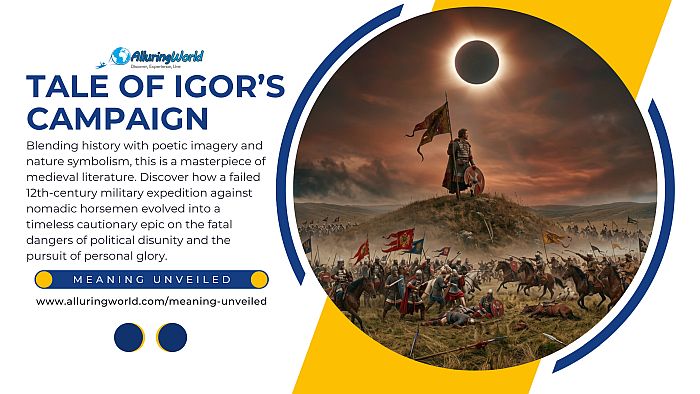
- The sun darkens into a sinister eclipse (“The sun blocked his path with darkness; night groaned with storm sounds”).
- Birds and wild animals wail across the steppe, anticipating the impending slaughter.
- Rivers, forests, winds, and the open grasslands seem to react with visceral emotion to human decisions.
These evocative descriptions reflect a dual worldview in which pre-Christian Slavic mythology seamlessly coexists with Christian symbolism. The author further invokes pagan deities like Dazhbog (the sun god), Veles (god of cattle and poetry), and Stribog (god of winds) alongside prayers to the Virgin Mary and God.
Instead of viewing these two traditions as incompatible, the poet incorporates both of them to create an intricate mosaic in which the natural universe itself becomes a part of the human struggle.
Yaroslavna’s Lament:
One of the most memorable sections from the epic is that of the lament of Yaroslavna, the devoted wife of Prince Igor. Hearing about the loss and capture of her husband, she stands on the ramparts of Putivl crying out:
“O wind, great wind! Why do you blow so fiercely? Why do you carry the enemy’s arrows on your light wings against my husband’s warriors?”
In her grief, Yaroslavna addresses her pleas directly to the forces of nature, appealing to the wind, the majestic Dnieper River, and the bright sun to protect Igor, heal his wounds, and guide him safely back from captivity.
Besides being highly praised due to its great lyrical beauty, it also enjoys popularity because of its gentle depiction of human love and faithfulness amid the harshness of war. Yaroslavna is a perfect example of eternal faithfulness, sadness, and hope, managing to survive any crisis with the power of her emotions. Her song has been an important source of inspiration for many writers, artists, and composers throughout generations.
ADVERTISEMENT
The Rediscovery of the Manuscript:
In addition to its historical significance, the material history of The Tale of Igor’s Campaign itself holds an equally fascinating mystery for posterity. For several hundred years, the manuscript was left buried in monasteries until the beginning of the 1790s, when Count Alexei Musin-Pushkin, a wealthy Russian aristocrat and avid collector of manuscripts, acquired it.
Recognizing the extraordinary literary value of the text contained within the volume, Musin-Pushkin arranged for a transcription to be prepared for Empress Catherine the Great, followed by the first printed public edition in 1800.
Regrettably, however, the actual 16th-century copy was forever lost during the Great Fire of Moscow of 1812, when Napoleon’s invading forces had possession of the city. Without the surviving 1800 printed edition and the handwritten transcript prepared for Catherine the Great, this extraordinary treasure of medieval European literature would have been permanently erased from history.
Questions About Authenticity:
Because the original physical manuscript perished in 1812, a small number of skeptics in the 19th and 20th centuries questioned whether The Tale of Igor’s Campaign might have been a sophisticated 18th-century forgery, perhaps created by Musin-Pushkin himself or the scholar Antonovsky. Authenticity questions peaked in the mid-20th century with arguments by scholars like Edward L. Keenan that pointed to possible links with the Ossianic literary tradition of the 18th century.
Nonetheless, modern linguistic research has provided ample evidence that confirms the 12th-century authorship of the work:
- Linguistic Evidence: The text makes use of highly accurate grammatical structures, archaic dual forms, and specific Old East Slavic lexicon that was not known at all in the 18th century, but only discovered by modern historical linguists at the end of the 19th and 20th centuries.
- Textual Interdependence: The text shows deep structural affinities with real texts dating back to the 14th and 15th centuries, such as the Zadonshchina, which was based on the style and imagery of Slovo. Thus, the text definitely existed long before the 18th century.
In the modern period of scholarship, there is no doubt among scholars about the authenticity of this text thanks to studies made by linguists such as Andrey Zaliznyak and Roman Jakobson.
Influence on Literature and the Arts:
The influence of The Tale of Igor’s Campaign is much wider than that of history itself. This piece of work influenced the development of literature, music, and visual art significantly. Moreover, The Tale of Igor’s Campaign was used as one of the major pieces that formed the Eastern Slavic national consciousness.
The epic poem served as an inspiration for the composer Alexander Borodin, who composed the opera “Prince Igor.” Composing the score for almost 20 years, Borodin provided the story with beautiful melodies:
- The famous “Polovtsian Dances”, taken from Act II of the opera, remain one of the most celebrated and frequently performed orchestral pieces in global classical music.
- The opera dramatizes both the tragedy of Igor’s defeat and the exotic, captivating atmosphere of the Cuman camp, creating a masterpiece of national Romanticism.
The visual artists like Viktor Vasnetsov and Ivan Bilibin were influenced by the spectacular nature of the events in the epic and the mythical aura of the story, thus creating iconic paintings.
Modern Historical Perspectives:
Scholars of our time, coming from all around the globe, examine The Tale of Igor’s Campaign using various angles of its historic significance and aesthetic perfection:
- Literary Scholars explore its poetic rhythm, narrative transformations, complicated metaphors, and folklore presence.
- Historians interpret its descriptions of military techniques, weapons used, political geography, and diplomacy with steppe tribes.
- Linguists investigate its vocabulary as one of the most important landmarks of the evolution of the Old East Slavic language.
This literary work can be said to have a special place in relation to the common history that Ukraine, Belarus, and Russia share, in that the three nations owe their cultural and linguistic identity to the heritage of the civilization of Kyivan Rus’. Even when the political background of the modern world is taken into account while interpreting the text, there can be no denial of its literary value.
The Enduring Meaning of the Tale:
Nearly 800 years since its nameless writer wrote down his words on parchment, The Tale of Igor’s Campaign still communicates clearly to contemporary readers. Its message, that societies put themselves at risk of tragedy by focusing on personal gain over responsibility, is no less relevant in 2017 than it was in 1185. The work reminds us that force alone cannot provide security to a community unless it is accompanied by wisdom, unity, and restraint. The emotional depiction of sorrow, loyalty, courage, and salvation in the epic endows it with a certain timeless quality of humanity that transcends the era within which the epic was composed.
Instead of glorifying warfare, the epic turns out to be a philosophical reflection on peace, unity, and the high cost of war. It is such qualities of the work that are likely to ensure its continued place of prestige in the literary heritage of medieval Europe for many years to come.
Conclusion:
In summary, The Tale of Igor’s Campaign is one of the most magnificent pieces of medieval literature that came from Europe and even today is a prominent cultural heritage of the Eastern Slavs. With its rich imagery, deep emotional appeal, and sharp political observations, the poem turns one unsuccessful campaign led by Prince Igor in 1185 into a timeless reflection on leadership and the price of disunity.
Though there is great tragedy in the destruction of the original physical document in the Fire of Moscow of 1812 and many years of intense debate regarding its origins, contemporary scholarship has confirmed beyond any doubt that it is a genuine 12th-century work of literary art. Its legacy lives on through literature, fine arts, and classical music, especially in the opera of Alexander Borodin, Prince Igor. Ultimately, however, the moral that can be taken from this epic is just as relevant now as it was eight hundred years ago – that greed on the part of individuals at the expense of community responsibility will lead to disaster.