
Read time ca. 4 minutes
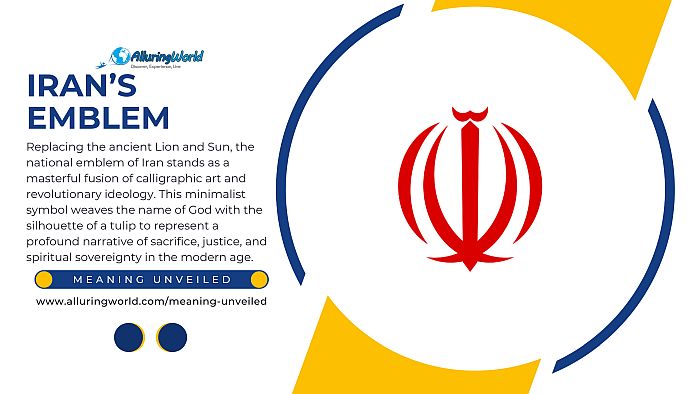
The Emblem of Iran is one of the most symbolic national emblems of the Islamic Republic of Iran, as it contains all the ideological values of the nation and serves as an embodiment of its culture and politics. The symbol was approved after the Islamic Revolution of 1979, replacing the previously known lion and sun symbol that had been appearing since the Safavid era through the Pahlavi dynasty until the 1979 Revolution. The emblem bears great philosophical, ideological, and historical significance to Iranians, but in order to understand its meaning and significance, one needs to examine its symbolic meaning, history, and ideology.
Historical Context:
Prior to 1979, Iran’s national symbol was the Lion and Sun, an ancient sign of royal power that had long been linked with Persia. In this case, the lion was symbolic of power and courage, while the sun was symbolic of knowledge and God’s blessings. In general, this traditional symbol includes a lion holding a sword behind the rising sun, combining royal power with divine light. But following the revolution, there arose a need for an additional image in the representation of the Islamic nature of Iran, and it would be applicable to the new regime that would rule the country for decades to come.
Iran’s national emblem has been designed by Hamid Nadimi, using both the symbols of the nation’s spirituality as well as its nationalism in its modern and minimalist design. It has been depicted widely on Iran’s flag, government buildings, government documents, and currency.
Design and Symbolism:
The Emblem of Iran consists of five distinct elements, where each of those elements has a different symbolic significance:
- The Central Shape: At the heart of the emblem lies the artistic rendering of the Arabic word “Allah,” (الله). This signifies the rule of God and His supremacy in governing affairs, and the emblem integrates calligraphy with geometrical shapes, consequently depicting the confluence of piety and modernity.
- The Four Crescents: These four crescents surround the central shape, forming a design that resembles a tulip. The symbolism behind this interesting design is that the tulip holds special meaning within Persian culture, since it represents sacrifice and death. The tulip is seen in Iran as a commemoration for those who gave their lives in the quest for freedom and justice.
- The Sword: The sword-like figure that stands upright from the center of the emblem represents strength, alertness, and faithfulness of the Iranian people. The message is that the principles embodied by the sword, namely justice, unity, and religious commitment, are safeguarded through bravery and perseverance.
- The Symmetry: The balanced structure of the emblem represents the harmonious balance between spiritual and secular rule. It implies that the state is well-ordered, organized, and based on religious values, which is characteristic of the Islamic Republic, where laws and morality are important.
- Abstract Minimalism: Unlike the more complex older symbols, the simplicity of the emblem helps ensure that it is both clear and easily recognizable, thus emphasizing modernism without losing its spirituality. Its simplicity also makes it flexible enough for use on flags, seals, and coins.
ADVERTISEMENT
Religious and Ideological Significance:
The Emblem of Iran has a deep connection with Shia Muslim beliefs and principles. The idea that there must be God in everything that concerns the state can be viewed as one of the most important Shia teachings. Using a stylized version of the wording of “Allah” at the top of the sword and in the middle of the emblem is a manifestation of it.
The flower-like symbol that references a tulip shape and symbolizes martyrdom is indicative of the respect Iranians have traditionally shown toward sacrifice for the cause of religion and nationhood. This design acts as a reminder about the price that is paid for freedom and ethical responsibility.
The inclusion of the sword as one of the key components of the symbol also emphasizes the need for spiritual and worldly balance, since the defense of religious and national values often demands strength, durability, and solidarity.
The Emblem in National Identity:
Iran’s emblem acts as a symbol of national identification that unites all Iranians based on their beliefs, culture, and politics. By being placed on the flag, government papers, and monuments, it conveys sovereignty and ideological continuity as well as reminds people about the nature of Iran as an Islamic republic.
The emblem is also serving as a cultural icon because it combines elements from Persian art, calligraphy, and spirituality. It is seen as a modern logo for the entire nation. After all, it symbolizes Iranian endurance, morality, and the unity of old traditions with new politics.
Global Recognition and Influence:
In the international arena, where the majority of nations have more complex and colorful coats of arms and/or emblems, Iran’s emblem stands out for its simplicity, single coloring, and most importantly, for being the sign of the Islamic Republic of Iran. Distinguished by its unique geometric and script-based design, the Emblem of Iran sends across a clear message of devotion and unity. Overall, the emblem has been used since 1979 on the international stage, on various occasions, including diplomatic, political, and cultural events.
Conclusion:
In conclusion, it can be stated that the Emblem of Iran is not only an elegant visual pattern but also a rich symbol of religion, nationality, and ethics. As one can see, the combination of the main elements of this emblem, the image of Allah, tulip-shaped crescents, and the vertical sword, means guidance, sacrifice, and vigilance. These components make up the very identity of the Iranian nation after the Islamic revolution. The elegance of this emblem is associated with the harmonious combination of elements of traditional Persian culture, Islamic religion, and symbolism of modern times.