
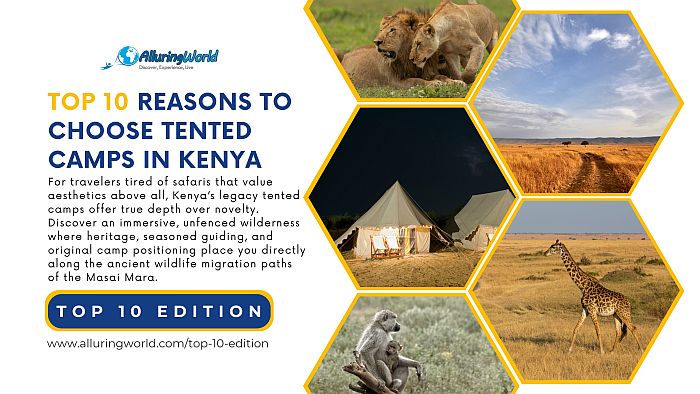
There is one type of tourist who has experienced lodges, private villas, and infinity pools overlooking the savanna. This tourist comes back to Kenya not out of lack of other choices, but simply because they have become tired of safaris that value aesthetic experience above all.
The attraction to the luxury tented camp comes from its depth rather than its novelty. Luxury canvas tents situated within privately owned conservancies abutting the Masai Mara provide what new developments do not: true proximity to wildlife migration paths, guides who excel in the craft of guiding, and an approach to camp architecture that always favors the bush.
As for those who have been on safaris before, Kenya isn’t merely a departure place anymore. Kenya represents a conscious choice of returning to something more sophisticated and knowledgeable, where heritage, naturalist expertise, and landscapes come first instead of just the quality of the linens and the wine selection. This is becoming more and more what makes a good safari.
1. Heritage Is Part of the Luxury in Kenya
The luxury of hospitality, typically, is evaluated through visibility. In safari, the most telling signs are never visible at all; they take decades to develop, rooted in the workings of the camp, the knowledge of the land of the guide, and the greeting of repeat clients without having to spell out their preferences. This is exactly the reason why tourists who assess the value of Kenya safari lodges on the basis of longevity of establishment and original site will have the best experience at Kenya’s legacy camps.
2. What Decades of Continuity Change on Safari
Camps with a legacy of being in existence through multiple generations in Kenya possess memories that newer camps cannot conjure. The guides who went through these camps picked up from their predecessors and learned the main things from the experience that the previous guides had shared with them. The pacing of the customized safari experience, the early mornings, the unexpected stops, and the wait are just some of the things that come easily with the experience, and it is not something that can be taught. This is the kind of attribute that discerning clients will refer to as trust, an attribute that money alone cannot buy, but rather proof that the safari experience is indeed something that was built throughout the decades.
3. Why Original Siting Still Shapes the Experience
Most heritage camps in Kenya existed much earlier than conservation borders had been established, or that land exclusivity was seen as a key advantage. They were placed strategically according to those with the knowledge of animal migration paths and not by map designers.
In the Masai Mara, the natural placement of the camp usually means that the camp is situated beside migration routes and rivers that new camps cannot replicate. A luxury tented camp strategically placed in such a way provides what no private game drive can give: a place that already knows how to exist in relation to the land, because in the end, the geography cannot be imitated.
4. The Setting Is Wilder Than Many Modern Lodges
The geographical location of the original tented camps in Kenya has led to the creation of a unique kind of luxury. This kind of luxury refers to more closeness to wild animals, higher levels of immersion, and greater integration with the environment. Due to the time it took these lodges to build up and grow over the years, the longer the original tented camp has been in place, the better and more realistic the experience would be.
5. Unfenced Camps Change Your Sense of Place
There exists a considerable distinction between a safari lodge and a camp where the fence between guests and the landscape disappears. Open camps on riverbanks in the Masai Mara allow you to interact with the environment without going through an intermediary. Canvas tents put the traveler in direct contact with nature through smell and sound.
The beat changes accordingly. The night noises come directly. The elephants come nearer than most lodges built today will allow. The game drive at dawn does not start by getting you transported into the habitat; rather, it starts within the habitat, where the action has already begun without waiting for you. For travelers who have sought out African safari adventures worth experiencing across multiple destinations, this quality of immersion is often what distinguishes a genuinely memorable experience from one that simply looked impressive in photographs.
ADVERTISEMENT
6. Wildlife Corridors Matter More Than Big Suites
The importance of the Masai Mara to experienced safari visitors is tied intimately to its geography. For example, the river crossings that constitute the Great Migration occur at particular points along the Mara River, which can only be reached by the camps that have traditionally stood there.
The closeness to already formed routes in the Big Five makes the entire day revolve around this proximity, right from the morning game drives to the night game drives. The camps’ proximity to these routes creates an edge in terms of location for the guides, which cannot be replicated through any other means. Overall, this experience is an immersion in the African wildlife mosaic, which experienced tourists look forward to, and not something to be said it is big in size.
7. Kenya Rewards Travelers Who Already Know Safari
There is very little appreciation shown for all of the greatness that Kenya has to offer the first-time visitor, but there are a few places that reward travelers who have already honed their instincts in the bush. After going through the well-organized, carefully maintained routine of other places, it makes perfect sense to return to the true nature of Kenya. This is a choice made by people who no longer feel the need to mark anything off a checklist.
8. Why Botswana and South Africa Set Up This Return
Both Botswana and South Africa boast some of the best safari experiences available in Africa. The private game conservancies in the Okavango Delta and Sabi Sand offer an amazing wildlife experience within the setting of a lodge environment that seems to be very refined and well-managed.
That structure suits first and second-time safari travelers well. After several such experiences, however, a certain kind of traveler begins to notice the shape of the format itself and starts wondering what exists beyond it. Kenya seems to show up at just the right time. Not as progress, but rather as a change in register, where there is more character in the camp, more weight in the guiding, and less of an imposed experience than one that is earned.
9. What Kenya Offers That Feels More Fluid
In cases where the South African conservation-based system structures a safari with regard to the lodge, the Kenyan heritage camps structure a safari according to the terrain. This can be felt rather than spoken, especially when it comes to the fly-in safari conducted in the Masai Mara and Laikipia ecosystems, which are completely different.
Laikipia offers scenery and walking safaris that are not very common at all. Masai Mara, on the other hand, provides scale, movement, and a high concentration of predatory action. For those who have experience with luxury travel across the African continent, Kenya is remembered as a place where one does not feel like they have been removed from their surroundings, thanks to the private conservancy setting.
10. Where the Model Works Best in Kenya
The Masai Mara is still the perfect example of how the original luxury tented camp was meant to operate. The camp located on the banks of the Mara River is right in the thick of the migratory route, meaning that it allows one to be spontaneous instead of driving to an organized show.
Laikipia extends this image greatly. The landscape changes from grass plains to semi-arid plateaus, and the camps in Laikipia have made themselves known through conservation research and walking safaris in a way that is quite different from the wilds of the Mara. Together, they create an itinerary with genuine contrast: two ecosystems, two camp styles, and two completely different modes of engaging with the landscape.
Tanzania and the Serengeti offer comparable migration access, and the comparisons are fair. Where Kenya’s heritage camps tend to separate themselves is in how guiding culture, camp siting, and landscape movement combine into something that feels less like a route and more like a relationship with a specific piece of land.
On balance, what attracts thoughtful tourists to return to the authentic luxury tented camps of Kenya is neither nostalgia nor romanticism but recognition. Once a person has had enough safari experiences, the distinction between the two becomes too glaring to miss.
Heritage location, heritage orientation, and heritage immersion in open landscapes cannot be retrofitted to a camp. These attributes come from the conception and positioning of the camp itself. The Masai Mara is one place where this heritage makes itself felt throughout the experience of the traveler. In Kenya, in this sense, we do not have nostalgia, but rather a more informed decision concerning luxury and safari.