
Read time ca. 6 minutes
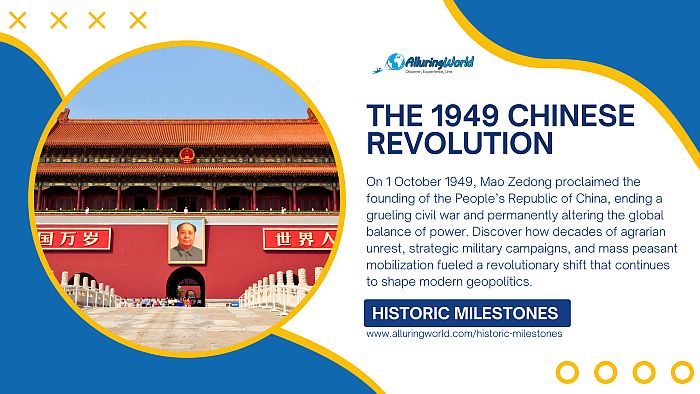
The middle of the 20th century saw many changes that took place, but none had the power of upheaval that the Chinese Communist Revolution did. On 1 October 1949, the Chinese leader Mao Zedong made his declaration from atop the Gate of Heavenly Peace in Beijing, declaring the founding of the People’s Republic of China, or most commonly abbreviated as the PRC. In doing so, the significance of this event was not simply the end of a prolonged civil war between the Chinese communists and the Nationalist government, but a complete reversal of the balance of power in Asia. This was just another point of the ideological conflicts of the Cold War era that would shape the latter part of the 20th century and would end with the start of the 1990s. As the smoke cleared after years of domestic conflict, the eyes of the world saw a country of hundreds of millions that was turning towards socialism, pushing the nationalists outside the mainland, and concentrating them on the island of Taiwan.
The Roots of Upheaval: A Nation Divided
The revolution did not emerge from a vacuum that was created after the Second World War. It was the culmination of decades of systemic decay, foreign intervention, and ideological fervor. Following the collapse of the Qing Dynasty in 1911 and the subsequent rise of the Republic of China, the nation endured the chaotic Warlord Era. In this environment of instability, two primary factions emerged as the architects of China’s future: the Nationalist Party, known as the Kuomintang (KMT), which was led by the Nationalist leader Chiang Kai-shek, and the Chinese Communist Party (CCP), which took root in 1921.
Although both parties cooperated temporarily as a “United Front” against the violent Japanese occupation in the Second World War, their ideologies for China were poles apart, as one was trying to introduce socialism as the official system, while the other was intending to introduce state-directed capitalism, land reform, social welfare, and government control of major industries, mixed with nationalism. The KMT, which was an embodiment of the feudal landlords and the urban elite class, suffered from widespread corruption and mismanagement, so it was not very popular among the rural population. On the other hand, the CCP had the advantage of its well-trained army, the Red Army, and most importantly, the mass base among the peasantry. Through the promise of land reforms, the Communists converted the grievances of the people living in the rural environments into a potent revolutionary movement. Prior to the post-WWII civil war, the CCP’s survival during the legendary Long March (1934–1935) and its subsequent decade in Yan’an allowed the party to consolidate Mao’s leadership and refine its peasant-centered guerrilla tactics.
The Three Stages of Decisive Conflict:
The civil war that followed the Japanese surrender in 1945 was an intense, three-stage struggle that would eventually seal the fate of mainland China.
- The Opening Gambits (1945–1946): During the period immediately following World War II, a power vacuum made both sides fight for strategic land areas that would bring greater control. Even though the KMT had the upper hand when it came to industry and Western support, the CCP had higher morale and better knowledge of guerrilla warfare. During this time, small battles escalated into full-fledged wars as both sides tried to gain control of the cities and transportation networks. The CCP concentrated on establishing its strength in the rural areas and created “liberated zones,” which acted as recruiting grounds for their growing army.
- The Shift in Momentum (1947–1948): By 1947, the situation began to change. The Nationalist regime was beset by problems like hyperinflation and corruption and found it increasingly difficult to sustain its logistical and command system. On the other hand, the CCP’s Red Army, which later became the People’s Liberation Army, transformed itself into a regular army that could carry out large-scale operations and could counteract Chiang Kai-shek’s army. The Communists were isolating the KMT troops in Manchuria and North China, thus depriving them of their sources of supply and strangling the Nationalist grip on the mainland.
- The Final Collapse (1948–1949): This final period was marked by a series of setbacks for the KMT. The major offensives conducted by the CCP, like the Liaoshen, Huaihai, and Pingjin Campaigns, led to heavy losses for the Nationalists. With the surrender or desertion of whole divisions, the morale of Chiang Kai-shek’s army fell apart. By the time of Mao’s declaration of the founding of the PRC at the end of 1949, the position of the KMT in China became unsustainable, thus requiring the leadership to abandon the mainland. Chiang Kai-shek and the remaining part of his government went to Taiwan across the strait, thus dividing China into two rival political units, which would continue to be present even today: the PRC in Mainland China and the Republic of China in Taiwan.
ADVERTISEMENT
The Ideology of the Masses:
One of the crucial elements that set the Communist movement apart from its Nationalist opponent was the use of mass-mobilization ideology. The leader of the Communist Party of China, Mao Zedong, synthesized classical Marxist-Leninist ideas with an emphasis on the revolutionary role of peasants.
This political philosophy was not just limited to promises of reform but was actually implemented through struggle sessions and reforms in local governance that would give the rural peasants the opportunity to confront their landlords. The CCP was able to create a very strong support base by making its objectives and the immediate needs of the agrarian community meet, such as land distribution, which was something the KMT, which was focused on urban centers, could never achieve. Alongside Mao’s political leadership, key figures such as diplomat Zhou Enlai and Red Army commander-in-chief Zhu De were vital in orchestrating the political strategies and military operations that secured victory.
Social Transformation and the New Order:
The formation of the People’s Republic of China marked the beginning of a drastic social transformation under the command of the state. The most crucial part of this social transformation included the restructuring of the ownership of the land, production, and the traditional Chinese family structure. The Chinese Communist Party acted quickly to take over properties, remove the landlords from power, and adopt state-run agriculture policies.
Although these policies were intended to address the inequalities of the past period, they took a terrible toll on human lives. In the following policies, such as the Great Leap Forward, which was an effort to achieve industrialization through forced collective farming and backyard steel production, the country would later face a terrible famine. The social chaos and violence that would later be seen during the Cultural Revolution showed the harsh reality of the friction of this quick and state-ordered transformation, and could be used as an example for future reforms to be done more gradually in other countries as well. The state was not only a government but also the creator of all aspects of human life.
The Geopolitical Legacy:
The revolution in 1949 served as one of the key triggers of the Cold War in Asia. The so-called “fall” of China into communism caused great concern in Washington and gave birth to the “domino theory,” according to which the whole continent would fall under the influence of communism. Such concerns were the main reason behind the U.S. military intervention in Korea and later in Vietnam.
Indeed, for many years, the United States practiced a non-recognition policy towards the PRC, whereas the Soviet Union offered its earliest and most important support to the new regime. Yet, the relationship between the two countries did not last long since ideological and territorial conflicts led to the Sino-Soviet split and made China become a “third force” in world politics. Nowadays, as China opened its doors to the world, the road that China has taken from being a poor agricultural country to becoming a powerful player in the world economy is one of the most widely discussed results of any 20th-century political event. In the end, the world order was broken forever, and its consequences are still felt today in international trade, military, and diplomatic relations.
Conclusion: An Indelible Mark on History
In conclusion, the Chinese Communist Revolution of 1949 did not only mean a change in leadership, but also the beginning of a new era of history for this part of the world, which would later have influence on the rest of the world. By destroying the existing socio-political system and concentrating power in the hands of the CCP, Mao Zedong was able to redirect the lives of one billion people. The reverberations of 1949 are still being heard in the present-day world, from the issue of Taiwan’s sovereignty to the aggressive foreign policy pursued by China on the international scene. In terms of history, it represents a turning point that reminds us of how internal division, based on ideology and outside influences, may affect the map of the world in one generation’s time.