
Read time ca. 9 minutes
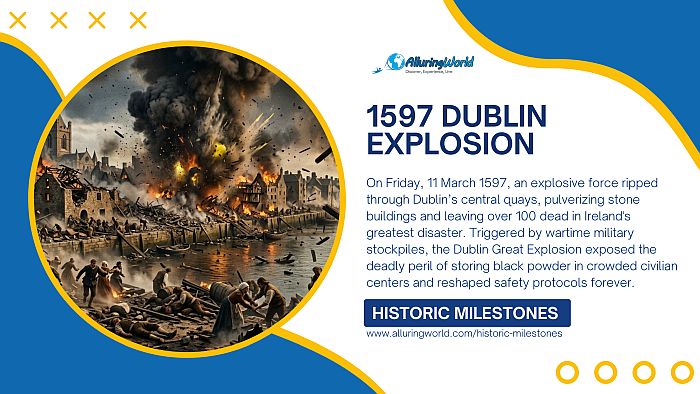
During the late afternoon on Friday, 11 March 1597, an explosion that seemed to come straight from hell shook the very core of the city of Dublin. In just moments, an immense reserve of government gunpowder exploded along the central quays of the city, leaving rubble in its wake by smashing up stone buildings, yanking down wooden structures from their very foundations, and sending large beams of oak flying over the River Liffey. The Dublin Great Explosion is considered the greatest catastrophe during the peacetime period in early modern Irish history.
Even though this disaster caused tremendous damage, it has been overlooked in many historical accounts in favor of more widespread political and military turmoil associated with the conquest during Elizabethan times. However, for historians, urban planners, and military experts, the incident in Dublin is an important landmark that should not be forgotten. The incident made evident the great danger of keeping explosives in military logistics in densely populated civilian areas.
Dublin at the End of the Sixteenth Century: An Urban Powder Keg
In order to comprehend how this disaster happened, it is essential to analyze the physical and administrative environment of Dublin in the late 16th century. During the 1590s, Dublin was a medieval town that was a walled port with approximately 5,000 – 10,000 inhabitants. It consisted of cramped lanes filled with timber-framed buildings topped with thatch and stone-built warehouses. The River Liffey was the main waterway through which Dublin could conduct its maritime business with English cities like Chester and Bristol.
Dublin acted as the seat of the English Crown government in Ireland, which was not just a trading point at that time, but it was also a garrison town. Officials of the government, foreigners, local traders, and army men had to co-exist very closely in the old city walls, so there was no room to waste and be used for nothing. This led to the practice of keeping goods, stocks of grain, and weapons in the same waterfront storerooms close to residential buildings, sometimes just a few meters apart. The risk of disaster was always imminent with such a concentration of buildings, but as at that time, safety to civilians was not a top priority; goods and weapons were kept close to residential areas.
The risk factors played a vital role in determining the urban setting of the city at that time. The structural design was made according to the medieval style around the River Liffey, which was extremely dense in structure, with very narrow exit passages from the buildings. Materials used in constructing the buildings, like oak timber frame, wattle and daub, and straw thatch, were highly flammable. This meant that there was a constant presence of high-explosive weaponry around civilians’ homes. At the same time, the firefighters relied entirely on manual bucket brigades, hooks, and hand pumps that could not control large thermal blazes.
The Nine Years’ War: Driving the Surge in Military Ordnance
What triggered the stockpiling of gunpowder in Dublin was the Nine Years’ War (1594-1603). This war took place between the army of the Gaelic alliance commanded by Hugh O’Neill, Earl of Tyrone, and the forces of the English Crown. It marked the largest and most expensive war conducted by Queen Elizabeth I. The English troops who were fighting in Ulster, Connacht, and Munster needed a lot of modern armaments like cannons, arquebuses, matchlocks, and gunpowder.
Dublin served as the main storage center for all supplies needed for the royal military campaign in Ireland. Military supplies delivered by ships coming into the Liffey docks were unloaded and stored for distribution among the garrisons in other parts of Ireland. Since there were no special fortified buildings where gunpowder magazines could be housed outside of Dublin’s city walls, officials made use of the readily available commercial buildings situated near the docks, mainly around Wood Quay, Winetavern Street, and Crane Lane.
Gunpowder in the 16th Century: Volatile Science and Unregulated Risk
The late Tudor era was characterized by the use of black powder as the most powerful explosive in the world, which contained saltpeter (potassium nitrate), charcoal, and sulfur in specific quantities. Despite its immense importance in the warfare of the time, gunpowder of the 16th century was highly unstable and prone to deterioration. It could easily be spoiled by moisture or even set off by the slightest friction or a spark.
The ignition hazard arose due to the use of saltpeter, charcoal, and sulfur in wooden barrels that were not sealed so that the powder grain could leak out. Upon contact with open flames, sparks from iron hoops, or friction, disaster followed immediately.
Moreover, quality control and storage systems were rudimentary compared to present-day ones. The gunpowder was stored in oak barrels with wooden or iron hoops, which had to be sealed tightly to prevent powder leakage. In the process of transportation across the ocean, gunpowder would leak from barrels because of the cracks between the barrel staves, spreading an explosive dust layer over the floor of warehouses and docks. There were no safety precautions; for instance, workers used iron-heeled boots, iron instruments near barrels, and they even lit candles around this space.
Friday, 11 March 1597: The Anatomy of the Blast
This accident took place somewhere in the middle of the afternoon of 11 March 1597 in the central docks area near Crane Lane. The people were busy unloading and transporting the new stock of gunpowder owned by the government, which was believed to be 140 or 144 barrels. There were reports that some of the barrels were damaged in transit and were leaking on the paved road.
Unexpectedly, without any warning, the whole pile exploded at once. Modern computer programs for calculating blast yield show that an explosion of 140 barrels of black powder is equal to an explosion of several tons of TNT. The explosion caused a sudden bright flash of yellow color, which immediately incinerated all people working in the vicinity and created a supersonic shock wave, which passed through the city streets.
The explosion consisted of three immediate stages:
- Thermal Ignition: The temperature at which this flash started was several thousand degrees, setting fire to wooden structures, clothing, and other flammable sources.
- Overpressure Shockwave: A massive pressure wave radiated outward, shattering every window within a mile, blowing roofs off stone churches, and leveling timber structures along Wood Quay.
- Debris Projectiles: Tonnes of pulverized granite, iron barrel hoops, charred timber beams, and masonry were launched hundreds of yards across the River Liffey into the suburb of Oxmantown.
Immediate Devastation: Physical Damage Across Dublin’s Quays
The effects on the infrastructure of Dublin were instant and devastating. The explosion had demolished the entire row of buildings that stood at Crane Lane, Winetavern Street, and Wood Quay. This explosion had left a smoking hole where there used to be crumbled rubble. Even the oldest buildings of Dublin had sustained damage due to the explosion.
Outside the ground zero area, the shock wave destroyed structural bases throughout the inner city. Massive stone city gates were knocked off their hinges, and many homes were crushed by collapsing walls, with inhabitants buried beneath heaps of debris. The explosion was so powerful that its rumble was noted to be heard miles away in the Wicklow Mountains, as well as by residents of Oxmantown beyond the Liffey River, where debris fell through their ceilings.
ADVERTISEMENT
The Human Cost: Casualties, Trauma, and Community Impact
There was never a greater human cost to a catastrophe in an Irish urban settlement than that of the Great Explosion. There were official figures that revealed at least 126 casualties within a short while of the accident occurring, but the actual number could have been greater, considering the unreported dead laborers and soldiers, and those who died from their injuries or burns. A population of 8,000 experienced the tragic death of 120 individuals in a single second, leaving devastating pain throughout the city.
From reports made by the Tudor authorities, it is clear that the ground zero direct blast impact accounted for the death of 30 to 40 crown laborers and porters. Structural collapse and flying fragments took the lives of an additional 60 to 70 people, members of the local populace from the adjacent residences. Additionally, 15 to 20 military personnel stationed at the quay lookout posts were among the fatalities.
There were victims at all social strata in Dublin, from the rich merchant who ran a business on the riverside to the poor laborer who worked at the docks, and to children who played around the alleys. Entire families living in the upper parts of quay shops were instantly killed in the blast. The local medical system, comprising only barber-surgeons and apothecaries, could not cope with the number of victims.
Rescue, Recovery, and the Threat of Secondary Fires
The smoke created after the blast, immediately after the explosion, clouded the whole city and left the survivors blind. People thought initially that the Gaelic soldiers had stormed into the city or that there was an earthquake; however, once the smoke cleared, the locals went into action to save people trapped under the rubble of collapsed buildings.
A secondary wave of fires started breaking out everywhere in the quay area, using broken wood frames, broken hearths, and dry straw as fuel sources. Since Dublin had no firefighting service at all at this point in time, its citizens used a human chain of buckets that would go back and forth between the River Liffey and the burning fire to ensure that the fire could not spread to any other parts of the city.
Investigating the Cause: Accidental Ignition vs. Sabotage
The Crown government initiated a formal investigation into how an explosion of that magnitude occurred, given the fact that the Nine Years’ War was still ongoing, as well as many Gaelic sympathizers who lived within the urban centers.
But there is strong evidence to show that negligence and improper handling led to a catastrophic outcome. There were three primary hypotheses developed regarding the possible cause of the explosion:
- The Iron Hoop Spark Theory: The friction created when iron-hooped barrels were dragged or rolled on granite paved stones resulted in ignition of the trails of the powder left on the quay.
- The Open Flame or Smoking Pipe Theory: An accidental fire caused by sparks from the burning pipe of a worker or lanterns used in cargo inspection.
- Drop Impact Detonation: Physical shock caused by dropping a heavily damaged, leaking powder cask onto hard cobblestones during unloading.
Ultimately, no evidence of deliberate sabotage was ever established. The inquiry concluded that the disaster was an avoidable industrial accident caused by dangerous logistics protocols in a civilian area.
Evolution of Ordnance Storage: Long-Term Reforms and Legacy
This 1597 explosion of great magnitude became a rude awakening for military planners and civic authorities throughout Europe. The degree of devastation demonstrated the incompatibility of keeping large stores of explosives within city limits from a safety point of view. Over the years to follow, the English administration underwent a comprehensive change in its logistics strategy.
During the 1590s, ordnance was kept within the congested urban quay areas and the business areas of the towns. After the Great Explosion of Dublin in 1597, the authorities of the 17th century transferred the explosives into remote stone towers on the town walls and other fortifications away from the city. Later on, in the 1700s, the military standards called for brick-built magazines.
The following design of military magazines was made with these special safety features in mind in order to keep the magazines dry, protect them from explosions, and ensure that there would be no civilian housing within a certain radius of the area. The valuable experience gained on Wood Quay was used for designing famous military magazines like the Royal Magazine in Phoenix Park, Dublin.
Conclusion:
In conclusion, the Great Explosion in Dublin in 1597 is certainly a defining moment in early modern history as it provides a real-life instance of the dangers that arise when there is an uncontrolled development of military technology without proper regard for the rules of safety.
Over 400 years later, this 1597 explosion gives us valuable lessons on military logistics, city defenses, and how modern risk management started. It is a timeless lesson that any form of technology, whether the technology used in the sixteenth century, such as gunpowder, or the twenty-first-century industrial technologies, should be matched by safety procedures to protect the citizens.