
Read time ca. 7 minutes
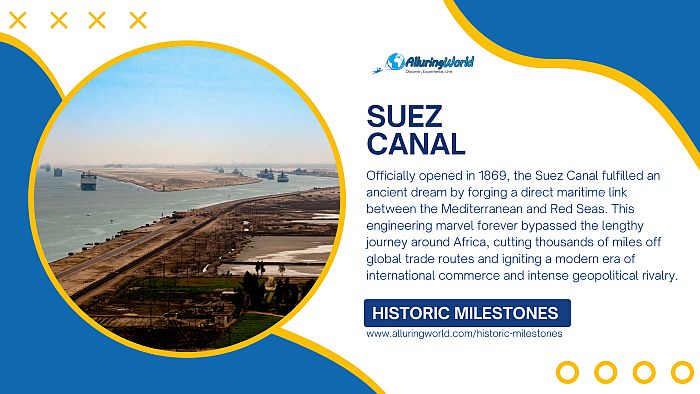
There was always the idea of connecting the Red and Mediterranean Seas, and throughout the centuries, people have been talking about how to make that a reality. This reality was officialized in 1869 with the opening of the Suez Canal, and it marked an entirely new sea route that shortened the shipping routes from Europe to India. The Suez Canal is a remarkable accomplishment in engineering that has been accomplished in Egypt and stands out as a milestone in international business and politics. The canal cuts off the time spent traveling from Europe to the Indian Ocean, obviating the need to take a roundabout route around the southernmost point of Africa. When the canal was opened, it marked the dawn of a new era of international commerce, colonial expansion, and strategic military planning, thus cementing Egypt’s position as a key junction in global maritime networks.
However, its importance was not confined to the engineering aspect alone, but rather it became a symbol of the aspirations of the industrial nations of the nineteenth century. This importance reflected globalization and the convergence of different factors like economics, politics, and technology, but most importantly, it changed the geopolitics of the region and drastically affected European imperialism as well as global trade.
Historical Context: The Need for a Maritime Shortcut
Prior to the building of the Suez Canal, the waterway was much longer because it had to encircle the continent of Africa. Nations in Europe looking to trade with nations in Southeast Asia had to navigate via the lengthy route passing by the southernmost tip of Africa through what is known as the Cape of Good Hope. Not only did such a journey take quite some time, sometimes months, but it was also risky because of piracy and inclement weather conditions. The need for an alternate, easier-to-navigate water passage became apparent in the 19th century.
The concept of linking the Mediterranean Sea to the Red Sea through an artificial waterway had been floated since antiquity. One of the greatest statesmen in European history, Napoleon Bonaparte, also thought of the possibility of building the Suez waterway and studied its feasibility when he undertook his campaign in Egypt towards the close of the 18th century. He realized the strategic importance that the canal would provide France, apart from its economic advantages. With technological developments in the field of engineering, surveys, and digging by the mid-19th century, the Suez Canal became a possibility, consequently culminating in the creation of the Suez Canal Company.
Ferdinand de Lesseps and the Canal’s Construction:
The main individual who initiated the creation of the Suez Canal was Ferdinand de Lesseps, a French diplomat and engineer. Born in 1805, de Lesseps possessed some experience in working on large projects and in negotiating. This helped him significantly because he was able to persuade the government of Egypt and also find European investors for his project. In 1854, de Lesseps signed a concession with the Khedive of Egypt, Sa’id Pasha.
The construction work started in 1859, but as soon as it began, the work encountered many problems, such as difficult terrain, high temperatures, diseases, and logistical problems. Thousands of workers, mainly Egyptian laborers, but also foreign laborers, worked in difficult circumstances, as would have been expected in the region and time period. Steam dredgers were invented for excavation purposes, and large amounts of sand were excavated, making the canal about 164 km (102 mi) long. Although there were some delays due to financial problems, progress was made gradually, and the canal was finally opened to traffic on 17 November 1869.
The Canal’s Engineering and Design:
Since its opening to today, the Suez Canal has been considered one of the most incredible achievements of engineering in the 19th century. Spanning from Port Said in the Mediterranean to Suez in the Red Sea, the Suez Canal permitted the transit of sizable commercial ships, consequently revolutionizing shipping at the turn of the 20th century. The construction required the excavation of huge amounts of sand and rocks to form a navigable channel with artificial banks and locks, but the engineers worked out the kinks and made sure the Suez Canal would remain usable for decades to come.
Unlike any other canals during its time, the Suez Canal did not need elaborate locks since both the Mediterranean Sea and the Red Sea were almost on the same plane. Despite this detail, the canal still needed constant monitoring to maintain proper depth, widen some areas, and control tide flow. Originally, the canal was about 8 m (26 ft) deep and 22 m (72 ft) wide, enabling most ships from that period to sail through, while subsequent widening made way for larger ships.
ADVERTISEMENT
Economic and Commercial Impacts:
As soon as the canal was opened, it immediately brought about a complete change in international trade because ships traveling from Europe to Asia would cover a shorter distance and would be economically justified. For instance, the distance that was covered when shipping goods from London to Mumbai using the route through the Cape of Good Hope would be reduced by an average of 7,000 km (4,350 mi).
When the European nations saw this important detail, they immediately grasped the significance of the economic benefit of the water route, and the Suez Canal rapidly emerged as an integral part of world trade. The construction of the canal led to the development of port cities like Port Said and Suez, further creating numerous business avenues for the region. It also gave a strategic edge to Egypt as it positioned itself as an essential link between Europe, Africa, and Asia.
Geopolitical Significance and Colonial Interests:
Regardless of the details above, the strategic value of the Suez Canal was not limited to trade alone. The canal soon became a major bone of contention among rival imperialist nations that vied for control over its waters and use as a means of accessing power and influence in the area. Great Britain, seeing the importance of the canal to its journey to its colonial possessions in India and Asia, was especially interested in ensuring the security and smooth running of the canal.
The canal’s location further affected the political dynamics of the region and international affairs, so whoever owned the canal would have greater control, and thus it was used to facilitate colonial conquests and military movements. The Suez Canal was quite important during the two World Wars, since the canal played a crucial role by allowing the speedy transportation of troops and materials.
Social and Cultural Impacts:
The impact of the Suez Canal extended to several social and cultural changes that arose from its construction and operations. This was because there were many people involved, ranging from Egyptian workers to European engineers, as well as other immigrants. This led to a situation where there was a lot of social and cultural interaction, cultures would mix, and everyone would be able to influence each other.
From a cultural perspective, the canal represented the creativity of humans and the potentialities of modern engineering technology. Overall, the Suez Canal was an inspiration to other similar projects across the world, for example, the Panama Canal, which used it as a measure of success in civil engineering and cooperation between nations. In its inauguration ceremony in 1869, there were many distinguished guests from various countries, including kings and diplomats.
Long-Term Legacy:
Even though it was built a long time ago, the Suez Canal still plays an essential role in world trade and international relations after more than 150 years since its construction. Its construction has set a new precedent for mega projects whose main purpose is to change the economic and geographical environment, and would bring more benefits to the country that does the mega project. The most important role of the canal to this day is the link it brings to global trade and serves as a channel through which billions of dollars in cargo pass every year.
Geopolitically speaking, the canal is still an important factor to be considered in the strategic calculations that go into warfare and conflict, emphasizing the continued importance of controlling crucial choke points in international commerce. The presence of the canal itself is proof of the connection between technological progress, economic growth, and political power.
Conclusion:
If we ever have to wrap things up, we can say that the opening of the Suez Canal in 1869 will be considered a turning point in history, as it changed the face of international business, geopolitical relations, and technological development in general. The fact that this channel linked two seas and helped shorten travel distances and improve commercial activity contributed to increasing Egypt’s strategic significance. With all his efforts, Ferdinand de Lesseps and thousands of workers accomplished this goal.
The Suez Canal thus stands out as an example of how ambition, creativity, and world-changing events are interconnected, showing how infrastructure changes history. The canal’s significance is still felt today in its role as an essential channel for international trade, a testament to the creativity of the industrial era, and a reflection of the power of human creativity in creating new connections between nations. The opening of the Suez Canal was a pivotal point in the history of Egypt and the entire world.