
Read time ca. 8 minutes
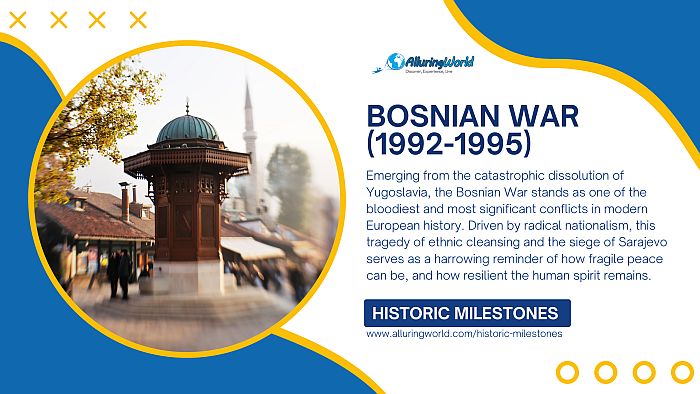
The Bosnian War, which took place from 1992 to 1995, stands out as one of the bloodiest and most significant wars in the history of Europe. This war took place in the center of the Balkan region after the dissolution of Yugoslavia, revealing how volatile the coexistence of multiple cultures and civilizations is if exploited by radical nationalists. Bosnia and Herzegovina, with its long history of intermingled cultures and religions, became a theater of an ugly war involving ethnic cleansing and even genocide.
The war in Bosnia was not simply an outbreak of violence but something much more, with roots in history, identity, power, and fear. Understanding the war in Bosnia means understanding the way political failure, nationalism, and hesitancy on the world stage brought about human tragedy of the worst kind, but also how the same people survived and continue to reconstruct themselves against overwhelming odds.
The Historical and Political Roots of the Conflict:
The case of Bosnia and Herzegovina in the former Yugoslavia was unique because, unlike others, it consisted of ethnic groups in roughly equal proportions. The Muslim population of Bosniaks, the Orthodox Christian Serbs, and the Catholic Croats co-existed within one republic in a manner that had evolved over several hundred years of Ottoman and Austro-Hungarian rule.
After World War II, Yugoslavia became a federation which was headed by its lifelong President Josip Broz Tito. His rule ensured that nationalist sentiments were curbed by a central government and unified Yugoslavian nationality. The situation prevailed until 1980 when Tito passed away, and ever since then, there have been gradual signs of disintegration. Throughout the 1980s, the economy of Yugoslavia had weakened significantly; unemployment rates increased; and there was disparity between the different regions.
As communist regimes crumbled in Eastern Europe by the end of the 1980s, Yugoslavia was not exempt from a similar pattern of events. Politicians resorted more frequently to ethnic rhetoric to ensure their dominance over the local and national politics. In Serbia, for example, Slobodan Milošević promoted nationalism, whereas in Croatia, Franjo Tuđman sought separation from the federal state. Bosnia and Herzegovina, which was composed of people from several distinct ethnic groups, found itself facing a difficult decision, and considering the people living in the country were a mix of different people with ties to certain neighbors, it was in a very difficult position.
Independence and the Slide Into Violence:
At the beginning of 1992, Bosnia and Herzegovina conducted a referendum for independence from Yugoslavia. The initiative was supported largely by Bosniaks and Croats, whereas most Bosnian Serbs opposed the decision, considering themselves to be at risk of marginalization as well as being severed from their connection with Serbia. Due to the major differences between these people, the civil war soon began, and it was followed by the recognition of Bosnia’s independence on 7 April 1992.
Military operations were conducted by the Bosnian Serbs, backed by what remained of the Yugoslav People’s Army along with the political elites in Belgrade. The entire motivation for this was not just a simple conquest for territory, but it was far more than this. In order to create ethnically pure zones, intimidation tactics, forced deportations, detention centers, and massacres were employed to eliminate non-Serbian people from their intended targets.
This abrupt transition into war disrupted life for everyone throughout Bosnia and Herzegovina. Villages that had been peaceful, neighbors living together for decades without thinking of their neighbor’s ethnicity, and functioning for years, became battlefields within hours. Families were left no choice but to pack up their belongings and evacuate their homes and their lives behind them. What was once seen as “Brotherhood and Unity” was instantly gone, and everyone was seen as the enemy that might be assisting the opposite side.
Ethnic Cleansing as a Systematic Strategy:
Among the distinctive features of the Bosnian War is the systematic use of ethnic cleansing as a form of warfare. In contrast to regular wars, which target opposing armies, in this war, civilians were victimized based on their ethnicities. The process involved mass deportation and intimidation in an attempt to change the ethnic demographics of a particular region.
Throughout the country, villages were evacuated by means of intimidation, murder, and vandalism. Internment camps were set up where civilians were subjected to torture, famine, and hard labor. Historical and religious monuments such as mosques, churches, libraries, and burial grounds were demolished to try to erase all evidence of the existence of the people who once lived on that land.
It should be noted that sexual violence was systematically employed by all sides, especially towards women, as an instrument of warfare. This form of aggression was not designed just to intimidate people individually, but whole families and communities. Later on, this aspect became pivotal for prosecution and the global perception of crimes against humanity and war.
The Siege of Sarajevo: Life Under Constant Threat
The attack on Sarajevo is the most vivid representation of what the Bosnian War entailed. In April 1992, the city was surrounded by artillery and snipers stationed on hills around it, and this was a siege that was not seen anywhere else. The citizens were living with fear for about four years, making this siege the longest one on record for any capital city.
Throughout these four years, the citizens of Sarajevo have been under constant shelling that struck civilian zones, markets, educational institutions, and hospitals. With the ongoing struggles to survive, Sarajevo citizens had to endure the scarcity of water, electricity, food, and medicines. When they were walking on open streets, this would attract snipers, and someone would lose their life. The most notable example of this is the “Romeo and Juliet of Sarajevo.” On 13 May 1993, Admira Ismić and Boško Brkić were crossing the Vrbanja Bridge when a sniper opened fire on them and killed them that day. There were only two people who were trying to endure the harsh reality everyone was living in, and they were killed while holding hands.
However, despite all of the circumstances, civilian resistance assumed some astonishing forms. There were cultural performances that took place underground in basements and shelters, art, music, and literature found no rest, but rather were used as means of resistance through creation. Overall, this resistance became an extremely important symbol of dignity amid adversity, showing how identity can live on in the absence of survival.
ADVERTISEMENT
Srebrenica and the Crime of Genocide:
The most shocking act of atrocities committed during the Bosnian War was committed in Srebrenica in July 1995. This city had been declared a “safe zone” by the UN because it had been under attack from Bosnian Serb soldiers who took over the area and executed more than 8,000 Bosniak males.
The victims were stripped of their right to live within their homes and taken to the location of their executions and eventually buried in mass graves. To conceal this crime, their remains were moved to other sites. What took place was finally declared genocide by the international judicial system, and this constituted the largest act of mass killing in Europe since WWII.
The tragedy of Srebrenica served to underscore the dangers of insufficient protection and indecision. It came to serve as a crucial moment in global consciousness and prompted a serious reconsideration of peacekeeping missions as well as the moral obligations of the international community.
International Response and the Road to Peace:
For most of the time during the war, international intervention was delayed and restricted. UN peacekeeping troops were sent to the region, but they had to work within stringent guidelines, which hindered their protection of civilians. Peace talks continuously failed amid growing violence.
However, by 1995, increased international pressure and instability in the region had brought about necessary actions. NATO forces launched air strikes against Bosnian Serb military targets, creating a new balance of power and making it possible for talks to begin. Talks led to the signing of the Dayton Peace Accord in December 1995 at Dayton, Ohio.
This peace accord stopped the violence and made sure that there was only one state, Bosnia and Herzegovina, split into two different political entities, roughly 51% of the territory to the Bosniak-Croat Federation of Bosnia and Herzegovina and 49% to the Bosnian Serb Republic, commonly referred to as Republika Srpska. This entire process created a complex, decentralized power-sharing structure, which can sometimes be very difficult for the country. Even though the treaty was successful in ending the war, it was also very complicated and created divisions among the people along ethnic lines.
Human Cost and Long-Term Consequences:
The Bosnian War resulted in an estimated death toll of 100,000 people and the displacement of over two million individuals. Communities became fragmented as refugees dispersed to various locations worldwide, contributing to one of the biggest refugee problems in the late 20th century. The task of reconstructing life had to be confronted by survivors who returned to their homes, but the return process was complex, partial, and varied significantly depending on the region.
Besides this, the issue of postwar justice became an important concern for all the parties involved. The International Criminal Tribunal for the Former Yugoslavia indicted those guilty of war crimes, crimes against humanity, and genocide. Through these prosecutions, several important judicial precedents were set, and it was firmly established that such crimes were punishable under international law.
Psychological wounds from the conflict continue to show even to this day. Generations have grown up scarred by the experiences of displacement, sieges, and sorrow. Memorials, museums, and various educational programs have become very important in remembering, refuting denial, and encouraging dialogue.
Bosnia and Herzegovina Today: Memory, Identity, and Renewal
Bosnia and Herzegovina in the present-day world is a country of many paradoxes. The towns of this country are a manifestation of many historical influences, ranging from architecture built under Ottoman domination to new streets laid down after World War II under Austro-Hungarian dominance.
Museums like the War Childhood Museum and the Srebrenica Memorial Center provide a highly personal outlook on the war, concentrating more on individuals than on numbers. They are important places to visit when you are looking to learn about the past because of their educational role.
Overall, even though Bosnia remains an attractive destination for those who wish to learn about resilience and the human spirit, if you decide to visit this country for the history that was endured during the 1990s, then this journey will make you understand how people can persist, adapt, and progress after a grand tragedy.
Why the Bosnian War Still Matters:
The effects of the Bosnian War on international attitudes towards prevention, intervention, and post-conflict justice have been profound. The speed at which peaceful coexistence can be unraveled by the fear and nationalism that supersedes conversation was made abundantly clear. However, it also showed incredible fortitude in the face of horror.
To those who have an interest in history, human rights, and contemporary conflicts, the Bosnian War provides invaluable learning experiences, which should not be ignored so that they won’t be repeated in the future. The Bosnian War is a constant reminder that peace is never assured, that memory plays a role, and that knowledge of history is crucial for avoiding future tragedies.
Conclusion:
In conclusion, the Bosnian War can be described as a historical event that occurred within a region that was peaceful after the great devastation from WWII, but it is also an event that is an important part of contemporary history. This particular event clearly demonstrated the negative results associated with political division, ethnic extremism, and delays in providing an international response. In addition, the impact of the Bosnian War is described through destruction, resilience, trauma, and memory; therefore, by analyzing the Bosnian War, you may gain an understanding of how fragile peace actually is as well as learn more about human resilience and strength.