
Read time ca. 8 minutes
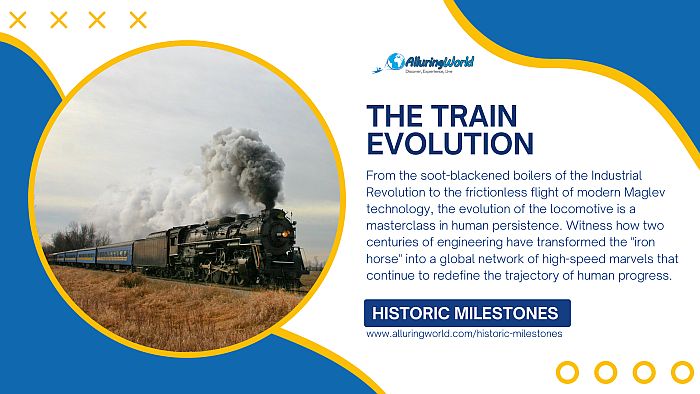
The development of the locomotive is a masterclass in human persistence, representing a two-century-old pursuit to conquer the physical constraints of distance. This evolution did not occur in a vacuum, but it was a systematic progression from the gritty, coal-fired mechanics of the Industrial Revolution to the sleek, well-intended aerodynamically optimized marvels of the modern, digital age. By moving through distinct technological eras, starting with the steam, then moving to the diesel, electric, and ending with the high-speed for now, engineers have successfully shifted the train from a localized industrial tool to a global network that changed how we are moving today around the world. If you are able to understand the history of trains, then you can understand the trajectory of human progress itself, because each breakthrough in propulsion and track design has fundamentally redefined how we connect cities, economies, and cultures.
The Dawn of Steam: Fire and Iron
The genesis of rail transport began not with passengers, but with the heavy industry of the early 19th century. Early pioneers like Richard Trevithick and George Stephenson recognized the potential of using the low-friction capabilities of iron tracks alongside the high-pressure steam to transport heavy masses. The success of the “Rocket” locomotive was demonstrated during the Rainhill Trials of 1829, marking the era of steam supremacy, and since then, the trains have advanced drastically.
During this era, locomotives were very rudimentary, but for that period of time, they were considered revolutionary. Engineers focused on the fire-tube boiler, which allowed for a greater surface area for heat exchange, turning water into high-pressure steam that drove pistons connected to massive iron wheels. These machines were visceral and demanding, requiring a constant supply of coal and water, yet they succeeded in linking industrial hubs like Manchester and Liverpool, forever changing the economic landscape of Britain.
By the mid-1800s, the “Railway Mania” had taken hold. Throughout the First World countries, the rail networks expanded, and they moved across continents. Because the engineers mastered the art of tunneling through mountains and bridging vast valleys, the trains were unstoppable and could go through different landscapes. The introduction of the bogie, which is a pivoting truck that allowed longer locomotives to navigate curves, enabled larger and more powerful engines. This period established the foundational infrastructure of the modern world, proving that land travel could finally compete with the speed of coastal shipping.
The Golden Age of Rail: Luxury and Logistics
As the 19th century gave way to the 20th, steam technology reached its zenith. This was the era of the great express trains, where speed became a marketing tool and a point of national pride. Locomotives changed significantly and were turned into streamlined giants that broke or set records, such as the Mallard, which set a world speed record for steam that remains unbroken to this day. But, as the years passed, the focus shifted from mere transport to the quality of the journey itself.
Passenger comfort became paramount during this period, and with the introduction of dining cars, sleeping berths, and climate control, the trains transformed into a “palace on wheels.” It was during this height of rail travel that iconic routes were solidified. Travelers began to rely on the train from Edinburgh to London as a vital artery for commerce and governance, turning a grueling multi-day carriage ride into a swift, overnight journey characterized by professional service and punctuality.
Technologically, this era saw the refinement of the “Walschaerts” valve gear, which allowed for more precise control over steam injection. Steel took the place of iron, which allowed trains to carry more loads at higher speeds. Although there was stiff competition from internal combustion engines and even from aviation, railways were still seen as the major players in logistics around the world, capable of transporting millions of tons of goods.
The Transition to Diesel and Electric Power:
The need for thermal efficiency drove the decline of steam. While the steam locomotives were very iconic and some are used today as tourist attractions, they were incredibly wasteful, losing nearly 90% of their energy as heat. Following World War II, the rail industry pivoted toward diesel-electric and pure electric traction. Diesel-electric engines acted as mobile power plants, using an internal combustion engine to turn a generator, which then powered electric traction motors on the axles.
Electric trains, however, represented the true leap forward in power-to-weight ratios. Because they got their energy from overhead wires or from a third rail, these locomotives did not need any fuel at all. They could therefore accelerate more rapidly and run more cleanly within city limits. But the move from steam to electric energy represented much more than a change in propulsion. That was seen as a revolution in railroad engineering, which continued to improve with the decades and inspired engineers to invent even better trains.
Still, this period saw the birth of integrated international networks and infrastructure that continued to be laid for journeys that would eventually bypass the traditional barriers for that time, and would connect countries on different continents, i.e., the Orient Express that linked Paris and Istanbul. Still, the concept of a seamless London to Paris train service began to move from a dream to a technical possibility as engineers researched ways to link the United Kingdom to mainland Europe. The focus on electrification meant that trains could finally operate at high speeds for sustained periods without the mechanical fatigue associated with reciprocating steam pistons. This was achieved especially with the construction in 1988 of the rail connection underneath the La Manche (English) Channel, as London and Paris were linked by train, and they are today only 2 hours away by train.
ADVERTISEMENT
The High-Speed Revolution: Defying Friction
The modern era of rail is defined by the “Shinkansen” philosophy, which originated in Japan in 1964 and quickly spread to Europe. High-speed rail (HSR) is not just a faster train; it is a dedicated system. To achieve speeds exceeding 300 km/h (186 mph), engineers had to design specialized tracks with wide-radius curves and sophisticated signaling systems that could communicate with the train faster than a human driver could react.
The aerodynamics of these trains are inspired by aeronautical engineering. The so-called “nose” of the train serves to control pressure waves, especially while traveling through tunnels, to avoid “tunnel booms.” The trains have regenerative braking systems, which means that when the trains brake, the motors behave like generators, supplying electricity back to the network. High-speed rail is one of the most environmentally friendly transportation modes invented.
In the present day, the only real competition for short-range air travel is high-speed rail travel. The accessibility offered by station-to-station service has made these forms of transportation highly valued by business travelers. The technical challenges involved in sustaining such high speeds include advanced suspension systems and cutting-edge metallurgy for the tracks themselves.
The Future: Maglev and Beyond
As we look toward the future, the goal is to eliminate friction entirely, and this is where the Magnetic Levitation (Maglev) technology comes into the picture. The Maglev technology uses powerful electromagnets to lift the train off the guideway and propel it forward, without any contact between the vehicle and the track. For the Maglev, the only limiting factor to speed is air resistance. Experimental Maglev trains have already clocked speeds exceeding 600 km/h (373 mph), promising a future where continental travel is measured in minutes rather than hours.
Beyond Maglev, the “Hyperloop” concept proposes placing these pods inside low-pressure tubes. By removing the majority of air resistance, these vehicles could theoretically reach supersonic speeds. While still in the testing phase, the pursuit of this technology shows that the human drive for faster, more efficient connectivity has not waned since the days of the first steam puffers.
The evolution of the train is a testament to human ingenuity. The railway is an emblem for progress, from its soot-blackened origins in the nineteenth century to its advanced computers of today. It is a network that persists in making the planet smaller through the beauty of physics and the strength of the rail.
Conclusion:
In conclusion, the train from its inception as the loud steam engine in 19th-century England to the modern-day prototype Maglev train has retained its prominence in the development of sustainable transport. Over time, the train has become more than a cumbersome, mechanical system, becoming an electronically controlled means of sustainable transport that also emphasizes speed. While envisioning a world where people use vacuum tubes with no friction whatsoever for transportation, the history of the railway is an example of continuous innovation, demonstrating that there is still no better way to transport humans than by using the iron horse.