
Read time ca. 13 minutes
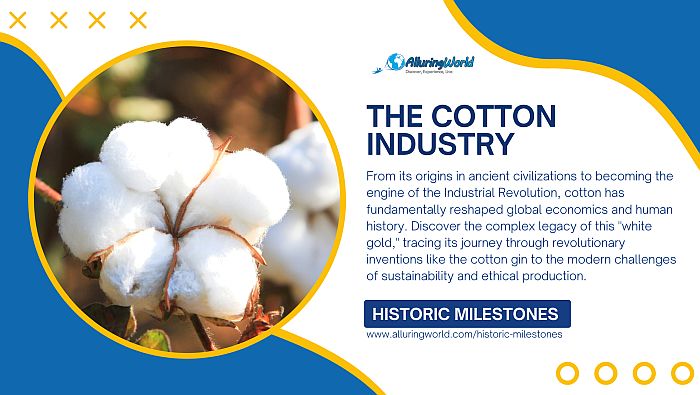
At present, cotton is one of the most significant economic and sociological factors to have emerged in the course of human history. From being grown as an agricultural product used for hand-spinning into fibers to becoming the driving force behind the globalization and industrial revolution, the history of cotton includes all aspects of human endeavor. From growing and harvesting cotton to spinning it and weaving it into various fabrics, cotton has been experimented with, exploited, reinvented, and transformed time and again throughout the centuries.
Cotton’s importance lies in its versatility and comfort as a textile, as well as in the vast networks of production it created. Interconnections between the fields, factories, ports, and markets paved the way for today’s globalization. Development of the industry reflects the combination of impressive successes and tragic sacrifices, which makes the topic of particular importance for people studying economic and industrial history.
Early Origins of Cotton Cultivation:
Cotton was independently domesticated in several regions of the world thousands of years ago, including the Indus Valley, parts of Africa, and the Americas. Early societies valued cotton for its softness, breathability, and adaptability to different climates. There is archaeological evidence that shows that ancient civilizations cultivated, spun, and wove cotton long before it reached Europe, and they also developed techniques that allowed fibers to be transformed into durable cloth.
In these early stages, cotton production was limited, and it remained at that time as a small-scale and labor-intensive process. Farmers harvested bolls by hand, separated fibers from seeds manually, and spun yarn using simple tools such as spindles. To make this raw material into something that would be perfect for making clothes, the cotton was woven within households or small workshops, thus making textile production a localized craft, which would allow each place to add its own unique design, rather than a centralized industry.
In addition to this, trade played a crucial role in spreading cotton beyond its original growing regions. Merchants carried cotton textiles along established trade routes, introducing new markets to the material. These exchanges gradually increased demand, encouraging wider cultivation and experimentation with improved methods of processing and weaving.
Cotton Reaches Europe and Expands Global Trade:
In Europe, before the advent of the Industrial Revolution, wool and linen were the primary sources for textile production, while cotton was an imported material that was considered somewhat of a luxury. With the growth in trade relations between Europe and Asia, the demand for cotton materials increased among European consumers, and slowly, cotton was starting to take its primary place. One of the most popular options with cotton at that time was the printed variety of cottons, which was especially popular because of its bright color and intricate designs. In contrast, wool and linen were mainly limited to solid and somewhat dull colors, whereas cotton allowed for clothes to be slightly different and bring a variety of designs into daily life.
This rising demand prompted European merchants to seek greater control over cotton supply, and trading companies had to establish routes that linked raw cotton producers with textile markets. This laid the early groundwork for global supply chains, which nowadays have been perfected, and you can get cotton raw material from the furthest place on Earth and have it in your home within days of ordering. Still, cotton textiles became a symbol of status and comfort, gradually transitioning from elite luxury to a widely sought-after commodity.
With rising demand, the European governments started promoting cotton cultivation and production within their own territories. Legislation and investments helped in developing indigenous industries, paving the way for the revolutionary transformation in industry to come in the future Industrial Revolution.
Raw Cotton Production and Agricultural Transformation:
Because cultivating cotton needs certain ecological requirements such as warm temperatures and plenty of water, the increasing demand for cotton has led to large swathes of land being used for cotton farming, especially in the continent of North America. The effects of this shift in agricultural practices were widespread, and the continent was reshaped into a system of massive scale that could produce large quantities of the material.
Plantation-based cotton production relied heavily on coerced labor, most notably enslaved Africans in the Americas. The cotton’s profitability encouraged exploitative practices within its industry, consequently connecting it with immense human pain. Production escalated drastically due to the efforts of landlords who were trying to achieve maximum profits, and making cotton was one of the most precious unprocessed goods in the world economy.
Throughout the centuries, the technological improvements in agriculture, such as better planting techniques and tools, boosted productivity and made cotton production more profitable when compared to previous decades. Starting in 1790, cotton production in the Americas was significantly boosted due to the invention of the cotton gin, which further expanded through the 1830s to 1860s. However, these advancements did little to improve conditions for laborers, highlighting the stark imbalance between economic gain and human cost embedded within the industry’s growth.
The Cotton Gin and a Turning Point in Production:
Overall, one of the most significant developments in cotton processing was the invention of the cotton gin in the late 18th century. The cotton gin is a machine that was invented by Eli Whitney in 1793, and it revolutionized agriculture by rapidly separating seeds, hulls, and debris from cotton fiber. Also known as “cotton engine,” it made use of hooks and mesh to comb out the fiber and was able to do so at 50 times the speed that hand labor could do it. By increasing efficiency, the cotton gin made large-scale cotton cultivation far more profitable, and it became an even more desirable business for the American landowners.
It should be noted that this invention had an immediate and far-reaching impact, especially in regions that were suited to its growth. Farmers could process more cotton in less time, and they can supply growing textile industries with abundant raw material.
While the cotton gin is often celebrated as a technological breakthrough, it made it possible for the exploitative labor systems to work against the regular person and be more in favor of the people with money. The ever-increasing demand for cotton led to expanded plantations and greater pressure on laborers, reinforcing the darker dimensions of the industry’s expansion.
The Industrial Revolution and Textile Manufacturing:
Cotton transitioned from being handmade to being manufactured in factories in the era of the Industrial Revolution. Inventions like the spinning jenny, water frame, and power loom brought about a great change in the industry. The use of machines made large-scale production possible.
Big factories replaced small workshops as the primary sites of textile production, and the centralized manufacturing allowed for greater control over quality and consistency. While the mechanization reduced reliance on skilled hand spinners and weavers, this is what allowed the cotton textiles to become affordable to a broader population, further fueling the cotton demand.
While we see industrialization as something that brought humanity into a different era, it must be noted that industrialization also reshaped urban life. The textile industry drew people into new industrial cities, therefore changing demographics and social relations in the cities, whereas working in factories brought about wages that involved long hours and dangers without safeguards. Throughout the years, many problems came to reality, and humans were faced with these problems in the development of the industries.
This era of rapid industrialization fueled what historians call the Great Divergence. It was the pivotal moment after 1800 when Great Britain and North America surged ahead of formerly dominant economies like China and India in terms of wealth and power. This shift was not merely a matter of ingenuity; as scholar Kenneth Pomeranz argues, it was driven by Europe’s unique access to the resources of the New World, specifically the vast “ghost acres” of cotton plantations, and a lucky abundance of well-located coal. Cotton was the engine of this divergence, providing the raw material that transformed Britain from a small island nation into the “workshop of the world.”
Global Supply Chains and Imperial Expansion:
With the growth of cotton processing industries, industrialized countries needed reliable sources of raw cotton. The empires that ruled the world in the 18th and 19th centuries were thus fueled by the need to control regions that produced cotton. Colonies could be organized to export raw materials while importing manufactured products, while the empires, i.e., the British Empire, would rule the people and make a profit out of the cotton production.
To make this easier for transportation, a transportation infrastructure network was constructed, mainly railways and ports, to support the cotton trade and integrate it better with the global markets. This way, the cotton moved across oceans, linking farmers, factory workers, merchants, and consumers in a complex web of exchange that was being improved and broadened with the decades.
Due to the strategic thinking, these global supply chains brought wealth to industrial centers while limiting economic autonomy in producing regions. This imbalance of power that was embedded in the cotton trade shaped international relations and further influenced patterns of development that persist in various forms today. A classic example of this power imbalance is the relationship between Great Britain and India during the 19th century.
Historically, India was a world leader in producing high-quality hand-woven textiles, but as the British Empire expanded, it used its political and military power to flip the script. The script was seen as the Power Move, where Britain imposed heavy taxes on Indian textiles while allowing British factory-made clothes to enter India tax-free. The end result was to forcibly turn India into a raw material provider (exporting raw cotton) and a captive consumer (buying finished British shirts).
ADVERTISEMENT
Labor Movements and Social Change:
Cotton was the backbone of the rise of the labor movement. With the poor working conditions that could be seen in the factories, increased demands for improvements were raised more often, such as reduced working hours, a better environment, and reasonable pay. In addition to this, workers formed unions and went on strike against factory owners.
In agricultural regions, the end of slavery and the transition to other labor systems reshaped cotton production. While sharecropping and tenancy were some forms of dependence that took the place of slave plantations in some places, all of these issues have played an important role in the debate regarding workers’ rights. This way, the cotton industry turned out to be a platform of social transformation.
Technological Innovation and Modernization:
Overall, the development of machines further revolutionized cotton production in the 19th and 20th centuries. The invention of automatic devices, artificial colors, and efficient looms resulted in greater efficiency and creativity.
Scientific studies have resulted in the improvement of the cotton plants, thus providing better fiber qualities and pest resistance. These factors have raised yields and minimized losses; moreover, mechanization lowered labor demands, changing the employment structure. Technology has led to diversification in the cotton sector as well, because in addition to clothes, cotton was used for various purposes ranging from medicines to household appliances.
Environmental Impact and Sustainability Challenges:
The production of cotton is environmentally taxing in many ways. Mass production requires huge amounts of water usage, fertilizers, and pesticides that cause soil degradation and water shortages. This has raised questions regarding its sustainable future.
The textile industry causes pollution in terms of chemicals used for processing and waste production. With the increased recognition of environmental consequences, there is an urgent need for the cotton industry to be more environmentally friendly, including through the use of organic cotton farming and efficient irrigation.
With constant attempts that are pushing for some balance between productivity and environmental sustainability, which will shape the future of the cotton industry, we have yet to see what these improvements can do to the environment, considering we live in an age of fast fashion.
One of the best examples of the environmental impact the cotton industry can have on a region is the Aral Sea Disaster, because this example shows how intensive cotton irrigation can literally erase a massive body of water from the map. The Aral Sea, shared between Kazakhstan and Uzbekistan, during Soviet times was a major center for cotton production. The Soviet Union planners and leadership in Moscow decided that the region around the Aral Sea would be the main location for cotton production as this was an integral part of a broader, state-driven economic strategy to achieve self-sufficiency in cotton production and to transform the desert region into a major agricultural hub.
Cotton in the Contemporary Global Economy:
Even today, the cotton industry is a vital component of the global textile industry. The producers provide the material used in the manufacturing industry, which caters to the needs of consumers around the world, and it is, in fact, the manufacturers that dictate mostly how the fashion and economy will be moving forward, while the consumers are sitting on the sidelines and do what is presented to them. Still, logistical development and the evolution of information technology have contributed even more to the efficiency of such systems.
On the other hand, the consumer is gaining a bigger voice in the industry because of increasing pressure on the industry regarding ethics and transparency; however, we are not yet in the phase where the consumers will be able to dictate to the manufacturers what processes should be followed, how the clothes will be made, etc. In recent years, various certifications have been developed to ensure the same, but introducing them all around the world requires time and effort.
While contemporary synthetic textiles pose stiff competition to cotton, cotton still retains its position due to the natural properties associated with it, as a preferred fabric for consumers.
Conclusion:
In conclusion, the history of cotton production is one that has been filled with innovation, interconnectedness, and consequence. From times long past until the modern era, the cultivation of cotton has fueled advancements in economics, technology, and society around the globe.
When we explore the history behind the cotton industry and how cotton became an integral part of our daily lives, we are offered lessons about progress, responsibility, and interconnectedness. As the industry continues to evolve, understanding its past provides a valuable perspective on the challenges and opportunities that lie ahead.