
Read time ca. 9 minutes
The Bombardment of Mogador in 1844 proved to be a significant military engagement that highlighted the increasing influence of European imperialism in North Africa in the 19th century. The attack took place towards the end of the Franco-Moroccan war on the Moroccan trade hub, the city of Mogador, currently named Essaouira. The French attacked the port to coerce the Alaouite Sultanate to abandon its backing of Algerian opposition against colonial rule, fundamentally altering Morocco’s geopolitical standing with Europe.
In the first decades of the 19th century, Morocco was one of the few countries in North Africa that did not succumb to foreign domination, and it was still an independent nation that was ruled by its own people. This was somewhat destabilized in 1830 when France invaded Algeria and disturbed the diplomatic balance in the region. The act of extending military support by the then Sultan of Morocco, Sultan Abd al-Rahman, to Emir Abd al-Qadir was perceived as a direct provocation; Paris viewed the gesture as an intolerable threat to its colonial ambitions.
The assault on Mogador went much further than being just a regular naval action against a coastal fortress. It became a clear demonstration of industrial military power, a tactical message for North African independent states, and an early case of gunboat diplomacy that changed the Mediterranean and Atlantic worlds in the age of high imperialism.
Morocco and the Strategic Importance of Mogador:
Morocco had taken up an extremely important geopolitical position by the mid-nineteenth century, as it was located at the junction of the Atlantic Ocean, northern Africa, and the western Mediterranean Sea, basically serving as a crossroads or centered around main events that happened around the Sultanate. Unlike other territories that were ruled by the Ottomans or occupied by France, such as the Algerian region, Morocco had retained its political sovereignty under the ruling Alaouite dynasty.
Mogador, located in the middle of the Moroccan Atlantic coast, was the jewel of the Sultanate when it came to international trade. Built during the 1760s under the supervision of the French architect Théodore Cornut by the command of Sultan Mohammed ben Abdallah, the fortress city was specifically built to serve as a modern harbor for trade with Western nations. Famous for having European-style fortifications, urban plan, and active market areas, the city of Mogador had a very mixed population base. The traders of Mogador who were Jews, Muslims, and Europeans were called the Tujjar al-Sultan (Sultan’s merchants).
Mogador at that time was the main point from which goods such as gum arabic, almonds, leather, grains, and gold were shipped out to other regions and to European and Atlantic markets. This is why Mogador became an easy target when tensions started rising between France and Morocco.
The Background of the Franco-Moroccan War:
The conflict’s origin stemmed directly from the complex regional fallout of France’s campaign in Algeria, which today is perceived as a crime. Following the French landing at Algiers in 1830, Emir Abd al-Qadir organized a formidable Islamic state and guerrilla effort to resist foreign occupation. His charismatic campaign gained wide sympathy across North Africa and among neighboring tribes across the border.
Sultan Abd al-Rahman tried to maintain a careful balance of not resorting to direct military conflict with France while at the same time providing moral, economic, and logistical support to Algerians who were opposing the French encroachment. Ultimately, Moroccan support shifted from silent sympathy to direct backing, raising immediate alarms in Paris. As the Sultan wanted to support Algeria indirectly, he allowed Abd al-Qadir’s forces to use the eastern regions of Morocco as a base of operations.
The French government led by King Louis-Philippe I regarded this act of allowing Algerian forces to use the Moroccan land as an act of war. The French diplomats issued harsh ultimatums asking Morocco to deport Abd al-Qadir, dismantle the military fortifications on the border, and formally acknowledge French sovereignty over Algeria; however, when diplomacy failed, in July 1844, France resorted to war.
The Battle of Isly and Escalation of the Conflict:
Before naval guns targeted Mogador, the conflict reached a critical juncture on land at the Battle of Isly on 14 August 1844. Near the border town of Oujda, a French army commanded by Marshal Thomas Robert Bugeaud engaged the main Moroccan royal force under the leadership of the Sultan’s son, Sidi Mohammed. Bugeaud’s well-disciplined army, consisting of infantry squares and fast-moving artillery, completely defeated the larger number of cavalry from Morocco. The defeat highlighted the wide disparity that existed between feudal military forces and the European military forces using modern tactics.
Though defeated by France in the Battle of Isly, the Sultanate did not readily comply with all the demands of the French. To achieve quick compliance without the enormous expense of mounting a military expedition into the interior, French commanders steered their fleets towards Mogador, which was the main economic center of the Alaouite Empire.
The French Naval Expedition:
In order to carry out the sea operation, France sent a naval fleet equipped with guns to the coast of the Atlantic Ocean. Leading the fleet was François d’Orléans, known as the Prince of Joinville, who was a naval officer of high aspirations and the son of King Louis-Philippe I. The French navy showcased significant advancements in maritime technology, combining heavy traditional ships of the line like the Suffren with modern steam frigates like the Gomer.
The mission was clear: destroy the harbor defenses, take control of the island of Mogador, known in French as Île de Mogador, bombard the batteries of the city, and make the Sultan sign a dictated peace agreement. On 15 August 1844, only one day after the defeat of Morocco at Isly, the fleet of Joinville sailed into the harbor of Mogador and presented an ultimatum to the governor of the city.
The Bombardment of Mogador:
When the Moroccan garrison refused to surrender, the French squadron initiated a massive naval bombardment on the afternoon of 15 August 1844. Positioning their heavy warships within range of the city’s sea fortifications, French gunners maintained a sustained fire using explosive shells and solid shot. The bombardment targeted the coastal artillery positions, including the Scala de la Ville and the water port fortifications (Scala du Port).
The heavy shelling inflicted severe damage on Mogador’s architectural and defensive structures. Masonry ramparts crumbled under the weight of modern naval artillery, weapons were dismounted, and quarters of the city caught fire. Civilians and merchant communities faced intense danger as explosive shells crashed through residential districts, prompting a widespread evacuation toward the surrounding countryside.
The French marines were able to take Mogador Island after they fired their guns at the garrison stationed there and took hundreds of Moroccan soldiers as prisoners. It is evident that the steamships with the ability to fire explosives had the upper hand against stone forts, hence why the French declared their victory.
ADVERTISEMENT
The Defense and Fall of Mogador:
Despite being severely outmatched in technology and firepower, Moroccan defenders put up a spirited initial resistance. The city’s artillerymen returned fire from the ramparts, but their older bronze and iron cannons lacked the range and explosive power of the French naval guns.
Moroccan forces were hampered by a lack of modern naval vessels, static defensive positions, and inadequate supply lines to replace damaged equipment. After three days of naval shelling and tactical landings, French troops secured complete operational control over the harbor and Mogador Island.
The defeat of the port was a hard blow psychologically and financially for the court of the Alaouite dynasty. This proved that the European navy had the capability of exerting its forces on the coastal areas of Morocco any time it wished. Nonetheless, the intention of the French military was not to make a permanent occupation of Mogador but rather to use their naval power to secure diplomatic concessions without incurring the massive cost of holding Moroccan territory.
The Treaty of Tangier and the End of Hostilities:
The simultaneous losses in the same period forced the Sultan to start peace negotiations with France, so the process was led by the Treaty of Tangier, which was signed between representatives of both countries on 10 September 1844. According to the provisions of the treaty, the Kingdom of Morocco agreed to accept French rule in Algeria, prohibited Emir Abd al-Qadir from the Moroccan territory, and disarmed its eastern border region.
While Morocco was able to maintain its sovereignty without being directly occupied by any European power until the 20th century, the Treaty of Tangier became a significant point in North African diplomacy. This situation demonstrated that the military power of the Europeans could be used against independent African nations and made their governments yield to their demands.
The Impact on Morocco’s Sovereignty:
Despite the fact that the Bombardment of Mogador did not make Morocco into an instant colony, it marked a change to its geopolitical course forevermore. The Bombardment of Mogador made it clear how desperately Morocco needed modernization administratively and militarily, which forced Moroccan rulers to think about moving forward and accepting modern warfare and industrialization.
Moroccan rulers realized that traditional military structures were no longer sufficient to protect national borders against industrialized European armies. In the decades following 1844, the Moroccan government attempted various internal reforms, modernizing coastal batteries and reorganizing its standing military (al-Askar al-Nizami).
Nevertheless, the combination of economic disruption caused by the war, joined with the coercive diplomacy by France, made Morocco susceptible to further pressure from Britain, Spain, and France. This then eventually set the stage for the 1856 Anglo-Moroccan Treaty and the 1859–1860 Spanish-Moroccan War.
European Imperial Expansion in North Africa:
The attack on Mogador was an important part of the larger story of 19th-century European colonialism in the Mediterranean area. During this time, industrialization gave Western countries steam power, rifled guns, and telegraphs, giving them a definite advantage over other nations around the world.
What happened at Mogador was a classic example of “gunboat diplomacy.” Instead of waging an expensive military invasion of the huge interior regions of the country, empires often chose strategic coastal locations to disrupt their economy in order to make them agree to advantageous trade and political terms. It helped Europeans weaken the autonomy of the non-Western states before they were colonized.
The Historical Legacy of Mogador:
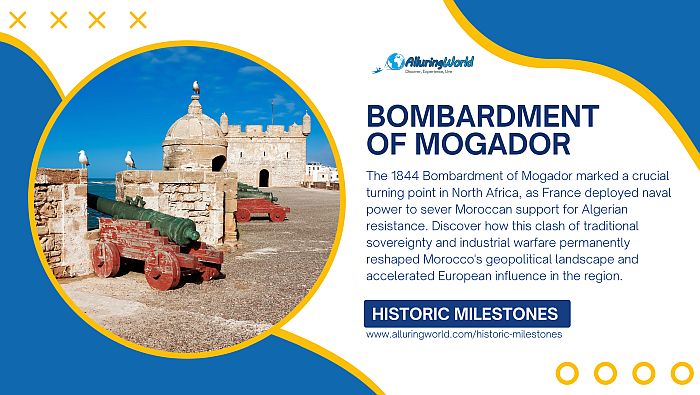
Currently, the historic Mogador port, which is now called Essaouira, is a UNESCO World Heritage Site and provides visible evidence of its military heritage. Tourists who walk around the Scala de la Ville are able to view the historic stone fortifications and Dutch-made bronze cannons, which were used to confront the French army in 1844. On the horizon, the Île de Mogador is still a visible landmark for the port city.
For history and travel buffs, the 1844 Bombardment is an absolutely indispensable prism through which to see the impact of nineteenth-century imperial conflicts on today’s North African landscape. It illustrates perfectly both the fragility and the strength of a country trying to protect its way of life and sovereignty in the face of the emergence of industrial powers. It is a significant milestone in the history of Essaouira as an international port city.
Conclusion:
In summary, the Bombardment of Mogador of 1844 is an important conflict in the modern history of Morocco and North Africa. It was the highlight of the naval battles of the Franco-Moroccan War that showcased the determination of France to consolidate its colonial grip in Algeria by removing the support of Morocco for any regional opposition movement against its rule. The destructive power of the French fleet made the Alaouite kingdom face the reality of industrial war from Europe.
While the French army retreated upon concluding the Treaty of Tangier, the geopolitical repercussions of the bombardment would reverberate for decades to come. The attack had diminished Morocco’s diplomatic bargaining power, hastened economic encroachment by European powers, and foretold the imperialism that would emerge towards the beginning of the twentieth century. But this was more than just a simple skirmish between two rival navies, as the tale of Mogador represents the tumultuous changes of the nineteenth century, as sovereign states attempted to cope with the age of empire.