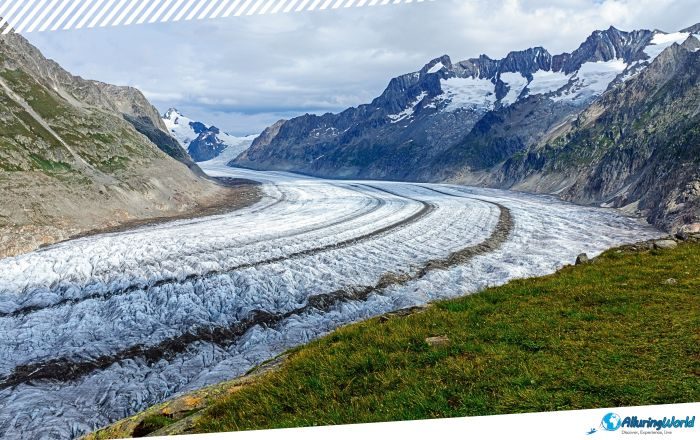
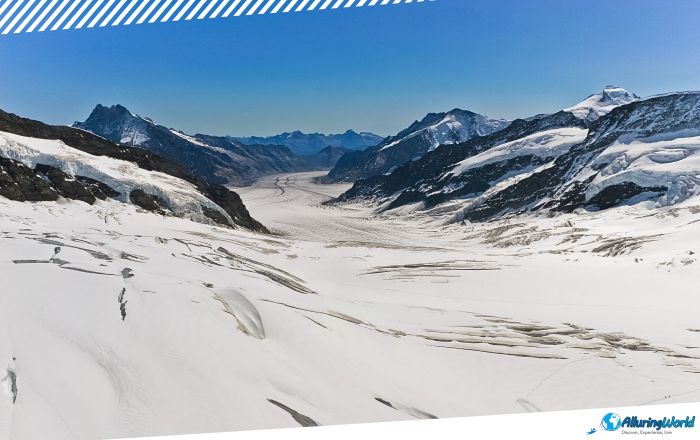
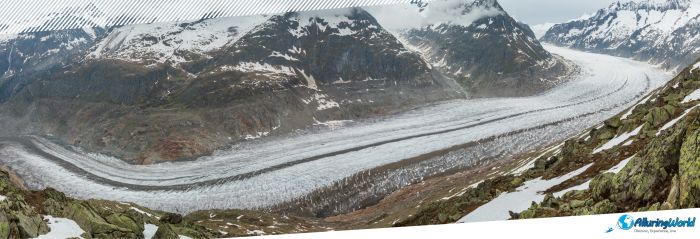
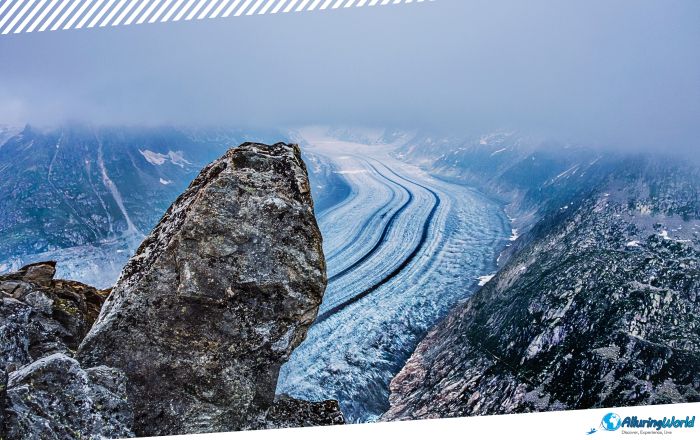
The Aletsch Glacier, also known as the Great Aletsch Glacier, is the largest in the Alps, located in the eastern Bernese Alps in the canton of Valais, in the Swiss Confederation, and is one of the many glaciers located between the cantons of Bern and Valais.
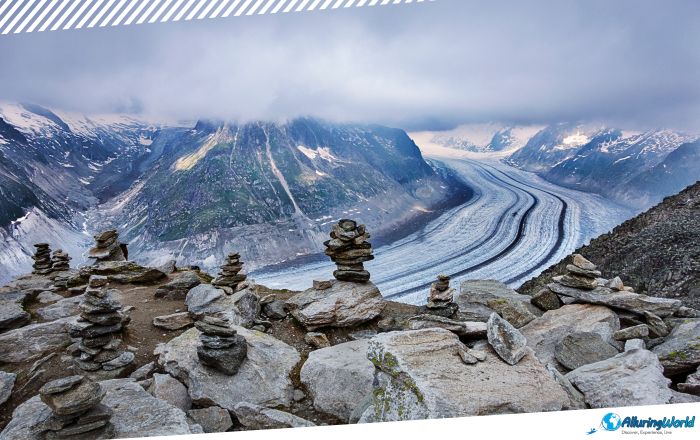
The whole area is considered to be the largest glaciated area in western Eurasia. The measured length of the glacier in 2011 was 23 km (14 mi), with a thickness of 940 meters (3084 ft), and it is retreating. The Aletsch Glacier resulted from the accumulation and compaction of snow, generally when the snow and ice accumulation exceeded snow and ice melt. During the last glacial period, the Aletsch Glacier was much larger than it is now.
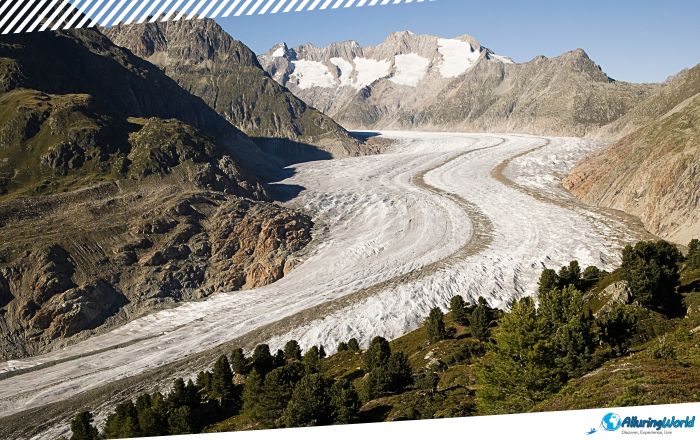
18,000 years ago, the lower part of the ridge, between Riederalp and the Aletsch Glacier, was completely covered by ice. Only the summits of the Bettmerhorn, Eggishorn, and the Fusshörner were above the glacier. After an important retreat, the glacier again advanced 11,000 years ago during the last glacial period. The Aletsch Glacier reached the Rhône valley, and its ice reached the Riederfurka. There are visible moraines in the Aletsch Forest.
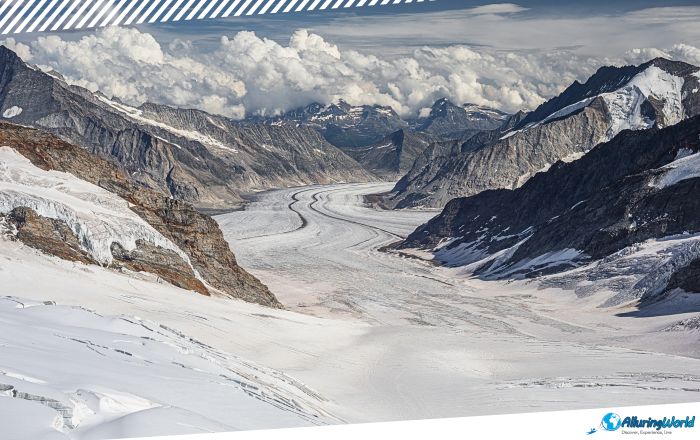
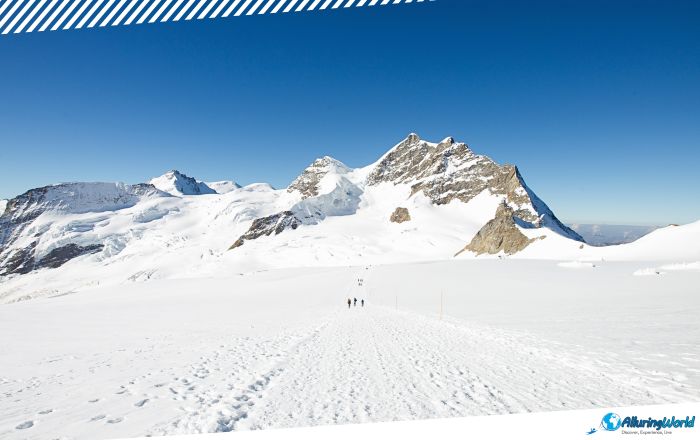
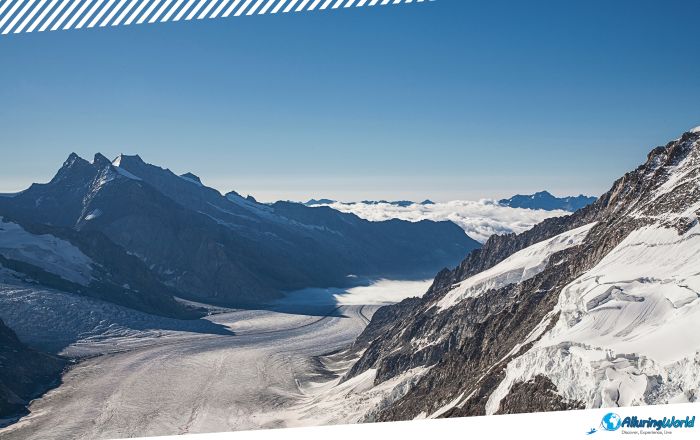
The boundaries of the Aletsch Glacier are formed from the Jungfrau and Mönch peaks, which constitute the northern boundary, the Gross Fiescherhorn and Gross Wannenhorn peaks lie on its east side, and the culminating point, the Aletschhorn, which is 4,193 m (13,757 ft), is located on the west side.
Before reaching the maximum flow, three smaller glaciers converge at Concordia Place: from the western mouth flows the Grosser Aletschfirn, which runs along the northern foot of the Aletschhorn and Dreieckhorn, from the northwestern mouth flows the Jungfraufirn; from the northern mouth flows the Ewigschneefäld, where its starting point takes the east flank of the Mönch, and from the east the Grüneggfirn.
ADVERTISEMENT
Since the last glaciation, the glacier generally retreated. However, slight climatic changes happened, and in 1860, the glacier was 3 km longer and the ice level 200 m higher. As for many other glaciers, records show a major longer-term retreat trend. The Aletsch Glacier receded by 100 m (330 ft) between 2005 and 2006.
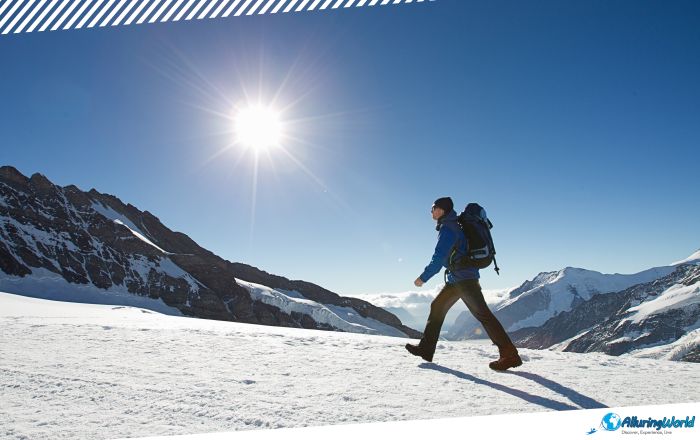
They are where the glacier is located, and some of the surrounding valleys are on the UNESCO World Heritage List, which means it is quite a popular tourist destination. There is a gondola that can take you to Bettmerhorn and Eggishorn, and the Massa River can be crossed since 2008 by a suspension bridge, thus allowing hikes between the left and the right part of the glacier.
On the Riederfurka, at 2,065 metres between Riederalp and the glacier, is located the historic Villa Cassel, a former summer residence of numerous famous and influential guests from the worlds of politics and finance. The house is now one of the centers of the environmental organization Pro Natura, which hosts a permanent exhibition about the site.
Also, on 18 August 2007, photographer Spencer Tunick used hundreds of naked people in a “living sculpture” on the Aletsch Glacier in a photo shoot which he said was intended to draw attention to global warming and the shrinking of the world’s glaciers.
The temperature was about 10 °C (50 °F) at the time of the photo shoot. The 600 participants on the shrinking glacier said that they had volunteered for Tunick (a collaboration with Greenpeace) to let the world know about the effects of global warming on the melting Swiss glaciers.