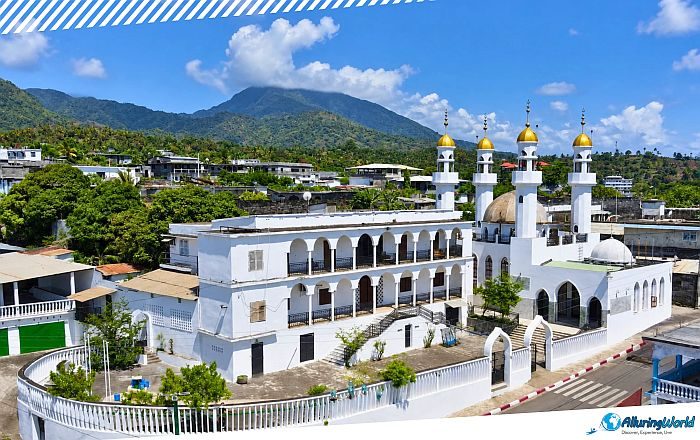
The Mausoleum of Ahmed Abdallah Abderemane, locally known as the Mausolée Ahmed Abdallah Abderemane, is a mosque complex that is also considered a mausoleum that serves as the last resting place dedicated to Ahmed Abdallah Abderemane, located in Domoni, a town on the island of Anjouan (Ndzuwani), in the southeastern part of the Union of the Comoros. Rising abruptly above the weathered coral-rag walls and narrow alleyways of the eastern part of the island, the Mausoleum of Ahmed Abdallah Abderemane is considered to be the most recognizable modern landmark in Domoni. The Mausoleum serves as the last resting place of Comoros’ first president since the country unilaterally declared itself independent in 1975, in addition to the structure serving also as a physical symbol of the politically tumultuous 20th-century history of the archipelago in the Indian Ocean. If you are traveling beyond the main port of Mutsamudu, then visiting the Mausoleum will give you an essential window into how modern Comorian statehood intersects with centuries-old Swahili-Shirazi heritage.
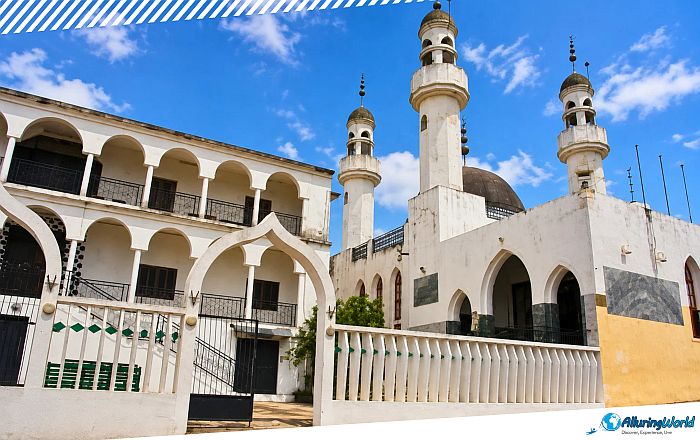
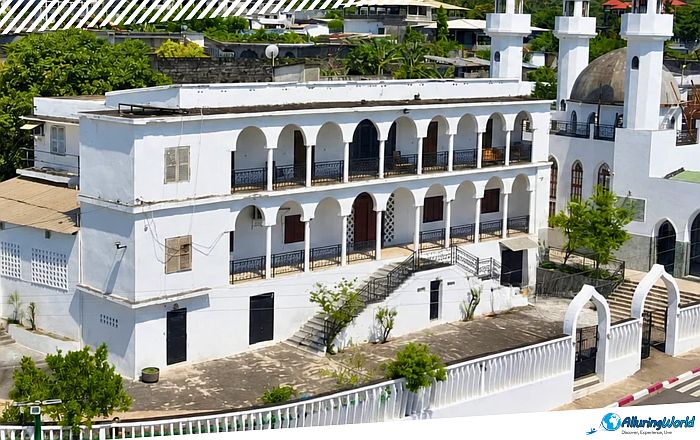
As opposed to the surrounding medieval medina, whose houses and mosques are made of dark volcanic rock and mortar, the tomb is eye-catching through its pristine white façade, polished marble work, and tall minarets. The structure acts as a powerful architectural statement for Islam in the 20th century that makes a connection between Domoni’s past as a royal sultanate capital and its modern role as the birthplace of the republic’s founding head of state. As Domoni is a historic coastal town on the eastern shore of Anjouan, in Shikomori, referred to as Ndzuwani or Nzwani, the island is one of the three autonomous islands that form the Union of the Comoros. Positioned roughly 27 kilometers (17 miles) southeast of Anjouan’s administrative capital and main port, Mutsamudu, Domoni sits between rugged, volcanic green slopes and the crashing surf of the Indian Ocean.
Well before the modern era, Domoni was the main base of the Sultans of Anjouan, forming an important node in the western Indian Ocean trading system, connecting East Africa, Arabia, and Madagascar. In today’s times, the dense historic quarter of Domoni maintains the plan of a typical Swahili stone town, with its labyrinthine walkways, elaborately carved doors in the style of Zanzibar, and ruined 16th-century fortifications meant to withstand Malagasy invasions. The Mausoleum of Ahmed Abdallah Abderemane stands at the fringe of this ancient city structure, signifying the importance of Domoni in the politics of the Comoros people. Specifically, the monument sits on the southern approach to the old medina near the coastal road, making it a clear orientation point before you step into the narrower pedestrian alleys toward the Friday Mosque.
Getting from Mutsamudu to Domoni entails an overland trip that takes you across the island’s mountainous interior along the RN23 road, past highland scenery and ylang-ylang and clove plantations. Due to the lack of signage in Domoni and confusing road networks, when you travel to Anjouan, you’ll need to hire a local driver or take a walking tour guide to access the Mausoleum and the adjacent medina. In order to appreciate the significance of this Mausoleum, you must first come to terms with the convoluted political journey of the man buried inside. Ahmed Abdallah Abderemane was born on 12 June 1919 in Domoni and became a highly successful merchant dealing with the imports and exports of the island’s vanilla and ylang-ylang crops before joining politics under the French colonial government. His success was remarkable as he climbed up the ranks of the colonial government all the way to the French Senate in Paris, where he represented the Comoros between 1959 and 1973.
When the Comorian Chamber of Deputies voted unilaterally for independence from France on 6 July 1975, Abdallah became the fledgling nation’s first president (note that the neighboring island of Mayotte voted to remain under French administration, a territorial dispute that persists today). Abdallah’s initial tenure lasted less than a month; on 3 August 1975, he was ousted in a coup d’état backed by French mercenary Bob Denard, briefly installing Said Mohamed Jaffar before ushering in the socialist-leaning regime of Ali Soilih in early 1976. In May 1978, in an extraordinary geopolitical reversal, Abdallah reclaimed the presidency through another coup which was orchestrated by the very same mercenary leader, Bob Denard, and his European mercenaries. Abdallah governed the then Federal Islamic Republic of the Comoros for the next eleven years, presiding over a single-party state characterized by authoritarian control, economic challenges, and heavy reliance on his mercenary-led Presidential Guard. His rule ended violently on 26 November 1989, when he was assassinated inside his office in the national capital of Moroni on Grande Comore under disputed circumstances involving members of his own security detail and Denard’s forces. The historical memory of the Comoros holds Abdallah as a controversial person who has been respected by many as the architect of national independence, while others have viewed him critically as an authoritarian and pro-Western leader. Depending on what you read, you should form your opinion about him from all the facts and weigh both his pivotal role in securing statehood and the turbulent realities of his rule.
ADVERTISEMENT
After his assassination in Moroni at the end of November 1989, Abdallah’s body was taken back to his home island of Anjouan rather than being buried in the country’s capital. In establishing a permanent burial site for him in Domoni, his last resting place honored his deep familial roots, his birthplace, and his lifelong political base on the eastern coast. The Mausoleum was built in the early 1990s, transforming the grave into a prominent civic and religious monument. Although it is true that various personal accounts and building research can support the fact that the building was constructed shortly after his death, there are no publicly available municipal files about the date of foundation, primary designer, or any contractor of the building in Domoni. Contrary to the notion that the Mausoleum is a static relic, the Mausoleum of Ahmed Abdallah Abderemane still performs an important commemorative role. Every year, on 26 November, Abdallah’s family members, along with local notables and the community, gather at the monument to offer prayers, recite verses from the Quran, and conduct memorial services marking the anniversary of Abdallah’s death. These annual observances ensure the monument remains a living space of family remembrance and political reflection.
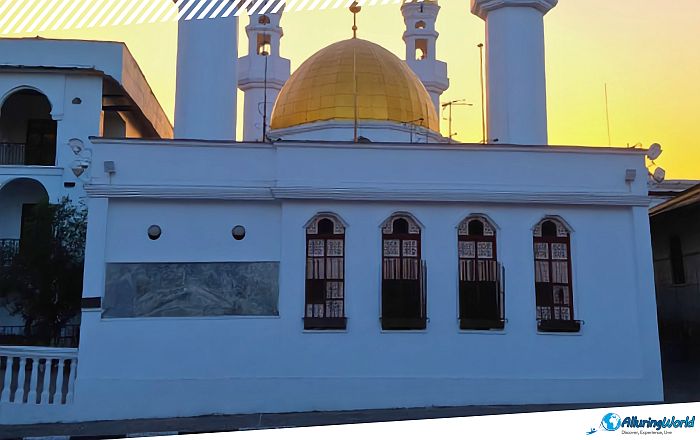
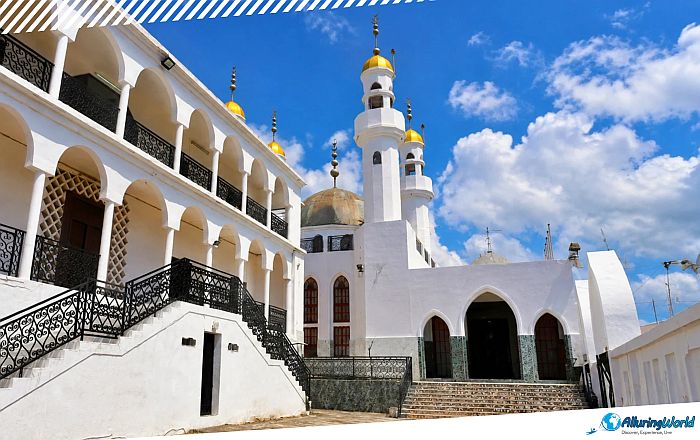
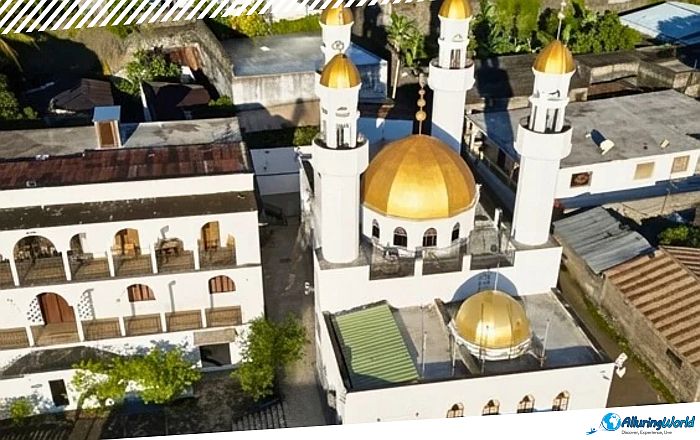
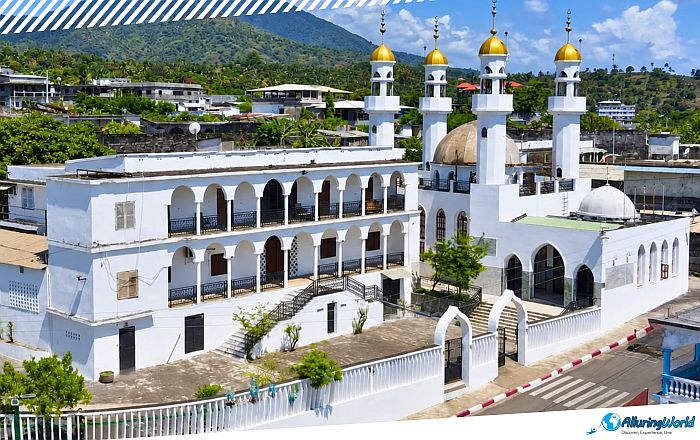
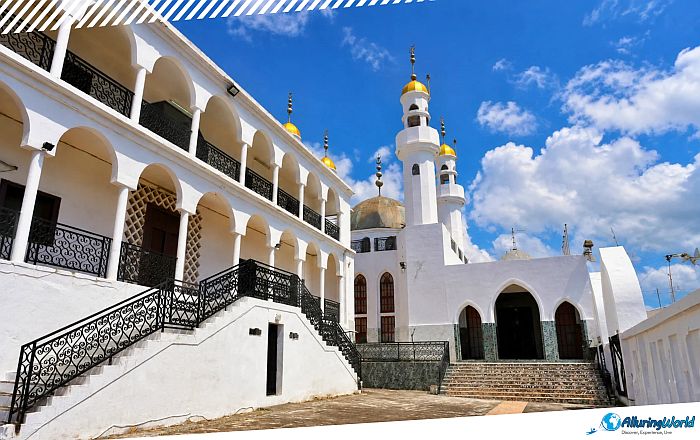
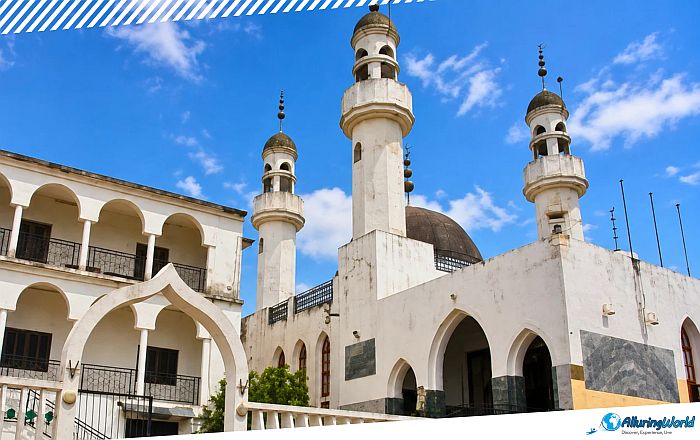
The Mausoleum of Ahmed Abdallah Abderemane is very distinct from the style seen at Domoni’s traditional buildings. Unlike the traditional buildings of 16th- and 17th-century coastal Shirazi style, whose notable features include unembellished coral limestone construction, a flat roof, and elegant design, the Mausoleum has a neo-Islamic monumental style. Its ornate plasterwork and symmetrical layout draw noticeable inspiration from North African and Gulf Islamic monuments, reflecting the close diplomatic ties Abdallah cultivated with Arab states during his presidency. There are four slender, towering minarets that frame the corners of the structure, and they rise well above the surrounding rooftops and palm trees to serve as an unmistakable visual beacon from several hundred meters away. Three central domes crown the main roof, reinforcing the building’s symmetrical, mosque-like silhouette. The exterior walls are finished in bright white stucco accented with decorative reliefs and geometric trim that catch the harsh equatorial sunlight.
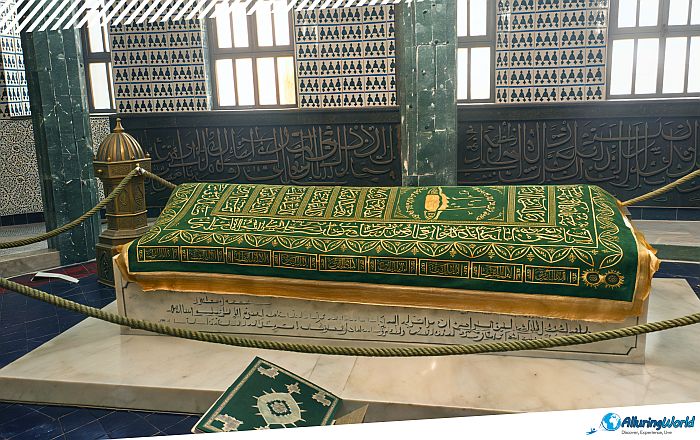
Within the building, the architecture moves from grandeur to somberness. The inner chambers are lined with cool, polished marble, with massive, elaborately crafted hardwood doors that are reminiscent of the woodwork of the Comoros people. This building is designed with dedicated prayer rooms on the ground floor, whereas the main burial chamber is located on an elevated upper floor that is reached through an inner staircase. For those who go into the building, there is an upper viewing room where you can view the whole tomb complex, the red roof tiles of Domoni, and the turquoise reef line of the Indian Ocean just a few hundred meters to the east. Your preparation for your visit to the Mausoleum of Ahmed Abdallah Abderemane will require you to have realistic expectations because Anjouan receives very few foreign tourists, and formal visitor infrastructure is virtually nonexistent. There is no ticket office, no gift shop, nor any opening-time schedule, and instead, access operates through community hospitality and local coordination.
The best time to visit Anjouan and explore Domoni on foot is during the dry, cooler season, which runs from May through October, as this is the period when daytime temperatures hover comfortably between 24°C and 28°C (75°F and 82°F), while the rainfall is minimal. Unlike the hot, humid cyclone season, which runs from November to April, you will see heavy downpours that can make overland travel across Anjouan’s steep mountain roads slow, slippery, and somewhat dangerous. Regardless of the season, you should aim to arrive in Domoni in the morning between 08:30 and 11:00, when the coastal light is ideal for photography and the town’s narrow lanes are active before the midday heat settles in. While you are already in Domoni, you should combine your visit to the Mausoleum with the other historic sections of the city:
- The Shirazi Mosque: Located just a short walk through the medina, this ancient coral-stone mosque is famous among architectural historians for featuring two mihrabs (prayer niches) side by side, and this is considered a rare feature linked to historical divisions between rival royal lineages in Domoni.
- Royal Tombs and Town Ramparts: While this is not the only last resting place, you should also aim to explore the nearby carved coral-stone tombs of the early Shirazi rulers and trace the surviving segments of the 16th-century stone fortifications that once enclosed the settlement.
- Mutsamudu Overland Transfer: You should plan at least 90 minutes each way when you travel from the island’s capital, Mutsamudu, to Domoni by private taxi. You can also hire a 4×4 from Mutsamudu, but be aware to depart before 15:00 if you intend to return before dusk at 18:00, as mountain roads lack street lighting.
Because the Mausoleum of Ahmed Abdallah functions simultaneously as a burial site and an active house of prayer, you must observe local Islamic customs. You should be aware that Comorian society on Anjouan is deeply conservative and devout; thus, respectful behavior ensures a warm reception from local caretakers and residents. This is why you should:
- Dress Modestly: Both men and women have to cover their shoulders and knees before entering the Mausoleum, and women need to carry a light scarf to cover their heads in case they are invited into the prayer rooms or burial chambers. In contrast, both genders have to take off their shoes before walking on carpeted/marble floors.
- Request Permission First: You mustn’t assume that the interior doors are open to the general public. You should talk to the locals or the caretakers politely before you enter the complex or visit the upper chamber of the tomb. Always ask the caretaker before taking photographs inside the prayer halls or the upper burial chamber, as photography of the tomb itself may be restricted even when exterior photos are welcomed.
- Time Your Visit Around Prayers: Avoid coming in during the five prayer times each day, but particularly during the Friday midday prayers that take place from 12:00 to 13:30, because this area is meant only for praying during this period.
In terms of physical security, Domoni is a friendly town, and walking around during the day is completely safe, but petty opportunism can take place in the market area. Be sure to bring some small bills of Comorian francs (KMF) to pay a local caretaker or kid from the neighborhood who will help you find the keyholder who can open the Mausoleum’s doors for you. While there is no official admission fee, offering a tip of around 1,000 to 2,500 KMF (roughly €2 to €5) is customary and appreciated when someone unlocks the monument and accompanies you inside. Also, be sure to bring at least 1.5 liters (50 ounces) of bottled water per person due to coastal humidity. While traveling and attempting to learn more about the Union of the Comoros other than its impressive volcanic islands and scent-filled spice fields, it becomes imperative that you see the Mausoleum of Ahmed Abdallah Abderemane. As the building is set in striking stark white against the centuries-old coral stone walls of Domoni, the mausoleum embodies the struggles and aspirations of a fledgling country in search of independence, autonomy, and stability. Visiting Abdallah’s resting place, along with a leisurely tour of the old medina nearby, will reveal to you how deeply modern politics and centuries-old Swahili-Islamic traditions remain intertwined on the eastern coast of Anjouan.