
Read time ca. 6 minutes
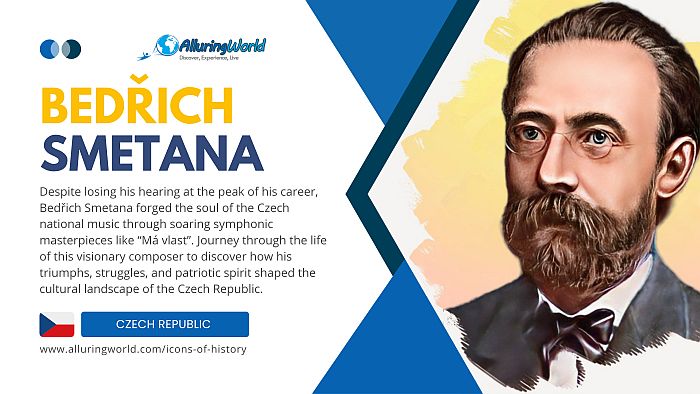
In the very center of Central Europe, music is not just a form of amusement but an integral part of the country’s identity, culture, and natural landscape. The person who occupies the central place in this musical tradition is Bedřich Smetana, who was a composer known as the founder of Czech national music. He was born on 2 March 1824 in the Bohemian town of Litomyšl in Central Europe, where, at that time, the German-speaking Habsburg Monarchy had a strong dominance in contrast to the Czech language and traditions. Using his great symphonic poems, nationalistic operas, and exceptional orchestration, Smetana created his own language of music, which helped to make Prague one of the greatest artistic centers of Europe.
In today’s world, by tracking the life of Smetana, you will be able to view the history of the Czech Republic through a truly deep perspective. Through Smetana’s life experiences, we can trace our way through some of the most beautiful places in the country, including the fairytale courtyard of Litomyšl Castle, the magnificent halls of Prague’s National Theatre, and the winding bends of the Vltava River. Understanding the person behind the music means discovering the great composer, who was deaf but still created beautiful pieces of music, and a patriot of the nation.
Early Life in Litomyšl and the Struggle for Cultural Identity:
Bedřich Smetana was born in a comfortable middle-class family environment within the brewery premises of the noble Wallenstein-Vratislav family estate in Litomyšl. The Smetana family belonged to the affluent brewers of Litomyšl, whose wealth and prosperity were derived from their brewery business in the town of Litomyšl. Young Bedřich sat at the piano by age four and performed publicly by six; however, like most educated Bohemians under Austrian rule in the early 19th century, Smetana was raised speaking German. The Czech language was largely relegated to rural peasants, as it lacked prestige in the bigger cities, and the urban middle class operated almost entirely within German cultural spheres. If you are going to visit Litomyšl today, you can explore his birthplace preserved as a museum within the UNESCO-listed Renaissance castle complex, or walk through Smetana Square lined with historic pastel arcades.
As Smetana grew older, his desire for greater accomplishments in music brought him to Prague, where he experienced the excitement of politics in Central Europe before the 1848 revolutions. This was a time when Smetana’s intellect opened up, and he decided consciously and drastically what his path would be: to become entirely devoted to the cause of Czech nationalism. Being aware of the fact that he couldn’t even write literary Czech properly, he studied this language thoroughly and mastered it accordingly.
Years in Sweden: Artistic Maturation in Gothenburg
Following the failed uprisings of 1848, Prague fell under a period of strict political reaction and economic stagnation under Austrian neo-absolutism. Struggling to earn a livelihood as a private teacher and facing financial hardship, Smetana made the difficult decision to leave Bohemia in 1856. He accepted a position as director of the Philharmonic Society in Gothenburg, Sweden, where he would spend nearly five years as a conductor, teacher, and virtuoso pianist. This would prove to be very inspirational for him, as it shaped him for the years to come.
The period that Smetana spent in Sweden was significant in the context of his artistic growth. Having got away from the oppressive environment of Prague, he adopted the style of contemporary Europe and created connections and associations with people like Hector Berlioz and Franz Liszt. Liszt’s idea of the “symphonic poem,” an orchestral composition in one movement, based on literary, pictorial, or scenic subjects, played a significant role in the development of Smetana’s style. The works of symphonic poetry that he created during his stay in Gothenburg contributed greatly to his mastery of the technique that he later applied when composing his most outstanding works. Yet, although successful in Scandinavia, Smetana was homesick and kept expressing his wish to create a truly national opera to his friends in Prague.
ADVERTISEMENT
Returning to Prague: The Birth of Czech Opera and the National Theatre
In 1861, the political atmosphere in the Habsburg Empire had loosened, providing room for cultural organizations in Bohemia to prosper. Smetana moved back to Prague with a renewed vigor, plunging straight into the process of founding a national Czech theater. In 1866, he was made the conductor of the Provisional Theater, which was later to become the National Theater on the Vltava River.
During this time, Smetana established his legacy as the greatest representative of the Czech opera, and his second opera, “The Bartered Bride” (Prodaná nevěsta), was first staged in 1866, which enjoyed immediate and massive success. Blending exuberant lyrical melodies, lively village dances like the polka, and witty domestic comedy, the work captured the joyful spirit of Bohemian rural life without falling into generic cliché. Beyond comedy, Smetana explored grand national epic themes in works like Dalibor (1868) and Libuše (composed in 1872), the latter written specifically for the eventual grand opening of the Prague National Theatre.
Tragedy, Resilience, and the Creation of Má vlast:
In 1874, when Smetana’s career had reached its peak, an awful thing happened to him. Suffering from serious health problems, he started to have auditory hallucinations and constant ringing in his ears. In a matter of months, he lost all his hearing capacity in both ears. Overwhelmed with grief, Smetana resigned from his positions at the theater and went to a small village in the northeast of Prague named Jabkenice.
Remarkably, much like Ludwig van Beethoven before him, Smetana’s total deafness catalyzed one of the most astonishing creative periods in classical music history. Operating entirely within his internal ear, he composed his crowning achievement: Má vlast (My Country), a cycle of six grand symphonic poems created between 1874 and 1879.
Each movement of Má vlast paints a vivid sonic canvas of Czech geography, history, and legend. Vyšehrad evokes the ancient high castle sitting on the rocky promontory overlooking Prague, while Vltava (The Moldau) depicts the journey of the river from two small forest springs to a grand, surging waterway flowing through the capital. Šárka recounts the dramatic Amazonian legend of the Maidens’ War from Slavic mythology, and From Bohemia’s Woods and Fields celebrates the lush, sunlit agricultural countryside. The final two movements, Tabor and Blaník, draw upon the heroic history of the 15th-century Hussite wars and the legend of sleeping knights awaiting to rescue the nation. The second movement, Vltava, remains one of the most famous pieces of classical music ever written, and listening to its sweeping main theme while walking across the Charles Bridge offers an unforgettable connection between music and place.
Experiencing Smetana’s Heritage:
If you are looking for a chance to experience Smetana’s heritage in full measure, coordinating your visit with the country’s rich culture calendar will definitely make it all more interesting. Traditionally, the opening night of the famous Prague Spring International Music Festival, held annually on 12 May, commemorating Smetana’s death in 1884, features an entire performance of Má vlast in the Smetana Hall of the Municipal House. The spring months of May and June are sunny, whereas autumn presents crisp and bright days with the start of the theatre season.
If you are a cultural traveler, then you should also plan time for the Bedřich Smetana Museum, housed in a former neo-Renaissance waterworks building on the bank of the Vltava River in Prague, offering direct views of the waterway that inspired his most famous music. Additionally, a day trip east to Litomyšl during June and July allows you to attend Smetana’s Litomyšl Opera Festival, which, as a matter of fact, is held directly in the arcaded courtyard of the town’s Renaissance chateau.
Conclusion:
Conclusively, despite suffering immense personal struggles, political exile, and physical hardships, Smetana’s creative genius endowed a developing nation with a voice of its own. By combining traditional Bohemian folk melodies and rhythms in elaborate compositions in the late 19th century, Smetana set the stage for the likes of Antonín Dvořák and Leoš Janáček in the world of music composition. Indeed, the music of Smetana continues to remain the perfect score to the landscape of the Czech Republic today, whether it be the banks of the river Vltava or the historic streets of Old Town Prague.