
Read time ca. 5 minutes
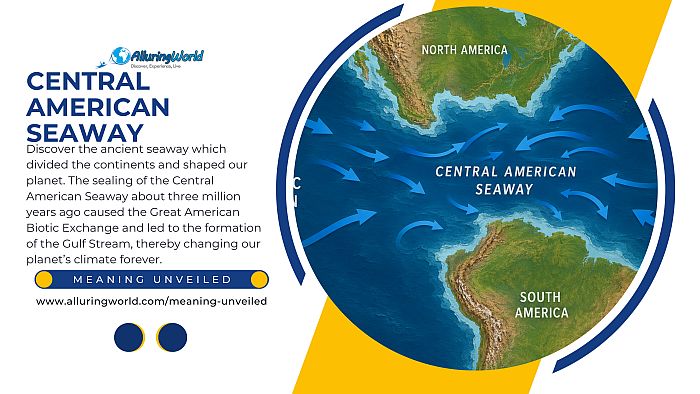
The Central American Seaway refers to an ancient, oceanic passage that once connected the Pacific and Atlantic Oceans through what is now Central America. The significance of this seaway in understanding the Earth’s past geology, climate, and biological evolution cannot be underestimated. Its ultimate closure, about three million years ago, changed the flow of currents, the global climate system, and animal movements on land and sea. The Central American Seaway is an important study area for plate tectonics, oceanography, and evolution that can tell us a lot about how our planet once looked.
Geological Formation of the Seaway:
The Central American Seaway came into existence in the Miocene epoch, some 20 million years ago, because of tectonic movements of the Caribbean Plate and ocean floor. The current locations where Panama, Costa Rica, and some parts of Colombia lie used to be a chain of volcanic islands that were separated by shallow waters.
Through millions of years of time, these islands slowly came together because of volcanic eruptions, where scientists could confirm that sediments deposited by flowing water, and the uplifting of land masses, happened through movements of Earth’s crust. Throughout its time, the seaway provided a clear passage between the Pacific Ocean and the Atlantic Ocean, as it acted as a corridor that affected the ocean currents, temperatures, and even the salinity levels.
Ecological and Biological Impacts:
The impact of the Central American Seaway was significant for all marine and land-based life forms. As far as the marine organisms were concerned, the seaway served as a pathway for their migration from one ocean to another, or in other words, from one part of the planet to another, thereby ensuring a high level of biodiversity and affecting evolutionary trends. Many fossils in Central America have been found, indicating the widespread distribution of several species of fish, mollusks, and corals, among others.
In terrestrial animals, the seaway played the dual role of being a barrier as well as a route. Prior to its closure, the majority of the terrestrial fauna in the Americas was isolated from one another and underwent evolution independent of one another, something which we know today in Asia/Oceania as the Wallace Line. It was the formation of the isthmus that led to the Great American Biotic Interchange, where species like armadillos, opossums, and porcupines went north, and bears, cats, and horses headed south.
Oceanographic and Climatic Implications:
The closing off of the Central American Seaway around three million years ago brought about drastic changes in the global oceanic circulation and climate system. The blocking off of the flow of water from one ocean to the other by the creation of the Isthmus of Panama led to an increase in the Gulf Stream. This change resulted in more warmth being transported to the North Atlantic region, leading to cooling in the South and glaciation in the North.
In addition to this closure, it also had an effect on salinity and nutrient distribution. There was an increase in the salinity levels in the Atlantic Ocean, and this made the thermohaline circulation strong enough to affect the ocean currents across the globe. This change affected not only the production in the ocean but also the air circulation and even the rainfall in tropical zones.
ADVERTISEMENT
Paleontological Evidence:
The existence and the age of the Central American Seaway have been proven from geological and paleontological evidence that scientists have gathered over the decades. Marine sediments provide evidence of alternations between the two groups of organisms coming from the Pacific and Atlantic, suggesting times when the seaway existed and times when it did not exist. Paleontological evidence from marine invertebrate fossils and microfossils, like foraminifera, is available, hence proving the existence of the seaway.
Moreover, isotope analysis of sediments has enabled researchers to determine past water temperature and salinity values. This clearly shows the effect of the seaway in shaping the chemical composition of the ocean, as well as its ecosystems. Land fossil records also confirm when the seaway closed, since the movements of mammals across continents coincide with the emergence of the Isthmus of Panama.
Geological Mechanisms of Closure:
The slow closure of the Central American Seaway was a gradual process that involved uplift, volcanism, and sedimentation. The collision of the Caribbean Plate against the South American Plate led to volcanic arcs being uplifted, thus resulting in contiguous areas of dry land. River sediments brought by flowing rivers from both plates played a part in filling up shallow seaways.
This process did not happen overnight, but at different times for different parts of the seaway; in some cases, there were even shallower passageways and lagoons where water could still flow, but over millions of years, all of those passageways were eliminated, and the two oceans became permanently separate.
Legacy and Modern Significance:
Since the Central American Seaway is no longer in existence today, however, traces of its existence continue to influence the region in some aspects. The existence of the Isthmus of Panama continues to play an important role as it helps in dictating the migratory routes for various species of fauna. The currents in the sea and climatic conditions can also be traced back to this event in history.
Overall, the investigation into the Central American Seaway remains relevant to many scientific fields, such as paleoclimate, evolutionary biology, and geology. Examination of its creation, role, and eventual closing offers a glimpse at how complexly interlinked our planet is and demonstrates the far-reaching impact that plate tectonics and oceanic activity can have on all aspects of life and climate.
Conclusion:
In summary, the Central American Seaway has played a significant role in the geology and biology of our planet Earth, as it provided a connection and separation for the species in terms of the terrestrial and aquatic species. The closing of this seaway roughly three million years ago has had a profound impact on our planet that can be felt even today.
Knowledge about this ancient sea helps researchers to understand more about the processes of plate tectonics, evolution, and climatic change. The existence of the Central American Seaway is a testament to the processes that have been at work to create the natural phenomena in our world, where geographical changes affect all forms of life worldwide.