
Read time ca. 9 minutes
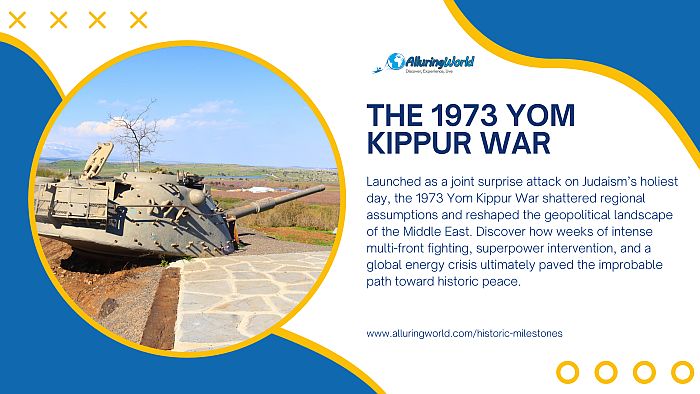
The Yom Kippur War has been recognized to date as one of the most important wars of the 20th century, not because of its duration but due to the effects it left behind after it came to an end. The Yom Kippur War broke out unexpectedly in October 1973 after the armies of Egypt and Syria launched an attack against Israel on Yom Kippur, the holiest and most solemn day of the year in Judaism, as believers seek forgiveness from God and from fellow humans for wrongdoings and sins committed over the past year.
Although the fighting was brief and lasted only a few weeks, the impact of the war was felt long after the battlefront. The war shifted the balance of power in the region, changed the Israeli military doctrine, rekindled Arab confidence following previous losses, and paved the way for future peace talks. To understand its significance, it is important to analyze the conditions that led to the war, how it was fought on multiple fronts, and why it continues to influence international relations even today.
Background to the Conflict: The Road from 1967 to 1973
The Yom Kippur War is closely linked to the events following the Six-Day War of 1967, which was a brief military conflict fought between Israel and a coalition of Arab states, primarily Egypt, Jordan, and Syria. During this war, Israel had a decisive victory over its Arab neighbors, and it managed to gain a control of the Sinai Peninsula from Egypt, the Golan Heights from Syria, the West Bank from Jordan, and East Jerusalem. The result of this war significantly improved the strategic position of Israel at that time in the region; however, it also resulted in territorial conflicts.
Because of this war, Egypt and Syria did not just face a tactical problem in terms of the loss of their land but a national humiliation as well. The Egyptian government under President Gamal Abdel Nasser and later on Anwar Sadat saw the occupation of the Sinai Peninsula as a humiliating experience that they were not ready to accept. The Syrian government, on the other hand, ruled under Hafez al-Assad, saw the loss of the Golan Heights as a national security threat from Israel. Both countries did not find any diplomatic solutions to be successful and hence had to consider other methods. In contrast, King Hussein of Jordan decided not to have a third front opened up on the Jordan River, as he contributed only an expeditionary force to support Syrian positions in the north while keeping his own border quiet.
The 1970s had arrived, and nothing much seemed to be changing in the Middle East. As far as Israel was concerned, there was a belief in military superiority and intelligence capabilities; no problem could not be sorted out by the Israeli forces. Despite this overestimated confidence, Egyptian and Syrian leaders had been working secretly on plans for what would turn out to be a limited war which would not be aimed at destroying Israel but at ending the political deadlock and forcing international engagement.
Strategic Planning and the Element of Surprise:
The success of the first Arab offensive would depend greatly on secrecy, coordination, and deception. Egyptian and Syrian officials spent years preparing for an assault that would take the Israelis by surprise. Exercises were carefully conducted in such a way as to make them look like regular exercises, and any movement was done under the guise of defensive maneuvers. Despite early warnings, Israeli officials did not take the chances of another war breaking out seriously, believing that the Arabs would never launch an offensive unless they had air superiority. Such thinking was part of the dogma of their strategy known as HaKonseptziya (The Concept). This concept presumed that Egypt would never initiate a war until it acquired long-range strike aircraft capable of neutralizing the Israeli Air Force.
The timing of the attack was well-chosen. In Israel, Yom Kippur is a day of fasting, praying, and contemplation, and on this day, most of the country comes to a standstill. Meanwhile, the attack happened to coincide with the holy month of Ramadan among the Arabs. This made the operation even more surprising and psychologically meaningful for Arab troops.
On 06 October 1973, Egyptian forces launched an attack as they crossed the Suez Canal in a very well-prepared offensive. This happened at the same time as Syrian forces made their advance against the Israeli forces stationed in the Golan Heights. The joint operation of the two armies was so effective that they managed to surprise the Israeli forces. What had been assumed as an impossible probability by Israel became reality, thus forcing Israel into a desperate struggle to stabilize the situation.
The Sinai Front: Egypt’s Breakthrough and Tactical Innovation
The Egyptian attack in the Sinai was one of the most outstanding military feats by the Egyptian army. The Suez Canal had long been considered a natural and powerful defensive position, which was further reinforced by the Israeli defense of the Bar Lev Line. This Line was a chain of fortifications that were constructed by Israel along the eastern bank of the Suez Canal shortly after the 1967 Arab–Israeli War, and even though all previous efforts to break through this defense were doomed to failure, this time the Egyptian forces succeeded in doing so.
Engineers and infantry of the Egyptian forces overturned this assumption owing to their proper planning and new techniques adopted during the process. Through the use of water cannons, they broke down the sand embankments formed at the canal so that bridges could be built quickly for armored personnel carriers. The infantry proceeded with anti-tank weaponry against the Israeli tanks, thus neutralizing Israeli armor and preventing immediate counterattacks.
The significance of this early success cannot be overstated psychologically for the Arab nation because, for the first time since 1967, an Arab army was able to cross a key defense line and hold its position against Israeli troops. Although the goals of Egypt were modest in nature, they concentrated more on setting up bridgeheads than penetration; it still managed to help restore their national pride and be considered the “wind in their back” for future fighting.
ADVERTISEMENT
The Golan Heights: Syria’s Push and Israel’s Counteroffensive
When it comes to the Northern Front, the fierce battles were fought at the Golan Heights, which were quite intense and brutal. The Syrian forces launched a massive armored assault, which was conducted in order to overwhelm the Israeli forces, with the intention of breaking through them, with the result being the regaining of control of the plateau, which overlooks the northern part of Israel. The terrain is even today characterized by narrow passes and elevated positions, which magnified the stakes of the battle.
The Israeli defenders were severely outnumbered at the beginning, but put up a determined fight in order to stall the Syrian army. Particularly in the tank battle referred to today as the Valley of Tears, heavily outnumbered Israeli forces stalled a huge number of Syrian tanks for four important days, thus stopping them from crushing the Israeli positions before reserves arrived. There were high casualties at first on both sides, but Syrian tanks managed to make their way towards the Golan Heights. The situation was highly crucial; otherwise, the northern region of Israel, or as some would call it, Israel’s northern heartland, would have been exposed to further attacks.
As Israel rapidly deployed its reserves and launched counterattacks, the country began to gain momentum. Reinforcement units managed to stop the Syrian forces from advancing further, and the Israeli army even pushed them back beyond the pre-war ceasefire lines. Overall, this part of the war in the Golan Heights illustrated the fragility of the Israeli army and how close it came to defeat.
Superpower Involvement and the Global Dimension:
The Yom Kippur War was taking place during a period that witnessed the rivalry between the USA and the USSR as Cold War opponents. The two superpowers analyzed the ongoing war from the perspective of global influence, providing military aid to their allies in different parts of the world.
The danger of escalation became one of the biggest worries as the intensity of the war increased. The United States sent many airlifts to help Israeli troops, whereas the Soviet Union supplied weapons to Egypt and Syria. These actions posed the danger of the two major nuclear powers getting involved.
Through diplomatic intervention, there was eventually a ceasefire, which was finally arranged through the United Nations. The crisis brought out the precarious nature of regional conflicts in a bipolar world, and the need for proper handling of proxy wars. The conflict also showed how a regional dispute in one part of the world can rapidly acquire global significance, and would further require attention from major and politically strong world players.
The Oil Embargo and Economic Consequences:
Among the most significant repercussions that came from the Yom Kippur War were far from the battlefield. Following the backing of the West to Israel, Arab oil producers announced an embargo on the oil supply to the United States and its allies. The embargo led to an energy crisis whose impact rippled across the global economy. Shortages of fuel, high prices, and economic uncertainty made it necessary for governments to re-evaluate their energy policies and Middle Eastern oil dependency.
This changed the whole dynamic with respect to energy, geopolitics, and security forever, and countries were coordinating diplomatically and politically carefully to avoid a similar situation. This war was evidence that wars can create economic problems for the world with global implications lasting for decades to come.
Aftermath and the Path Toward Diplomacy:
When the fighting was over, neither party could claim a decisive victory. It was Israel that later regained the upper hand in the situation thanks to its daring counterattack, which was led by General Ariel Sharon. This counterattack entailed crossing the Suez Canal in Operation Gazelle to trap Egypt’s Third Army. While this shift in the balance of forces was menacing to Cairo and re-established Israeli tactical dominance, Egypt had reached its main political goal of breaking the diplomatic stalemate.
Overall, the conflict led to a reevaluation of Israel’s thinking on matters of its security and intelligence. The complacency was replaced by changes in military preparedness and strategic planning. In Egypt’s case, the war boosted its morale and helped President Sadat gain the upper hand to begin and pursue the negotiations. This eventually led to significant diplomatic breakthroughs. Following the disengagement agreements that helped to ease tensions, the momentum created by the war resulted in the signing of the Egypt-Israel Peace Treaty at the end of the decade, making this war a turning point from confrontation to dialogue.
Legacy and Historical Significance:
The Yom Kippur War is considered to be one of the biggest landmark events in Middle Eastern history. This event changed military doctrines, shifted political perspectives, and served to show the limitations of military power as a means of conflict resolution. For Israel, the war showed the need for vigilance and flexibility, while for the Arab nations, it showed that through careful planning and coordination, even a superior enemy could be contested. On a wider scale, the war revealed the link between regional conflicts and superpower politics and economics, and it further showed how it can influence the superpowers to get involved in a region that is far away from them. Many decades later, the lessons of the Yom Kippur War still echo today. This war serves as a reminder that surprises, perceptions, and preparations can shape history and that small wars can have a lasting impact on the international arena.
Conclusion:
In summary, the Yom Kippur War is still an important example of how the flow of history changes when a number of factors come together to create an unpredictable situation. What started as a well-planned surprise attack became a war that revealed weaknesses everywhere, challenged the invincibility of the military, and created new strategic thinking in the Middle East. The Yom Kippur War showed that technology was not enough to ensure security and that political deadlock may lead to conflict.
Off the battlefield, the war brought about changes on the regional and international levels. It restored the confidence of Arabs in their political dealings, thus forcing the Israelis to think institutionally. It made the world’s superpowers play a dangerous game of balance in which they were constantly reminded of the dangers of escalation during the Cold War. Economically, the impact was seen in the form of the oil embargo and showed the power of energy politics and the linking of Middle East disputes to international economic stability. What is important is that the Yom Kippur War changed the course of Arab–Israeli relations. It broke down the psychological barriers that had stopped the negotiations since 1967 and paved the way for future discussions and eventual treaties.