
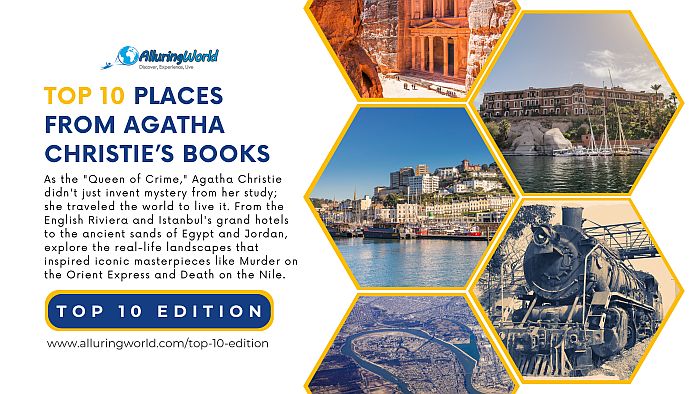
Agatha Christie is among the most significant crime novelists who have ever lived. With her great novels that feature great plots, characters, and intriguing scenes, Agatha Christie earned the title “Queen of Crime.” In total, she authored more than 60 detective novels as well as many short stories. Whereas her imaginary universes were full of grand country houses, far-flung places, and strange locales, some of her tales were inspired by real places she visited during her unique existence. Christie was both a writer and an ardent traveler, archaeologist, and observer of people’s behavior. Her travels to Europe, the Middle East, and elsewhere helped her get ideas of the landscape, cultures, and society that would feature in her mystery books.
Whereas many writers created distant settings while sitting in the comfort of their study rooms, Christie had actually visited most of the places that she had written about. She had visited by rail, by boat, and by car; visited old civilizations, stayed in luxury hotels, and seen local traditions. Following in Agatha Christie’s footsteps is an enchanting experience that takes you around beautiful English villages, archaeological ruins, Mediterranean Islands, and grand historic hotels, all of which have inspired her to write some of her most renowned novels, like “Murder on the Orient Express,” “Death on the Nile,” “And Then There Were None,” and many others. For literature enthusiasts and curious travelers like you, these ten locations will give you a unique opportunity to discover the landscapes that shaped the imagination of the world’s most famous mystery writer, and possibly inspire you to visit them yourself.
1. Torquay, England: The Coastal Town That Shaped Agatha Christie’s Imagination
Featured Novel: The Mysterious Affair at Styles (1920)
Key Landmark: The Agatha Christie Mile & Imperial Hotel Torquay
Torquay is located on the coast of Devon, England, and it served as the birthplace of Agatha Christie, which in turn was one of the biggest inspirations for her writings. This place is full of Victorian flair, beautiful scenery, and wealthy tourists, which inspired many of Christie’s stories. Christie was born in Torquay in 1890, and she spent most of her youth exploring the countryside in the region. She learned about the types of people that would appear in her mystery stories through the large mansions, the seaside hotels and social events in this area.
There are a number of novel settings that have been featured in Agatha Christie’s novels that draw from the English Riviera. These include rich communities, seaside towns and countryside homes that have their own secrets. You can be among others and visit various places that are linked with Agatha Christie’s life, such as the waterfront in Torquay and the Agatha Christie Mile. Torquay, overall, represents the foundation of Christie’s storytelling world, where observation of people, social behavior, and hidden relationships became central themes in her work.
2. Greenway, Devon, England: Christie’s Beloved Country Retreat
Featured Novel: Dead Man’s Folly (1956)
Key Landmark: Greenway Estate (National Trust) & The Boathouse
One of the most cherished holiday homes for Agatha Christie was Greenway, located along the River Dart in Devon. This was one of the places where she felt most connected to nature and creativity, and she drew enormous inspiration to write. The Georgian house and surrounding gardens became a private retreat where Christie spent time with her family, entertained guests, and found inspiration for her writing.
The tranquil environment, surrounded by woodlands, gardens, and the riverside, embodies the same kind of serene ambiance portrayed in most of her mysteries involving country houses. Greenway has always been linked to the world that Christie created through her novels, where grand estates conceal all sorts of family secrets and intrigues. Today, Greenway gives you an opportunity to see the preserved home, gardens, and personal effects that provide an insight into Christie’s life away from the books.
3. Istanbul, Turkey: The Gateway Behind Murder on the Orient Express
Featured Novel: Murder on the Orient Express (1934)
Key Landmark: Pera Palace Hotel (Room 411)
Few locations are as closely connected with Agatha Christie as Istanbul, the final destination of the famous Orient Express and an important setting connected to “Murder on the Orient Express.” Christie traveled on the Orient Express during her journeys through Europe and was fascinated by the luxury train experience, which represented adventure, international travel, and encounters between different cultures.
Istanbul’s position between Europe and Asia made it the perfect setting for a mystery involving passengers from different backgrounds. The city’s historic architecture, bustling markets, and cultural diversity contributed to the atmosphere surrounding the novel. The well-known Pera Palace Hotel, which Christie used while traveling, has many associations with the development of the plot. The hotel maintains its historic atmosphere and boasts its association with the famous writer. Exploring Istanbul will give you the opportunity to experience the place where cultures meet, just like Christie did while writing her mystery novel.
4. The Orient Express Route: The Journey That Inspired a Classic Mystery
Featured Novel: Murder on the Orient Express (1934)
Key Landmark: Venice Simplon-Orient-Express Train & Sirkeci Train Station
It is not only the train route, but the entire era of luxurious travel and adventure that was represented by the famous Orient Express. Agatha Christie’s travels by train led her to write her famous novel “Murder on the Orient Express,” which was written in 1934. The train provided a link between the major cities of Europe, such as London, Paris, Vienna, and Istanbul, and brought the continent closer to people from Western Europe.
Christie was fascinated by the idea of placing a group of strangers together in a confined space where secrets could gradually emerge. The train itself became almost like a character in the novel, creating the perfect environment for mystery and suspense, and bringing in the crowds of fans that loved the novel. Today, you can experience restored luxury train journeys that have been inspired by the original route, thus allowing you to reconnect with the golden age of railway travel that influenced Christie’s imagination.
ADVERTISEMENT
5. Cairo, Egypt: The Ancient World Behind Death on the Nile
Featured Novel: Death on the Nile (1937)
Key Landmark: Old Cataract Hotel (Aswan) & The Egyptian Museum (Cairo)
The love for archaeology and ancient Egypt had a great impact on Agatha Christie’s writing career, especially in Aswan. Her visit to Egypt inspired one of her best-known novels entitled “Death on the Nile.” Agatha Christie first visited Egypt as a young traveler, and then she traveled to Egypt again with her second husband, Max Mallowan, who was conveniently an archaeologist.
The Nile River, ancient temples, and desert landscapes were the ideal setting for a story full of travelers, mystery, and hidden intentions. The story has a great depiction of the environment of luxury river cruises as passengers sail on the boat while visiting historical sites and getting entangled in a dangerous puzzle. Tourists visiting the same places as Christie visited will be able to visit the museums and historical places in Cairo and the legendary Nile.
6. Petra, Jordan: Archaeology and Inspiration in the Middle East
Featured Novel: Appointment with Death (1938)
Key Landmark: The Treasury (Al-Khazneh) & Petra Archaeological Park
The ancient city of Petra, which was made of reddish rock, gained importance to Agatha Christie owing to her passion for archaeology. While traveling with Max Mallowan, Christie got acquainted with the culture and history of the Middle East. Petra serves as the location for one of Christie’s best-known books, and its cultural background was used in the creation of her Middle Eastern novels.
The scenic beauty, the ruins of the past, and the element of mystery that surrounds the archaeological sites completely match some common themes in Christie’s work. This is precisely why Petra is the link between her travels and imagination.
7. Baghdad, Iraq: The Archaeological Adventures Behind Her Later Writing
Featured Novel: They Came to Baghdad (1951)
Key Landmark: The National Museum of Iraq & Royal Cemetery at Ur
Baghdad became an important destination in Agatha Christie’s life because of her archaeological work with Max Mallowan. She participated in archaeological digs and exploration across key historical sites in Iraq, and these events affected her views on ancient civilizations and people. This was the place that helped her write books like “They Came to Baghdad,” which is also another of her masterpieces.
Her experiences allowed her to portray Middle Eastern locations with greater authenticity and detail. Apart from being a writer, Christie was also involved in archaeological conservation work, and Baghdad can be said to be one of the lesser-known parts of Christie’s life that are directly linked to her travels.
8. The English Countryside: The World of Miss Marple
Featured Novel: The Murder at the Vicarage (1930)
Key Landmark: Cockington Village (Devon) & Oxfordshire Cotswold Villages
The fictitious village of St. Mary Mead, where Miss Marple lived, was created with inspiration from the English countryside villages, which Christie came across during her lifetime. This is evident in books such as “The Murder at the Vicarage” or “The Body in the Library.” Even though St. Mary Mead is not a real place, there were several villages located in Devon, Oxfordshire, and surrounding areas that served as an inspiration for the fictitious one.
The calm and serene nature of rural England was the perfect foil for all the mystery that occurred. People who visit English villages will have the opportunity to see the countryside landscapes through which Christie viewed rural life: cottages, gardens, churches, green space, and close-knit community.
9. Burgh Island, Devon: The Inspiration Behind And Then There Were None
Featured Novel: And Then There Were None (1939)
Key Landmark: Burgh Island Hotel & Tidal Causeway
One of the islands that are most associated with the island themes by Agatha Christie is Burgh Island, which lies off the coast of Devon. The island provided inspiration for the environment in the highly successful book, “And Then There Were None.” The island’s dramatic location, surrounded by water and accessible only during certain conditions, creates a natural sense of isolation.
Christie was familiar with this region and used to stay at the Burgh Island Hotel, which was designed in the Art Deco style. The luxury, isolation, and amazing beauty of the coastline symbolize numerous characteristics of the mysteries written by Christie. The island gives visitors an idea about why remote places were interesting for Christie’s mysteries.
10. The Canary Islands: A Tropical Influence on Christie’s Travels
Featured Novel: The Companion (Short story from The Thirteen Problems, 1932)
Key Landmark: Puerto de la Cruz (Tenerife) & Sitio Litre Garden
The Canary Islands were significant to Agatha Christie’s travel experiences and served as an inspirational source due to the amazing volcanic landscape and special atmosphere that prevailed there. Christie had visited the islands when she was going through transitional moments of her life and felt relaxed in the calm atmosphere away from her native England.
She got to learn more about international places, making her stories more extensive geographically because of her experiences there. These are places that Christie has been intrigued by throughout her life due to her love of adventure and culture. For the traveler looking to be closer to Christie’s writing, visiting the Canary Islands is like having a peek into some of Christie’s inspirations.
To conclude, the trail that Agatha Christie left behind is quite an interesting example of how traveling and creativity can be connected. Each of the places she visited was not just another spot on the map; it was a source of atmosphere, character, and story creation for her. From the serene English countryside and Devon coastline to the Egyptian antiquities and Istanbul, every location represents a particular aspect of her brilliant mind.
Her skillful conversion of actual experiences into intriguing mysteries was what made her one of the greatest writers of all time. Visiting these places enables tourists to learn how landscapes, culture, and personal experiences contributed to the stories that continue to captivate the minds of millions of people around the globe. For all those who are fond of literature and travel, an Agatha Christie experience is not only a journey to well-known places; it is a journey to view the world from a writer’s perspective.