
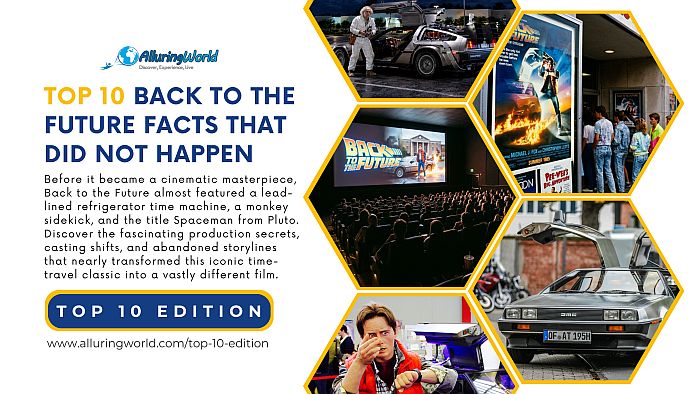
Very few films in the cinema’s history have managed to leave such an indelible mark on popular culture as the 1985 film Back to the Future by Robert Zemeckis. This groundbreaking tale of time travel, with the heroes Marty McFly and Doc Brown, is well-renowned for its excellent scripting, ideal timing, and superb acting. Yet, the journey to this great film was anything but ordinary.
Internet forums and trivia websites are often full of rumors regarding what might have been, but understanding where Hollywood lore ends and production facts begin demands a closer examination of the record. If some of the starting concepts, casting choices, or screenplay drafts had been pursued further, our beloved movie would bear no resemblance to what it is today. From a completely different type of time machine to very different fates for our characters, here are the top 10 things about Back to the Future that never made it into the final cut.
1. Eric Stoltz as the Definitive Marty McFly
This is one of the best-known facts in Hollywood history: Eric Stoltz was initially cast to play Marty McFly and shot for about six weeks before he was swapped out for Michael J. Fox. The legend is that Stoltz was just a temporary actor or that his footage was minor. The truth is that Robert Zemeckis and Steven Spielberg really wanted Eric Stoltz to be their final choice.
This change happened because while Stoltz was working on the part, he applied his acting skills dramatically instead of applying a lighthearted and comedic approach that was needed in the scene. Stoltz even went to the extent of requiring to be called “Marty” even outside the shoot. Although Stoltz is a very skilled dramatic actor, his acting was missing the special charm needed to make the time-traveling teenager relatable. It was therefore decided to spend about a month’s worth of shooting to start again using the perfect Michael J. Fox.
2. A Refrigerator as the Time Machine
When co-writers Robert Zemeckis and Bob Gale first conceived the mechanics of time travel, they did not picture a sleek, stainless-steel sports car, as we see it in the final cut, tearing down a runway at 142 kilometers (88 miles) per hour. In the earliest drafts of the screenplay, Doc Brown’s temporal device was a heavily modified, stationary home refrigerator.
To activate the mechanism and return to the future, Marty was supposed to harness the immense energy of an atomic bomb test site in Nevada. This idea was abandoned due to two major factors: logistics and child safety. Steven Spielberg was deeply concerned that young children watching the movie would accidentally lock themselves inside old latch-style refrigerators while playing time travel. Additionally, building a mock nuclear test site would have blown the budget. The writers shifted gears and realized the machine needed to be mobile, leading them straight to the iconic DeLorean DMC-12. Fascinatingly, Spielberg would eventually revisit the concept of surviving a nuclear blast inside a lead-lined fridge over two decades later in Indiana Jones and the Kingdom of the Crystal Skull.
3. The Movie Released Under the Title “Spaceman from Pluto”
One of the most bizarre corporate interventions in film history came from Sid Sheinberg, the head of Universal Pictures at the time. Sheinberg sent a now-infamous interoffice memo to Robert Zemeckis insisting that the title Back to the Future was unappealing and that audiences would not watch a movie with the word “future” in the name.
Sheinberg strongly advocated changing the title to Spaceman from Pluto. He also suggested changing Marty’s dialogue when he dresses up in the radiation suit to scare his 1955 father, making him say “I am a spaceman from Pluto” instead of “I am Darth Vader from the planet Vulcan.” Producer Steven Spielberg saved the day by sending a brilliant reply thanking Sheinberg for his “hilarious joke memo,” pretending the executive was just playing a prank. Embarrassed to admit he was serious, Sheinberg dropped the issue, and the original title remained untouched.
4. Doc Brown’s Pet Chimpanzee, Shemp
In the final version of the movie, Doc Brown’s faithful dog is Einstein; however, initially, it was intended that the quirky scientist would be accompanied in the laboratory by a chimpanzee named Shemp.
The shift from a monkey to a standard dog was completely based on economic reasons at the studio and the superstitions of its executive. Sid Sheinberg said that there was no film with a chimp that brought any profit. Writer Bob Gale argued, mentioning the successful movie Every Which Way but Loose (1978) starring Clint Eastwood. However, Sheinberg denied the idea, roaring, “An orangutan! Not a chimp!” (the real examples of chimp movies include the film Bedtime for Bonzo from 1951). The producers decided not to argue with the studio, and the substitution of Shemp for a dog became a great decision from the creative point of view since it is much easier to train a dog in a fast-paced environment than a monkey.
5. Johnny Depp or Charlie Sheen as Marty McFly
Prior to the time when playing the character of Marty McFly would become the trademark for Michael J. Fox, even before Eric Stoltz was cast for the part, a massive casting process took place. The internet is full of rumors that big names such as Johnny Depp and Charlie Sheen almost got the leading part.
While both actors did audition during the massive talent search, neither came close to landing the part. Johnny Depp was quite young at the time and, according to Bob Gale, his audition was entirely unmemorable, leaving no lasting impression on the creative team. Charlie Sheen had a different vibe that did not match the suburban, wholesome energy required for Marty. The team always wanted Michael J. Fox from day one, but his commitments to the hit sitcom Family Ties forced them to look elsewhere initially.
ADVERTISEMENT
6. A Post-Apocalyptic 1985 Ending
In one of the early drafts, the ending of Marty’s story was quite different. The film was going to end with him arriving in an altogether alien futuristic environment, unlike the happy 1985 in which his dad was a best-selling author and his family was flourishing.
In this abandoned version, the events of Marty’s journey back in 1955 had changed the timeline to such an extent that the whole world found itself in a retro-futuristic universe filled with inventions of Doc Brown, like flying cars and advanced technology. However, the emotional core of the movie was missing from the script, and thankfully, the directors recognized that the real emotional pay-off of the movie wasn’t in altering the whole world; the emotional part came when George McFly finally stood up to Biff Tannen.
7. Melora Hardin Staying as Jennifer Parker
When Eric Stoltz was let go from the production, he wasn’t the only casualty of the casting shake-up. Actress Melora Hardin (who later found immense fame playing Jan Levinson on The Office) had already been cast as Marty’s girlfriend, Jennifer Parker.
Hardin never actually filmed a single scene. When Michael J. Fox was brought in to replace Stoltz, a physical discrepancy arose. Melora Hardin was notably taller than Fox, especially if she wore heels. The creative team worried that having a girlfriend who towered over the male lead would alter the visual dynamic and make Marty look less commanding on screen. Hardin was reluctantly let go, and Claudia Wells was brought in to play Jennifer because her height perfectly complemented Fox’s stature.
8. John Lithgow as Doc Brown
It is impossible to imagine anyone other than Christopher Lloyd delivering the wide-eyed, manic energy of Doctor Emmett Brown. Yet, he was far from the studio’s first choice, and Lloyd himself nearly turned down the role to pursue a stage play in New York.
The casting department made serious attempts to get John Lithgow, who had been doing very well in unusual sci-fi and dramatic roles lately. Lithgow was unavailable because of his schedule, which paved the way for Lloyd. Jeff Goldblum was also considered for the role briefly, but in the end it was not finalized. Lloyd got the idea for his character when he combined the images of the great conductor Leopold Stokowski and the renowned scientist Albert Einstein.
9. A Sequel Intentionally Set Up by the Ending
It ends with Doc Brown arriving from the future and telling Marty and Jennifer that “something has to be done about your kids.” The DeLorean then flies off into the movie screen, so for many years, audiences believed that this was evidence that a trilogy was always intended.
Bob Gale and Robert Zemeckis have repeatedly debunked this. The flying car ending was written strictly as a fun, optimistic joke to send audiences home with a smile. The filmmakers had absolutely no intention of making a sequel at that time, and when the movie became an unprecedented global box office phenomenon, Universal Pictures demanded a continuation. The writers actually found themselves trapped by their own joke, realizing they had to write a script that included Jennifer inside the time machine, which complicated the narrative structure of Back to the Future Part II.
10. The Nuclear Energy Source inside the DeLorean
In the final cut, the DeLorean requires a plutonium-powered nuclear reactor to generate the necessary 1.21 gigawatts of electricity, which Marty subsequently replaces with a lightning strike in 1955. However, early concepts did not use plutonium at all.
The original power source for the vehicle was intended to be standard, everyday garbage from the very beginning of the movie. The writers eventually decided that using a highly dangerous, stolen material like plutonium added a ticking clock element and high stakes to the opening act, giving the Libyan nationalists a reason to pursue Doc Brown. They pushed the garbage-powered concept, the “Mr. Fusion Home Energy Reactor,” to the very end of the movie as a sign of how far technology had advanced in the year 2015.
In summary, the phenomenal evolution of the movie Back to the Future from being an initially rejected screenplay to a cultural phenomenon demonstrates that the magic of the movie is sometimes a consequence of good luck, changes in approach, and quality control measures. Had the studio stuck with the initial concept of a refrigerator for a time machine, preserved its bleak post-apocalyptic ending, or insisted on naming it Spaceman from Pluto, the movie would have certainly been consigned to oblivion. But having dropped these elements in favor of the likeability of Michael J. Fox, the design of the DeLorean, and an emotionally charged family tale, the producers created a classic.