
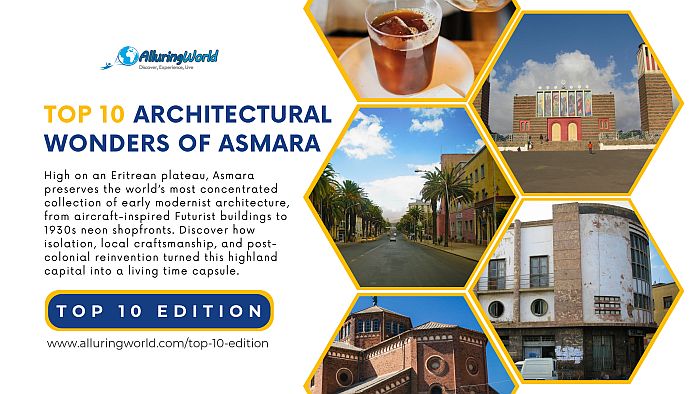
When people think of the world’s great architectural capitals, they are often prompted to think first of cities like Paris, Rome, or Miami, as these are the mainstream cities that immediately come to mind. Yet, high on a rocky plateau in the Horn of Africa, sitting more than 2,300 meters (7,545 feet) above sea level, lies the planet’s most concentrated and intact collection of early modernist architecture. Asmara, the inland capital of Eritrea, is an open-air time capsule, one so significant that in July 2017, UNESCO inscribed its entire historic center as a World Heritage Site. Asmara’s unique visual identity is a result of its complex and troubled colonial history. Initially consisting of four small Tigrinya clan villages, the town was occupied by Italian forces in 1889 and officially became the capital of Italian Eritrea in 1900. The construction efforts on the highland colonial outpost went into full swing during the 1930s under the leadership of the fascist leader, Benito Mussolini. The progressive Italian architects and city planners from that period, whose work was curtailed because of stringent aesthetic rules and legislation for conservation at home, were given the chance to experiment with Asmara, which later would get the title of Little Rome. Unleashed on the Eritrean highlands, they mixed Art Deco, Futurism, Rationalism, and Novecento styles, and managed to create an incredible cityscape that has changed very little in nearly a century.
1. The Global Epicenter of Pre-War Modernism
Whereas the European cities lost much of their early modernist architecture during the World War II bombings and after the war as a result of rapid development, Asmara was miraculously kept intact from drastic changes. After Italian colonial rule came periods of British military administration and federation with Ethiopia, during which time Eritrea fought a vicious thirty-year battle for its independence between 1961 and 1991. This long period and the resulting economic isolation of the country inadvertently protected the historic districts of Asmara from the hands of real estate developers, bulldozers, and glass skyscrapers. Today, there are over 4,000 well-preserved examples of modernist architecture within an area of about 2.6 square km (1 square mi), thus offering a level of architectural coherence and historical purity found nowhere else on Earth.
2. The Daring Geometry of Italian Futurism
Captivated by speed, technology, youth, and flight, Italian Futurist architecture reached its most dramatic form in Asmara. Unrestricted by the constraints of the building codes of Rome and Milan, Italian architects were able to create buildings resembling aircraft, with portholes and swooping lines, that seemed about to take flight. Nothing demonstrates this better than the Fiat Tagliero Building, a 1938 petrol station designed by Italian engineer Giuseppe Pettazzi. Conceived as a monoplane in mid-flight, the building has two enormous concrete wings, 15 meters (49 feet) long, which appear to float above the street with no visible support columns. According to local folklore, Pettazzi was so sure about the strength of his mathematical calculations that he stayed up on the roof when the wooden scaffolding was being dismantled to demonstrate that the wings would not collapse, and his work of architectural art would remain in its position for decades to come.
3. Strict Rationalist Precision
Contrary to the whimsical, aerodynamic curves found in the futurist designs, the Rationalist style favored order, symmetry, and stripped-back functionalism. This can be seen in the administrative, banking, and entertainment buildings in Asmara, which have clean lines devoid of classic ornamentation. Instead, there are dramatic geometric shapes with repetitive grids. Along the central thoroughfare, Cinema Impero, built in 1937 and named after Mussolini’s declaration of the Italian Empire, stands as a masterpiece of Art Deco and Rationalist design, with its towering vertical lettering and vertical rows of circular porthole lights. Nearby, you can also notice the equally amazing Cinema Roma, the Banca d’Italia building, and the stately Governor’s Palace (now the Presidential Office). All of these buildings project the crisp, minimalist aesthetic that would later inspire mid-century modern design across the globe.
4. Local Craftsmanship and Regional Materials
Though the Italians drew the blueprints, it was the hands of the Eritrean builders, stonemasons, and artisans that brought the city to life. These men had taken the European designs and adapted them to the highland environment using dark local stones, volcanic rock, terracotta brick, and subtle African decoration. Many buildings took the idea of mixing reinforced concrete with native methods and built the bold European structure within an East African environment. The mix of exotic design and local materials made the buildings very resilient to withstand over eight decades of high-altitude UV rays, cold evenings in the mountains, and heavy seasonal rains.
5. Human-Scale Urban Planning, and Its Divided Past
The charm of Asmara is as much in its visionary planning as in its landmarks. Wide, clean sidewalks, palm-lined boulevards, sunny public piazzas, and mixed-use blocks with apartment buildings above commercial stores make an active pedestrian city culture without any automobile sprawl at all. The spine of the city, Harnet Avenue (formerly known as Viale Mussolini), was designed as an elegant promenade for evening strolls, drawing residents out into the crisp highland air after sunset. But the tranquil appearance came along with the brutal aspect of colonialism because, according to Italian fascist racial laws, segregation was strictly enforced. On the other hand, indigenous Eritreans were forced to move to overcrowded and under-resourced locations like the Aba Shawl district, a stark reminder that architectural beauty was closely linked with imperial inequality.
ADVERTISEMENT
6. A Lingering Espresso Culture in East Africa
Entering an Asmara coffee shop is an experience of instant sensory surprise, one that you cannot experience in other places. Years after the collapse of the Italian colonial power, the city retains even today a café and espresso culture that can compete with Naples or Milan. At famous spots like Bar Zilli or Pasticceria Moderna, vintage 1940s and 1950s Gaggia and Faema espresso machines stand at the polished wooden bars, hissing as baristas extract aromatic cups of local Eritrean coffee along with plates of freshly baked cornetti and mille-feuille pastries. On Harnet Avenue, the daily custom of meeting for afternoon espresso combines traditional East African hospitality with leisurely Mediterranean café culture, which is unique to Africa.
7. Spiritual Harmony Along the Skyline
The center of Asmara showcases several centuries of religious harmony, since important structures of different faiths exist close to each other, and you can see different religious buildings throughout the city center. Rising prominently above Harnet Avenue is the Lombard Romanesque Church of Our Lady of the Rosary (commonly known as St. Joseph’s Cathedral), completed in 1923 with striking red brick and a 57-meter (187-foot) clock and bell tower inspired by London’s Big Ben. Not far from here are the Al Khulafa Al Rashiudin Mosque, marked by two minarets with flutes and Carrara marble, the historic Enda Mariam Orthodox Cathedral, with colorful geometric murals on it, and the white Asmara Synagogue. Instead of fighting for attention, their bell towers, domes, and minarets complement the low skyline of the city and show how the country is respecting the different religious groups that worship in Eritrea.
8. Preserved 1930s Typography and Shopfronts
For graphic designers, historians, and street photographers alike, the business districts of Asmara are one-of-a-kind in their wealth of historical references. Numerous coffee shops, pharmacies, barbershops, tailoring firms, and auto repair garages boast of their original 1930s custom signage and interior fittings. The handpainted signs, the vintage neon tubing, the wooden apothecary cabinets, and the cast-iron signage featuring the names in Italian and Tigrinya script are still intact on their time-worn fronts. It’s all of these details that are still present in Asmara and continue to attract visitors because they have been eradicated, simplified, and updated in Europe.
9. The Post-Colonial Reclamation of Space
After Eritrea gained its long-awaited independence in 1991, there was an important dilemma as to how to shape its capital, which was created by the occupying forces. The citizens did not opt for destroying the monuments and buildings linked with a dark period of colonial occupation; instead, they decided to take possession of the whole city. All the boundaries of the colonial era were erased, the neighborhoods became accessible, and the buildings that used to serve the purposes of fascist parties started functioning as schools, town halls, libraries, and neighborhood centers. Even the vintage Fiat 1100 taxis running through the streets of Asmara took on new meanings. Overall, the Eritrean people, with their ingenuity and self-reliance, have made it clear that they want to keep their colonial history alive and use it as a reminder of how others are shaping the lives of people who live far away from their own countries.
10. Redefining Modern Architectural History
For decades, architectural texts concentrated on European cities such as Germany’s Bauhaus school, the work of Le Corbusier in France, or the early skyscrapers of Chicago while completely ignoring the African continent. The World Heritage Site status of Asmara has changed all that. This site forces the world to realize that one of the best examples of modern architecture in the 20th century was created not in Europe or North America, but in the mountainous regions of East Africa.
Asmara is unique in that it cannot easily be described as anything other than a living museum of early modernism, as well as an extremely resilient and bustling East African capital. With the modern trend towards making historic city centers around the world uniform due to chain stores and high-rises, Asmara remains exceptional in its own right. By ensuring that the historic facades, handpainted signs, and sunny boulevards of Asmara survive demolition and decay, Eritrea has managed to preserve a piece of history that cannot be replaced.