
Read time ca. 6 minutes
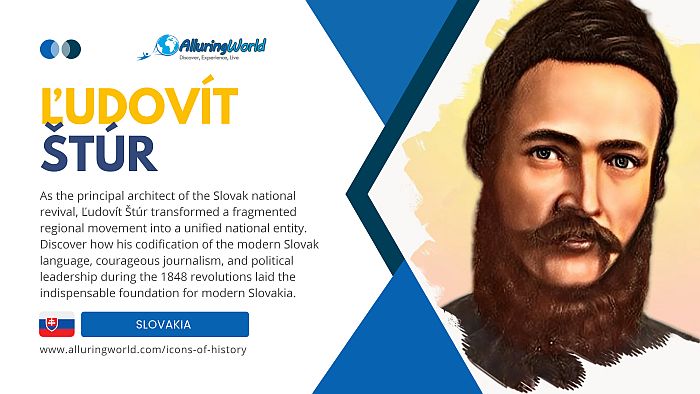
Ľudovít Štúr, born on 28 October 1815 in the village of Uhrovec, in the Kingdom of Hungary (modern Slovakia), is the key figure of the Slovak national revival. Being a linguist, poet, journalist, philosopher, and political reformer, Štúr turned a fragmented regional movement into a national entity. At the time of intense turmoil characterized by a Magyarization policy and political autocracy in the Habsburg Monarchy, Štúr offered a conceptual, linguistic, and political basis for the Slovak people to express their nationality. The legacy of Štúr far outlasted his short life, greatly influencing the history of Central Europe.
Early Life and Education:
Štúr was raised in a family that placed great value on education, learning, and citizenship. His father, Samuel Štúr, was a Lutheran schoolmaster; on the other hand, his mother, Anna Ružičková, created an atmosphere at home that emphasized discipline and knowledge. This Lutheran Protestant background exposed young Ľudovít to literacy, biblical scholarship, and community leadership, instilling principles that ultimately guided his work in developing and codifying the modern Slovak language. Right from his childhood, he showed remarkable talent in language, classic literature, and European history, with particular interest in human dignity and equality.
He received his primary education at the local schools and went on to join the famed Lutheran Lyceum in Pressburg (today’s Bratislava) in 1829. As a member of the Department of the Czechoslovak Language and Literature at the Lyceum, which was a student society, he soon became a very inspirational leader and served as an assistant professor. To enrich his philosophical knowledge, Štúr attended the University of Halle in Prussia between 1838 and 1840. In Halle, he embraced German Romanticism and Hegelian philosophy and learned about the organic nature of nations, the historical destiny of the Slavs, and the importance of language as the Volksgeist (spirit) of a nation. This academic foundation molded Štúr into both a rigorous theorist and a pragmatic public advocate.
Linguistic Achievements and Standardizing Slovak:
The greatest accomplishment of Štúr was the development of a modern literary language for Slovaks in the 1840s. Before Štúr, the Slovak language had been divided; Catholics used the language developed by Anton Bernolák, while Protestants used an old archaic dialect of liturgical Czech, called Bibličtina. Štúr understood that cultural division stood in the way of political advancement, so he looked for a language that would unite all Slovaks, regardless of their religion.
Štúr held meetings in July 1843 with his two main collaborators, Jozef Miloslav Hurban and Michal Miloslav Hodža, at Hurban’s rectory in the village of Hlboké. There, they made the groundbreaking decision to develop a new literary language based on Central Slovak dialects that were spoken throughout the region and had a phonetic beauty. This system was developed by Štúr in two main theoretical works that he published in 1846: Nauka reči Slovenskej (The Grammar of the Slovak Language) and Hlasovanie za spoločnú reč (A Plea for a Common Language). By codifying a distinct, accessible standard, with this language, Štúr gave the Slovak people their own unique voice, democratizing education and providing the indispensable cornerstone for modern Slovak literature and public life.
Literary Endeavors and Journalistic Leadership:
Besides his linguistic work, Štúr was an author, poet, and creator of Slovak journalism. He realized the need for a standardized language to have media through which such a language would reach wider populations and create civic awareness among people. Therefore, in August 1845, after years of working around governmental red tape and censorship by the Austrian Empire, he established the Slovenskje národňje noviny (Slovak National Newspaper), accompanied by its literary supplement Orol tatránski (The Tatra Eagle).
As an editor-in-chief, Štúr published works that were meant to tackle the pressing social and economic problems, such as poor peasant life, the need for educational reforms, the process of industrialization, and freedom from serfdom. His literary manner combined a romantic idealistic approach with sharp social analysis. In his poems, articles, and social-political writings, Štúr was calling upon his fellow people to wake up from lethargy and make use of their cultural traditions and work for moral improvement of their community. The newspaper proved to be an influential public platform, bridging the gap between intellectuals and rural peasants while establishing a shared national narrative across the Slovak lands.
ADVERTISEMENT
Political Advocacy and the Revolution of 1848–1849:
The activities of Štúr moved effortlessly from the defense of culture to political activism, as he wanted to make changes and make sure his fellow Slovaks would live in a place where they would be well respected. In 1847, Štúr was elected to the Hungarian Diet as the representative of the town of Zvolen, so by being one of the few representatives of minorities in Hungary, he gave fiery speeches in support of the emancipation of serfs, freedom, universal education, and language rights for all nationalities of the Kingdom of Hungary.
During the revolutionary surges of 1848 in Europe, Štúr took up leadership with Hurban and Hodža in the movement for Slovak nationhood. In May of 1848, they arranged a meeting in Liptovský Mikuláš and produced the Demands of the Slovak Nation (Žiadosti slovenského národa). This was a document that laid down demands for national autonomy, representation in the Hungarian Diet, Slovak language schooling, and freedom of assembly.
When the revolutionary Hungarian government rejected these demands and issued warrants for their arrest, Štúr and his colleagues formed the Slovak National Council in Vienna. During the autumn of 1848 and spring of 1849, they organized armed Slovak volunteer campaigns against the Hungarian revolutionary forces, aligning temporarily with the Habsburg imperial court in an effort to secure constitutional guarantees and administrative separation from Hungary. Although the Habsburg regime ultimately failed to fulfill its promises to the Slovaks after suppressing the revolution, Štúr’s leadership firmly established the Slovak people as an independent political actor in Central Europe.
Philosophical Vision and Later Years:
After the crushing of the 1848-1849 revolution, Štúr found himself under strict surveillance of the imperial Austrian police service. Forbidden from teaching, journalism, and active politics, Štúr withdrew into the small town of Modra near Bratislava to take care of his brother’s orphans and devote the remainder of his life to extensive writing and contemplation.
It was during this period of enforced seclusion that Štúr produced some of his most important philosophical writings such as O národných piesňach a povestiach plemien slovanských (On National Songs and Myths of Slavic Tribes), and Das Slawenthum und die Welt der Zukunft (Slavdom and the World of the Future), which he wrote in German. Disillusioned with the inability of Western European liberalism and Habsburg absolutism to safeguard the interests of the minorities, Štúr turned to Pan-Slavist ideas and pondered the historical destiny of Slavic peoples, thus contemplating the long-term historical destiny of Slavic cultures and urging spiritual renewal, moral integrity, and social justice grounded in community solidarity.
Personal Character and Tragic Death:
Throughout his life, Štúr was appreciated by many for his high level of moral integrity, humility, and dedication to serving others. He deliberately opted to live a life of sacrifice rather than that of comfort and luxury in order to serve society.
Tragedy struck in December 1855 during a hunting excursion near Modra, when he accidentally shot himself in the thigh. He succumbed to his injuries on 12 January 1856, when he was 40 years old. His untimely death came as a shock to the Slovaks and elevated him instantly to the status of a national hero devoted to his people.
Conclusion:
In conclusion, Ľudovít Štúr is a pivotal historical figure of Slovakia who made valuable contributions to language, literature, and political thought that still have a resonance today. Through his visionary efforts to develop the central dialect, write journalism, and fight politically during the 1848 revolution, he created the necessary basis for modern Slovak society. His work provided the cultural strength that enabled the Slovak nation to survive systematic assimilation efforts and ultimately achieve self-determination in the 20th century. Today, monuments, academic institutions, and schools have been established in Štúr’s honor all over Slovakia, such as the city of Štúrovo, along with his portrait on national banknotes before the adoption of the euro, thereby immortalizing him as a living symbol of cultural perseverance, intellectual fortitude, and national pride.