
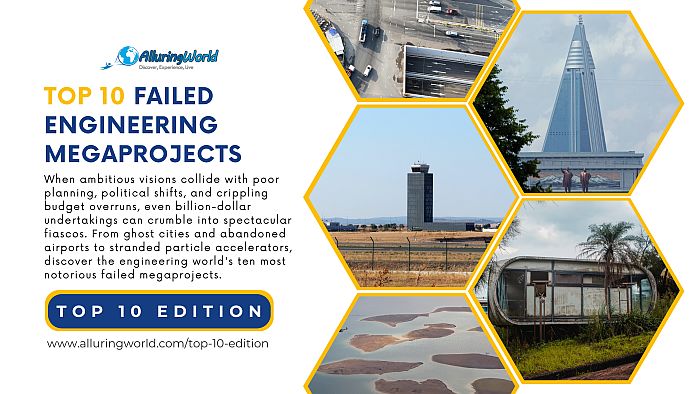
It is a known fact that the combination of ambitious visions with inadequate planning, rampant corruption, or unforeseen economic changes will lead to almost certain disaster. All over the world, governments and private organizations have spent billions on projects designed to transform the landscape and economy in revolutionary ways; yet these plans ended up turning into high-risk financial fiascos.
According to civil engineering and urban planning literature, a megaproject refers to a project that entails a cost of over one billion dollars, or an amount around this number. Despite the fact that several megaprojects encounter some problems in terms of time delays and budgetary constraints, a true mega failure takes place when the project is abandoned, structurally unsound, or is a ghost site with zero economic benefits.
These massive undertakings serve as sobering reminders that no project is too big to fail, but to understand how even the most well-funded concepts can collapse under their own weight, here is the definitive list of the top ten biggest mega failed projects that shook the engineering world.
1. The Superconducting Super Collider (United States)
- The Strategy: The concept of the Superconducting Super Collider was developed during the 1980s as a huge collider facility that was intended to be located in Waxahachie, Texas. The SSC design involved construction of a ring structure, with a circumference of 87 km (54 mi), generating energy of 20 TeV in each beam. This project was meant to surpass the capacity of the European collider LHC.
- The Execution: The construction began in 1991; however, it did not take long for the huge project to be dominated by political and financial issues. The projected cost of $4.4 billion increased to over $12 billion due to changes in designs and poor management, but with the breakup of the Soviet Union, there was no longer any political need to assert its dominance in the realm of high-energy physics. It was the leaders of the project and party leaders as well that rethought the benefits this project would bring. In light of huge budget deficits in the country, the U.S. Congress officially terminated the project in October 1993. Approximately $2 billion was invested in the project, while construction of 22.5 km (14 mi) of tunnels had been completed.
2. The Forest City Project (Malaysia)
- The Strategy: Forest City was introduced in 2016 as a futuristic and environmentally sustainable megacity worth $100 billion and developed by Country Garden, a China-based developer, in collaboration with a Malaysian investment firm. The city, which consists of four artificial islands in the Johor Strait, close to Singapore, is designed to accommodate 700,000 foreign citizens through seafront towers, technology centers, and tax havens for businesses.
- The Execution: The project fell victim to a perfect storm of regulatory shifts, capital controls, and market realities. Domestic policy shifts in China restricted capital outflows, severely limiting the ability of mainland buyers, who made up the majority of pre-orders, to finance their mortgages. Simultaneously, Malaysian political shifts restricted long-term residency visas for foreign buyers. By the early 2020s, financial instability within the primary developer stalled construction. Today, despite towering residential structures being finished, less than 1% of the planned population resides there, turning the vast artificial island network into a luxury ghost city surrounded by vacant commercial complexes.
3. The New Valley Project / Toshka Project (Egypt)
- The Strategy: This project was launched in 1997 during the presidency of Mubarak with an objective to channelize the water from Lake Nasser using the giant Sheik Zayed Canal into the Western Desert of Egypt, which is dry and barren in nature. The objective of the project was to irrigate about half a million acres of barren land by making it suitable for agriculture.
- The Execution: There were serious environmental and economic barriers to overcome in the engineering process. The extreme heat of the desert caused very high rates of evaporation, whereas soil salinity made huge areas of the reclaimed land unfit for crop farming. The venture cost the national budget billions but yielded virtually nothing, unable to bring in the millions of settlers needed because of inadequate infrastructure and living conditions. Although scaled-down versions of the project are still underway, the dream of creating an agricultural haven out of the Western Desert was a complete failure.
4. Ciudad Real Central Airport (Spain)
- The Strategy: Ciudad Real Central Airport came into being during Spain’s building boom years in the early part of the 2000s. It was intended to be the best airport in the whole country from the perspective of private international airports. Built at an expenditure of over €1.1 billion, it had a runway of 4,000 meters (13,123 feet) that could even accommodate the great Airbus A380 planes.
- The Execution: Opening in 2008, the airport immediately suffered from geographical isolation and structural flaws in its transport integration. Commercial airlines flatly refused to route traffic through a facility located two hours from the capital when Madrid–Barajas Airport was expanding its own capacity, which continued to be improved throughout the year. Passenger volume remained practically non-existent, and the operating company declared bankruptcy in 2010. Operations ceased entirely by 2012. Despite attempts to auction the facility for cargo, aircraft storage, or media production, the multi-billion-euro airport remains one of the most prominent ghost infrastructure assets in European aviation history.
5. Mirabel International Airport (Canada)
- The Strategy: The Canadian government announced in 1969 the construction of Montréal–Mirabel International Airport. It was designed to be the largest airport in the world, as it would be occupying over 39,000 hectares (96,371 acres) of land. The mega-airport was supposed to cater to fifty million passengers per year, replacing Montréal–Trudeau (Dorval) Airport in Montréal.
- The Execution: The project’s master plan failed due to urban transit logistics and changing aviation mechanics. Mirabel was constructed 55 kilometers (34 miles) outside downtown Montréal, and the high-speed rail link intended to connect it to the city center was never built. Furthermore, long-range jet technology eliminated the need for refuel stops in Montréal for flights heading deeper into North America. Airlines strongly resisted operating domestic flights out of Trudeau while running international flights out of Mirabel, as transfers required an expensive one-hour road journey. Passenger services were completely discontinued in 2004, and the multi-million-dollar passenger terminal was ultimately demolished in 2014.
ADVERTISEMENT
6. The World Islands (United Arab Emirates)
- The Strategy: Launched in 2003 by Nakheel Properties in Dubai, The World was an offshore engineering project comprising 300 private artificial islands constructed in the shape of a global map. Built using over 300 million cubic meters (392 million cubic yards) of dredged sand and millions of tons of rock, the project was envisioned as the ultimate luxury enclave for high-net-worth investors and sovereign developers.
- The Execution: The global financial crisis of 2008 had a huge impact on the private equity market and developmental investments; work has since been brought to a halt throughout almost the whole of the archipelago. With the exception of the few beach club and hotel projects that have been developed, most of the islands, out of the total of 300 islands, have remained untouched sand banks. The survey results noted that islands that lacked protection measures were at risk of being actively eroded and having channels filled up with silt.
7. The Ryugyong Hotel (North Korea)
- The Strategy: The Ryugyong Hotel project started in 1987, and it is a 105-story pyramid-like skyscraper with a height of 330 meters (1,083 feet). It was designed as a symbol of the technical power of the Cold War and was supposed to hold 3,000 hotel rooms, dining halls, gambling places, and lounges for executives.
- The Execution: After experiencing extreme macroeconomic turbulence and the disintegration of its benefactor, the Soviet Union, the construction came to a standstill in 1992. The building was an empty concrete frame with no windows and interior features for 16 years, and the Egyptian telecom giant Orascom stepped in by glazing the building and adding LED displays, which were installed between 2008 and 2011. Nowadays, the interior is entirely incomplete, lacking even basic features such as plumbing and electricity, and structural safety certifications, but the exterior appearance does give the resemblance of a finished and well-working structure. It has housed no one at all, although the government has invested billions into its construction.
8. The Sanzhi UFO Houses (Taiwan)
- The Strategy: The Sanzhi Pod Village started being built in 1978 in the Sanzhi District, which is part of New Taipei City. This was a project intended to build a highly modernized seaside resort village, and it included the use of highly futuristic modules, known as “Futuro” pods, made of fiberglass-reinforced plastic.
- The Execution: The project suffered fatal financial, structural, and management failures almost immediately. The extreme thermal expansion of the experimental plastics, paired with harsh salt-water winds, caused severe structural degradation during construction. Fatal industrial accidents during assembly, combined with severe capital shortfalls following the 1970s oil shocks, caused the primary backing companies to pull funding. The site was permanently abandoned in 1980 before ever opening to guests. Decaying for decades as a famous ruined ghost town, the entire pod complex was completely demolished in 2010 after multiple commercial revitalization schemes failed to materialize.
9. The Yucca Mountain Nuclear Waste Repository (United States)
- The Strategy: Designated by the Nuclear Waste Policy Act amendments of 1987, the Yucca Mountain Repository was designed as the United States’ primary deep geological repository where the spent nuclear and high-level radioactive waste would be stored. Located inside a remote ridge in Nevada, the $15+ billion underground facility was engineered to isolate over 70,000 metric tons of radioactive materials deep inside volcanic tuff formations for up to 10,000 years.
- The Execution: In spite of years of thorough geological investigation and construction of vast tunnels for exploration, the project continued to be plagued by political impasse, litigation, and resistance in the region because of issues regarding the safety of the environment and water. The site was denied government funding during the Obama presidency in 2011, owing to the consistent opposition by Nevada legislators. The site continues to be legally bogged down in the licensing process at the federal level, being altogether non-operational and thus leaving the country without a disposal repository for commercial nuclear waste, despite the expenditure of over $15 billion.
10. The Atlantic Coast Pipeline (United States)
- The Strategy: Launched in 2014 as a collaborative effort between energy companies, Dominion Energy and Duke Energy, the Atlantic Coast Pipeline was a huge energy infrastructure project worth $8 billion. The proposed project was supposed to be an 800 kilometers (497 miles) long natural gas pipeline transporting energy from the Marcellus Shale formation in West Virginia to North Carolina, through Virginia.
- The Execution: Legal fights involving regulatory issues, environmental lawsuits, and cost escalation complicated the project immensely. Federal permits were invalidated in federal appellate courts due to a lack of proper assessment of the environmental impact on endangered species and public land. While the project managed to win a positive judgment at the Supreme Court level about its right-of-way under the Appalachian Trail in 2020, prolonged litigation and regulatory delays led to an escalation of project costs from $5.1 billion to more than $8 billion. Under pressure from all these legal and financial uncertainties, along with the evolving dynamics of the natural gas market, the utilities officially scrapped the project in July 2020.
In summary, the failure of such mega projects does not arise from one particular engineering failure but rather from overconfidence exceeding actual conditions. Regardless of whether it has been an underestimation of geographical isolation or a lack of consideration for politics, these ten cases have shown that no amount of money can save a project from failure when its roots are already corrupt. The true value of these monuments of concrete will be the lesson learned from their data on what does not work in planning a sustainable project.