
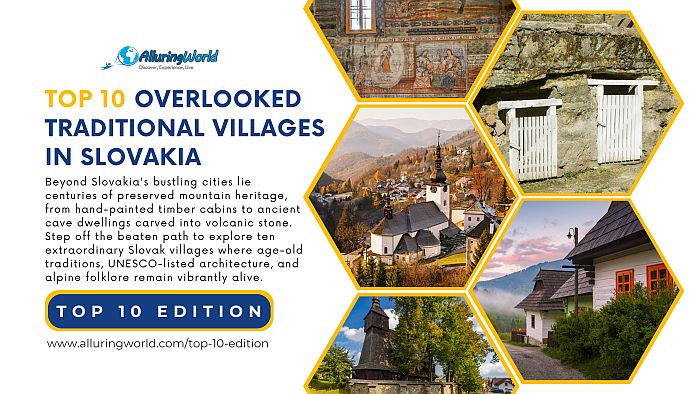
The most common perception about Slovakia is that of rugged mountains, ancient castles, and vibrant streets of the capital city of Bratislava. But besides the tourist spots of Slovakia lie other aspects of the country; villages in valleys, alpine villages, and historic agricultural villages where the traditional way of life is preserved.
Rural Slovak culture for many years past was influenced by the harsh terrain of the Carpathian Mountains. Due to their geographic isolation, various regions of the country formed unique dialects, architectural styles, regional costumes, and food traditions. Now ten genuine Slovak villages present a rare opportunity for curious travelers to get acquainted with the rich heritage of Central Europe alive to this day.
1. Vlkolínec (Žilina Region): A Living Carpathian Mountain Settlement
Tucked away in the foothills of the Great Fatra Mountains near Ružomberok, Vlkolínec is one of Europe’s remarkably intact rural settlements. Designated as a UNESCO World Heritage Site in 1993, this hillside hamlet features over 45 preserved log houses painted in muted pastel shades of blue, yellow, and white, topped with traditional wooden shingle roofs.
Different from fixed outdoor museums, Vlkolínec is actually a living village that still has some inhabitants who take care of the traditional buildings. Its planning has not been changed since the 19th century and includes a wooden bell tower from 1770 and a clean mountain river flowing through the log canal along the street. Visiting this village means getting back to the old days of logging and cattle breeding.
- Highlight: Wooden bell tower from the 18th century and the exhibition of folk architecture inside a genuine log cabin.
- Best For: People into photography, history conservation, and mountain walking.
2. Čičmany (Žilina Region): The World’s First Folk Architecture Reserve
Hidden in a deep valley of the Strážov Mountains, Čičmany is instantly recognizable for its striking dark timber log cabins adorned with elaborate white geometric motifs. Originally applied using lime to protect and seal the wood against weather damage, these hand-painted symbols mirror the traditional cross-stitch patterns found on local folk embroidery (kroj).
In 1977, the village was designated as the first folk architecture reservation of its kind in the world. Other than its famous walls, Čičmany celebrates its regional folklore with local music, lace making, and festive events. The Radenoff House is a museum where guests can experience life in past times with displays of regional utensils, attire, and craftwork.
- Highlight: Geometric designs painted on the exterior walls of Radenov Dom.
- Best For: Culture, history, textile arts, and regional folk design.
3. Osturňa (Prešov Region): Secluded Goral Traditions in the Spiš Region
Extending through a valley in the vicinity of the Polish border, Osturňa ranks as one of the most remote locations in the area of Belianske Tatras. The inhabitants of this village belong to a distinctive ethnographic group of highlanders called Gorals, famous for their peculiar speech and lively music.
Osturňa is officially designated as a Folk Architecture Monument Reserve, holding dozens of traditional Goral farmsteads consisting of log living quarters, timber barns, and gated livestock yards. Because it sits far off the standard tour bus routes, visitors can experience a serene, untouched countryside landscape where livestock farming and woodcraft remain primary livelihoods.
- Highlight: Well-preserved Goral log farmsteads framing views of the Tatras peaks. These are traditional mountain homesteads built by the Goral people in the Carpathian Mountains.
- Best For: Off-the-beaten-path exploration, regional folklore, and rural landscapes.
4. Špania Dolina (Banská Bystrica Region): A Historic Copper Mining Enclave
Špania Dolina is a small mountain village in the Low Tatras range above Banská Bystrica, and it holds the fame of having an interesting history as an industrial town. It was once a major provider of high-quality copper in Europe during the medieval and Renaissance periods.
Today, the village is a quiet retreat where historic miners’ log houses cling to steep, pine-covered slopes. Visitors can hike the historical mining trail up to the massive spoil tip (Šachtička) for panoramic views of the Starohorské Mountains, explore the historic 16th-century Church of the Transfiguration, reached by a covered wooden staircase, and observe local bobbin lace (čipka) making, a craft brought to the valley by miners’ wives centuries ago.
- Highlight: The covered wooden staircase leading to the mountain church and panoramic mining spoil views.
- Best For: Industrial history, the mountain hikes with scenic views, and bobbin lace craftsmanship.
5. Brhlovce (Nitra Region): Unique Cave Dwellings Carved from Volcanic Stone
Brhlovce, situated in the undulating hills of southern Slovakia, displays a completely different architectural style from the wooden log houses of northern Slovakia. Brhlovce is famous for its very special dwellings that have been chiseled out of volcanic tuff formations.
These underground chambers have been around since the 16th and 17th centuries, being built originally for use as shelter during regional conflicts and raids by Ottomans. With time, the residents enlarged them into multi-story houses, wine cellars, and workshops, taking advantage of the cooling and heating properties of the rock in summer and winter, respectively. A museum on Šurda Street provides visitors with access to these unique underground buildings.
- Highlight: The Rock Dwellings Museum Complex on Šurda Street.
- Best For: Unique architecture, adaptation, and history of southern Slovakia.
ADVERTISEMENT
6. Zuberec & The Roháče Valley (Žilina Region): Gateway to Orava Heritage
Zuberec lies in northern Slovakia, close to the Western Tatras, and it acts as an important cultural center for the traditional Orava region. Alpine meadows and evergreen forests surround it, and its cultural traditions are linked with forestry and mountain farming.
Just outside the main village sits the Museum of the Orava Village (Múzeum oravskej dediny) at Brestová, widely considered one of Slovakia’s finest open-air museums. Built along the mountain stream Studený potok, it features over 50 authentic regional structures relocated from across Orava, including an old wooden watermill, a blacksmith’s forge, a fulling mill for processing wool, and a rare 15th-century wooden church from Zábrež.
- Highlight: Seeing the work of traditional craftsmen along the river at the Open-Air Museum of Brestová.
- Best For: Family-oriented cultural experiences, living history, and hiking in the Roháče Mountains.
7. Liptovské Sliače (Žilina Region): Heart of Liptov Folk Traditions
Sitting at the foothills of the Low Tatras and the Choč Mountains, Liptovské Sliače village comprises three distinct villages, Nižný, Stredný, and Vyšný Sliač, which collectively preserve the special charm of the historical and geographical region of Liptov within the central part of Slovakia.
Liptovské Sliače village has become famous all over Slovakia for its folk traditions. and the local folklore bands often sing polyphonic songs of the mountains, dating back hundreds of years, and dance traditional dances on various festivals and holidays. Tourists who visit this region will have an opportunity to visit old wooden houses, sample traditional cheese made of sheep’s milk (bryndza), and learn about wood carving.
- Highlight: Traditional folk music performances and authentic regional cuisine from central Slovakia.
- Best For: Cultural immersion from daily Slovak life, music history, and tasting authentic local gastronomy.
8. Vlachovo (Košice Region): Craft Heritage in the Slovak Ore Mountains
Vlachovo is a village situated on the banks of the river Slaná in the Košice region within the eastern part of Slovakia. The village grew from the iron ore mining, forestry, and sheep farming, and it has maintained strong ties to its roots through industrial buildings and well-preserved cottages.
The historic ice-house (Ľadovňa) is one of the landmarks that characterizes Vlachovo in Slovakia. The village has preserved the historical blast furnace complex (Huť Karl) in the vicinity of the historic ice-house, giving visitors a glimpse of the history of metal production in the region in the 19th century.
- Highlight: Historic ice-house of the 19th-century Andrássy family estate and nearby industrial monuments.
- Best For: Off-beat history, industrial archaeology, and serene river valley landscapes.
9. Hervartov (Prešov Region): Home to Slovakia’s Oldest Wooden Church
Located to the south of the historic UNESCO town of Bardejov, Hervartov is a village that lies nestled amidst the forested Čergov Mountains. Despite its sparse population, it is home to one of the greatest architectural marvels of religious significance in Central Europe.
The Church of Saint Francis of Assisi is located in Hervartov and is made entirely of red spruce wood that dates back to 1500. It is listed as a UNESCO World Heritage Site, and it is considered the oldest and best-preserved wooden church of Slovakia. The inside of this Roman Catholic church contains late-Gothic paintings representing the fight between Saint George and the dragon and 15th-century altars.
- Highlight: Wooden church and 15th-century Gothic wall paintings.
- Best For: People chasing UNESCO World Heritage Sites, the sacred art, and medieval architecture.
10. Kvačany & The Oblazy Watermills (Žilina Region): Rural Engineering in Nature
Kvačany is a small settlement found at the entrance to the Kvačianska Valley in Liptov, and the first stop of one of the most beautiful countryside hiking trails in Slovakia. Although the settlement itself has maintained a very pastoral nature, its real gem is buried deep in the gorge.
The journey to Oblazy begins when tourists climb up the mountain path for a few kilometers, reaching a faraway meadow at the bottom of the valley, where two old mills from the 19th century have been built next to the flowing river. These functioning timber mills have been restored and maintained by some voluntary conservationists, giving tourists an opportunity to go inside and see wood-gearing mill equipment driven by water power.
- Highlight: The working 19th-century wooden watermills at Oblazy deep in the Kvačianska Valley gorge.
- Best For: Eco-tourism, family hiking, and historic rural technology.
Planning Your Journey to Rural Slovakia
Visiting Slovakia’s traditional villages is an exciting alternative to Europe’s busy cities, where visitors can directly encounter living history, nature, and hospitality, something that cannot be experienced in other parts of Europe or the world. To have a great travel experience in these historical areas, it would be recommended to consider some practical tips that would help you to explore these places much better:
- Getting Around: Although bigger hubs such as Ružomberok, Liptovský Mikuláš, and Banská Bystrica have rail transport, it is advised that one should rent a car when traveling to far-flung villages such as Osturňa and Brhlovce, because this way you will be able to see more, as you can stop and experience different sections of the trip.
- Best Time to Visit: Late spring through early autumn (May to October) offers optimal weather for countryside hiking, outdoor heritage museum demonstrations, and colorful village folk festivals.
- Local Culinary Must-Try: Be sure to sample bryndzové halušky (potato dumplings served with fresh sheep cheese and crispy bacon) at traditional roadside mountain taverns known as koliba or salaš.
In summary, discovering the hidden villages of Slovakia is an opportunity to see a part of Central Europe that demonstrates a rich history not bound by textbooks and glass encased in museums. The colorful wooden houses of Čičmany, the subterranean caves of Brhlovce, and the high mountain pastures of Osturňa demonstrate the resilience, creativity, and adaptability of rural Slovakian society.
While conventional tourism usually restricts itself to big cities and popular skiing areas, exploring these ten historic towns offers the traveler an experience filled with relaxation and authenticity. In doing so, you not only help preserve the local culture but also come across age-old traditions that survive in their full glory amidst the spectacular scenery of Slovakia.