
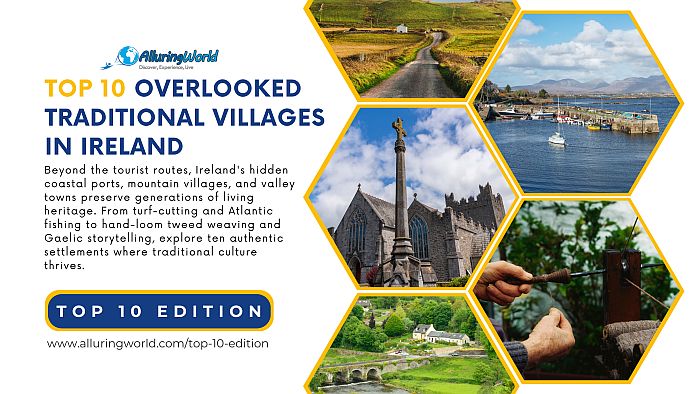
Typical perceptions about Ireland include images of the bustling cobbled streets of Dublin, the breathtaking plunge from the Cliffs of Moher, the picturesque Ring of Kerry, and famous historical locations such as Newgrange or the Rock of Cashel. However, there is another side to Ireland, hidden away from the main tourist areas, which includes coastal ports, mountain villages, and valley towns where traditional ways have been passed down for generations.
Across Ireland’s countryside and island settlements, traditional culture was forged through geographic isolation, harsh Atlantic weather, and a deep reliance on the surrounding landscape. From turf-cutting in central bogs to Atlantic fishing, hand-loom tweed weaving, and Gaelic storytelling, these ten hidden Irish villages offer an authentic look into the living heritage, regional architecture, and regional customs of the island that you should not miss if you embark on an Irish travel adventure.
1. Doolin (County Clare): A Coastal Music Enclave on the Atlantic Edge
The tiny village of Doolin lies precariously on the exposed coastline of North Clare and has achieved global recognition for its claim to fame as the traditional music center of Ireland. Although many tourists may visit the village just on their way to the famous Cliffs of Moher or the ferry to the Aran Islands, Doolin still retains the essence of a maritime and farming society.
The residents of Doolin have depended on fishing, gathering of kelp, and cattle raising on the difficult terrain of karst hills for decades. Even today, Doolin village continues to maintain its distinctive three-part design covering Roadford, Glenford, and Fisher Street with cottages made from thatch. The culture of Doolin can be best understood in the evening when local musicians come together for traditional Irish music sessions.
- Highlight: Catching an authentic nightly Irish music session at Gus O’Connor’s Pub or McDermott’s Pub.
- Best For: Folk music enthusiasts, coastal photography, and maritime history.
2. Cong (County Mayo): A Medieval Island Settlement Between Two Lakes
Tucked neatly into an isthmus connecting Lough Corrib and Lough Mask on the Mayo–Galway border, Cong is a historic village built and surrounded by pristine rivers, limestone caves, and ancient woodlands. The village developed around the ruins of Cong Abbey, which is a 12th-century Augustinian monastery that served as a major center for medieval religious craft and royal patronage.
The architectural style of Cong comprises dry stone walls, an arched stone bridge, and ancient cottages on the estate. Water has always shaped the activities of the people of Cong, as it has been home to many historical dry stone fish huts, and the waterways are also present along the banks of the river. Although known for being used as the setting of the 1952 movie “The Quiet Man”, Cong has maintained its quiet country feel and its focus on river and woodland conservation.
- Highlight: Exploring the 12th-century stone fishing house, better known as the Monk’s Fishing House, built directly over the River Cong.
- Best For: Medieval history, forest walks, and freshwater fishing heritage.
3. Adare (County Limerick): Historic Crafts and Thatched Architecture
Adare is a very charming Irish village lying on the banks of the River Maigue in County Limerick. It is famed for its quaint thatched cottages and ancient architecture, with a history that dates back to the 12th century. It prospered in the wake of the Earls of Dunraven, who carefully planned the village in the 19th century to accommodate local farm laborers and artisans.
Unlike modern suburban developments, Adare’s main street functions as a living archive of vernacular Irish architecture, combined with timber-framed, thatched-roof cottages that feature thick stone walls and limewashed exteriors designed to withstand Irish winters. Adare is home to three historic monastic friaries as well: the Trinitarian, Augustinian, and Franciscan friaries. This greatly highlights the area’s deep religious and stone-masonry history.
- Highlight: The restored thatched cottages of the 19th century on Main Street will make you swoon.
- Best For: Vernacular architecture, heritage conservation, and medieval history.
4. Inistioge (County Kilkenny): A Riverside Agricultural Village in the Nore Valley
Nestled in a picturesque curve of the River Nore in southern Kilkenny County, Inistioge is a village estate enclosed by forests and undulating farmland. It was originally founded as a 6th-century monastic site, and grew to become a flourishing medieval market town through river commerce, forest exploitation, and limestone quarrying.
Inistioge’s design has been characterized by its 10-arch stone bridge built in 1765, narrow terraced streets, and trees in the village green. The village has been involved in economic activities in the past within the Woodstock Estate, with farming and fruit growing being common, but at present, Inistioge continues to maintain an agricultural lifestyle with fishing, craft-making, and countryside conservation as major activities.
- Highlight: Crossing the 10-arch stone bridge from the 18th century and touring the refurbished Woodstock Gardens close by.
- Best For: River valley hiking, 18th-century architecture, and quiet countryside retreats.
5. Kinsale (County Cork): A Historic Harbor Town Built on Maritime Trade
Situated at the entrance of the River Bandon in County Cork along the southern coast of Ireland, Kinsale is a historic village with a seafaring past dating back to the 12th century. Way before it became famous for its cuisine, Kinsale was a significant trading port and naval base as well as a fishing village fortified by two 17th-century forts: Charles Fort and James Fort.
The twisting streets of Kinsale show the influence of the medieval city design scheme, which has shop fronts, old shipyards with slate roofs, and seafaring cottages along them; nevertheless, the maritime history of Kinsale is inseparable from the sea. This is seen from its fishing fleet and shipbuilding yards to its long-standing involvement in coastal trade and fishing operations.
- Highlight: The huge star-fort, Charles Fort, dating from the 17th century at the harbor’s mouth.
- Best For: Maritime history, coastal fortifications, and seafood gastronomy.
ADVERTISEMENT
6. Ardara (County Donegal): The Heritage Capital of Hand-Woven Tweed
Hidden away amidst the picturesque glens and coastline in Southwest Donegal is the mountain village of Ardara, which stands as the center of traditional Irish weaving production. For many years, houses located throughout the surrounding hills have been the centers of cottage industries that made use of hand-looms to weave the world-famous Donegal Tweed.
Ardara’s remote location allowed ancient Gaelic customs, traditional fiddle playing, and textile crafts to flourish uninterrupted. The village remains one of the few places in Ireland where visitors can see master weavers crafting tweed using raw spun wool dyed with native lichens and mosses. In addition to textiles, Ardara is celebrated for its lively folk music festivals and strong roots in the Irish language (Gaeilge).
- Highlight: Visiting active hand-weaving workshops like Triona Design or Eddie Doherty’s weave shop on Main Street.
- Best For: Textile art, hand-loom weaving, traditional music, and Gaelic culture.
7. Roundstone (County Galway): A Coastal Connemara Fishing Village
Located along the Atlantic coast of Connemara, Roundstone is a 19th-century fishing village founded by Scottish engineer Alexander Nimmo. Set against the dramatic backdrop of the Twelve Bens mountain range and Bertraghboy Bay, the village was built to support coastal fisheries and local stone quarrying.
Roundstone’s heritage is tied to the traditional wooden currach; a canvas-over-lattice fishing boat uniquely designed to navigate rough ocean swells along Ireland’s western coast. The village features a protected stone harbor, rows of fishermen’s cottages, and active artisan workshops. Located within the Gaeltacht (Irish-speaking region), Roundstone remains an important cultural outpost for traditional Irish crafts, including hand-crafting bodhráns (traditional Irish goat-skin drums).
- Highlight: Watching traditional drum-making at Malachy Kearns’ Bodhrán workshop inside the old Franciscan monastery.
- Best For: Maritime heritage, traditional boatbuilding, craftsmanship, and mountain views.
8. Kilfenora (County Clare): The Heritage Heart of Burren Music and Dancing
Kilfenora, located at the south of the limestone karst plateau known as the Burren, is an old village dating back to the 6th century. This village is known by the name “City of the Crosses,” since it boasts several stone crosses. The growth of this village was centered on St. Fachnan’s Cathedral, which was erected in the year 1189.
Apart from the early Christian landmarks that it possesses, Kilfenora has an honored place in the folklore of Ireland as being the birthplace of the internationally acclaimed Kilfenora Céilí Band, which was established in 1909. This cultural heritage in this village has been preserved through constant community dances, playing of traditional instruments, and cattle fairs held on the limestone plains for many years now.
- Highlight: Viewing the 12th-century High Crosses inside the ruined chancel of Kilfenora Cathedral.
- Best For: High Cross archaeology, céilí music, dance history, and Burren geology.
9. Portmagee (County Kerry): An Atlantic Fishing Port and Island Gateway
Positioned on the edge of the Iveragh Peninsula along the Ring of Kerry route, Portmagee is a coastal fishing village overlooking Valentia Island. Named after Captain Theobald Magee, an 18th-century smuggler who used the hidden inlets to transport goods, the village developed into an active Atlantic fishing port.
The shore of Portmagee features rows of colorful terrace houses, seafood pubs, and a bustling harbor at which trawlers bring in daily catches of cod, hake, and lobsters from the Atlantic Ocean. Portmagee has maintained an affiliation with the nearby but secluded Skellig Islands, which lie 12 km (7 mi) out at sea and feature a monastery built by early Christian monks on the islands during the 6th century.
- Highlight: Watching local fishing boats coming back to the central pier with their daily catch.
- Best For: Authentic local fishing culture, coastal scenery, and Skellig boat excursions.
10. Eyeries (County Cork): Pastoral Tradition on the Beara Peninsula
Overlooking Coulagh Bay on the remote Beara Peninsula in West Cork, Eyeries is a brightly colored village built into the coastal hillside. Surrounded by rugged hills and ancient megalithic sites, Eyeries offers a glimpse into Ireland’s agrarian and coastal history, unaffected by major tourist commercialization.
The village is known for its vividly colored homes that have been created to brighten the landscape from the winter mist that hangs over the ocean. Historically, the people of Eyeries were engaged in farming sheep, fishing from the coast, and mining copper at the local Allihies mines. Now, the village maintains a vibrant community life, holding fast to the old traditions of turf cutting and strolls by the coast along the Beara Way.
- Highlight: Hiking sections of the historic Beara Way trail with views of Coulagh Bay.
- Best For: Off-the-beaten-path travel, colorful streetscapes, and coastal trail hiking.
Planning Your Journey to Rural Ireland
Visiting the quaint villages of Ireland provides you with a unique way of touring the country, thus allowing you to experience a living history as well as hospitality. Consider the following suggestions when planning your trip to Ireland:
- Getting Around: Though regional train and bus services link large centers like Galway, Cork, Limerick, and Ennis, it is highly advisable to hire a car when visiting the distant and isolated coastal villages.
- Best Time to Visit: The period from May to September is perfect for enjoying, as it provides the optimal number of daylight hours, moderate weather conditions for coastal walks, and festivals hosted by local villages.
- Local Culinary Must-Try: During your travels, make sure to take time to indulge in fresh seafood chowder alongside homemade soda bread, Atlantic oysters, and lamb stew in traditional village taverns. This would be the highlight of your Irish adventure.
In summary, uncovering the mysteries of these hidden villages of Ireland proves that the authentic cultural identity of the country goes much deeper than its touristy coastal loop, crowded tour buses, and well-known city monuments. These ten off-the-beaten-path villages are like living repositories of Irish culture because the traditions in these villages are not confined to museum displays but are alive in their functioning fishing ports, looms, music sessions, and agricultural practices.
From the rich music tradition of Doolin to the expert textile skills of Ardara, these villages reflect the flexibility, inventiveness, and friendliness of rural Irish culture. Whereas many tourists tend to follow modern travel trends that involve fast-paced tours and fleeting photographic glimpses, if you decide to take things slower and spend time exploring these quiet areas, you will be given the chance to gain a much more authentic relationship with the country. This decision you make will help to preserve Ireland’s unique culture by promoting the work of local artisans, family-run pubs, and other rural cultural organizations.