
Read time ca. 7 minutes
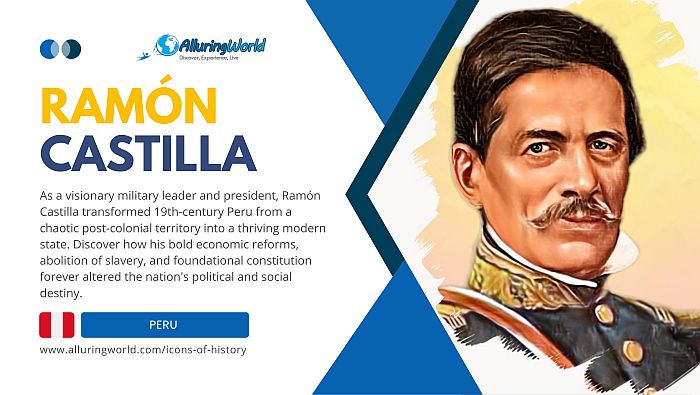
Ramón Castilla y Marquesado, born on 31 August 1797 in Tarapacá, then a major administrative territory of the Spanish Empire known as the Viceroyalty of Peru, emerged as one of the most influential figures in 19th-century Peruvian history. Castilla was famous for being a military leader, a politician, and an innovative president. He made important contributions to the development of Peru as a country due to his military skills, political abilities, and reforms. The biography of Castilla shows how difficult it is to rule a country after gaining independence and how visionaries can bring progress to the state.
Early Life and Military Formation:
He was born in the province of Tarapacá in the Viceroyalty of Peru during a time of political turbulence in South America. His military career commenced while he served in the royalist army of Spain, but he would later serve on the side of the patriots who were fighting against the royalists under the leadership of José de San Martín and Simón Bolívar. Castilla was notable for his participation in the War of Independence of Peru, especially the Battle of Ayacucho in 1824.
The military service gave him practical experience in tactics, logistics, and command, and also made him a witness to the political intrigues that influenced early Republican Peru. All of these experiences made him a unifying military officer who could act as an arbitrator for political factions, and positioned him in a key places that would later shape Peru into what we know today.
Role in Peru’s Independence and Early Political Career:
Peru has been struggling internally throughout the decades with internal fights for power, regional rebellions, and border conflicts, such as the War of the Confederation (1836–1839). Throughout Castilla’s career, he stood by his belief in the need for a centralized constitutional form of governance and became a national figurehead as a result.
Before assuming the office of President, Castilla had been serving in important administrative positions in his Tarapacá Region and also as the Minister of War and Finance. In all these capacities, he made use of fiscal control and gave priority to infrastructural development, an experience that he would later get to use during his presidency.
First Presidency and Major Reforms (1845–1851):
Ramón Castilla became president in 1845 following the fall and ousting of General Manuel Ignacio de Vivanco, who had subjected the nation to his autocratic rule. Ramón Castilla’s presidency became a crucial point in 19th-century South American history since it marked the end of constant civil war, coups d’état, and caudillismo that had been plaguing Peru ever since its independence on 28 July 1821. The beginning of Ramón Castilla’s rule initiated a new age of institutional order and institutionalized government known as “the Guano Era.” Such a revolutionary era was characterized by a huge global demand for guano, which is a bird manure that serves as a natural fertilizer, thus involving Peru in the world economic system in terms of international commerce with Western Europe and North America. With the help of his effective governance, Ramón Castilla used the natural resource wealth in the interests of economic development and state building. On top of this, he managed to do the following as well:
- Infrastructure and Innovation: Castilla gave permission for building the Lima-Callao railroad, which was then the first railroad to operate in all of South America, enhancing the efficiency of transportation from the capital city to its main port.
- Fiscal Stabilization: He was responsible for creating the first budget of Peru, as well as keeping the country’s records and paying off the nation’s debts that were almost staggering.
- Naval and Defense Modernization: He increased the strength of the navy through the acquisition of the steam frigate Rímac, making Peru a powerful maritime force in the South Pacific.
Leadership in the Guano Era:
Guano was a natural resource that was used during the middle part of the 19th century to meet the global need for fertilizers made of organic materials due to their high content of nitrogen. Castilla capitalized on this natural resource to promote the development of his country, and he managed to start his presidency quite successfully as he brought a significant amount of foreign currency the country needed.
Instead of letting all the money go into administrative expenses, as it might have been the case with other leaders, Castilla was smart, and he channeled the revenues into public works, education, national defense, and civil administration. His financial administration created a structure for economic growth and increased the presence of Peru in the international arena. His first presidential mandate lasted until 20 April 1851, and it was very evident that he made his impact on Peru’s daily life.
Abolition of Slavery and Second Presidency (1855–1862):
The 1854 Civil War in Peru was a trigger for significant social change in the country. After a huge financial scandal over the corrupt consolidation of the national debt by the then President José Rufino Echenique, liberal reformers and the army convinced Ramón Castilla to stage a revolt against the existing government. Setting up a provisional revolutionary headquarters in the Andean city of Huancayo, Castilla recognized that defeating Echenique’s regime required mobilizing broad public support. In an effort to destroy the socio-economic basis of the colonial system, Castilla decreed the abolition of the indigenous tribute in July 1854, then issued a historic decree on 3 December 1854, which abolished slavery in all of Peru. These measures provided moral clarity to the rebellion, successfully integrated marginalized Afro-Peruvian and indigenous populations into the revolutionary army, and effectively broke the power of the old landed oligarchy supporting the government.
After the defeat of the Echenique forces at the Battle of La Palma in January 1855, Castilla reclaimed his position as president and set out to make his social reforms during the war into laws through the constitution. In this regard, his regime was the first to introduce the progressive Constitution of 1856. However, in order to reconcile the radical liberals and the conservatives, he later introduced the more balanced Constitution of 1860. Designed to ensure executive stability while protecting civil liberties, the 1860 charter became the longest-lasting constitution in Peruvian history, remaining in effect for six decades until 1920. In parallel with this legal process, the second term of Castilla was characterized by the introduction of great modernization processes within the republic; this involved the allocation of government income to fund primary education, building the first telegraph networks, and undertaking big city-building projects within Peru.
ADVERTISEMENT
Challenges and Political Legacy:
The political obstacles that Castilla faced were many, such as the hostility of conservative landowners, regional military commanders, and market changes in export commodities. However, through his pragmatism in governance, he was able to institute sweeping reforms without altering the constitution.
The system he instituted played a key role in turning Peru from a politically divided post-colonial nation into a systematic republic, thereby creating a tradition of financial prudence and social reforms. He was a great leader and an example of how politicians should work with the nation’s finances.
Death and Historical Significance:
After stepping down from office in 1862, Ramón Castilla continued to be a prominent figure in Peruvian politics and was staunch in his defense of the constitution against any kind of executive tyranny. When Mariano Ignacio Prado took power at the end of 1865 and proceeded to dissolve Congress in order to form his own dictatorial rule, Castilla denounced this act strongly. Considering this government an undemocratic and unconstitutional violation of everything he had fought for all his life, Castilla openly declared against it, resulting in his exile to Chile in 1866.
Refusing to be exiled politically in his old age, the former president, who was already 69 years old, started to organize his revolutionary army from Chilean territory with the aim of returning democracy to the country. In the first months of 1867, Castilla started a northern campaign crossing the Atacama frontier, landing in his native Tarapacá region with a small contingent of loyalists. With the objective of organizing the southern forces of Peru and making a march towards Lima to topple Prado, Castilla subjected himself to difficult conditions, despite his poor state of health and advancing age.
Weakened from the harsh weather conditions and heavy physical labor, Castilla died on 30 May 1867 in the desolate Tiliviche valley, just as his revolution was about to reach Lima. His death in the desert brought an end to his final and most dramatic effort at restoring the constitution that he had worked for all his life. In spite of his death as a rebel exiled in the southern deserts, Ramón Castilla is traditionally hailed as one of the architects of modern Peru. Indeed, he introduced several major policies such as abolishing slavery, eliminating tribute taxes on the natives, investing the country’s guano money in development projects, and drafting the 1860 constitution that defined the shape of the nation to come. Using military strategy along with institutional reforms, he managed to turn a republic into a modern state, and the Peruvian people nowadays consider him one of the greatest national heroes who led the country.
Conclusion:
In conclusion, Ramón Castilla’s life and work can be seen as the embodiment of the opportunities and difficulties associated with leadership in Latin America after independence. Having been an outstanding military man, politician, and reformer, he displayed an extremely high level of vision, discipline, and commitment to the development of his country. Abolishing slavery, promoting education, and managing the economy wisely show what can be achieved under competent leadership, and the role of Castilla as one of the builders of modern Peru will remain eternal.