
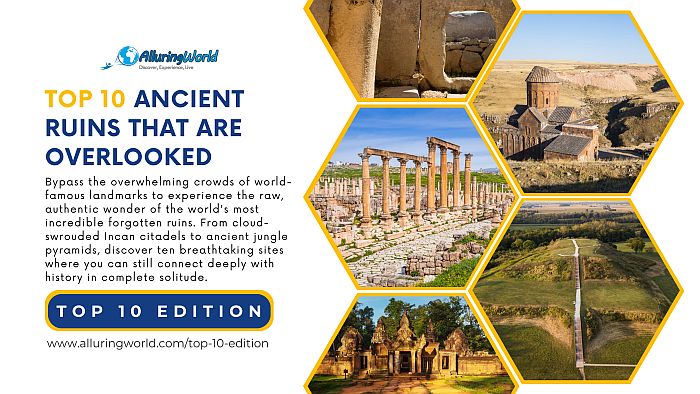
The appeal of past events, places, and their mysteries brings millions of people to historical sites each year throughout the entire world. Popular destinations such as the Colosseum, Machu Picchu, and Angkor Wat are always packed with tourists, flashing cameras, and long queues for admission, so you might not find them as intriguing or inspiring as you might think when seeing them in brochures or online. Although there is no doubt about the beauty of these famous historical landmarks, at times their crowds become an obstacle to feeling awe.
Thankfully, history is broad, and a great deal of the world’s most amazing artifacts and places are yet to be discovered right under our noses, as we do not need to follow the beaten path. Buried amidst the dense jungle, remote hills, and unspoiled coasts are majestic cities, temples, and fortresses, which receive only a portion of the world’s tourism, so you need to take an interest yourself to have them discovered.
When you are opting to see these sites, it gives you the opportunity for an intimate, real, and genuine traveling experience, something that you most likely will not experience when visiting the most popular ones. This guide will help you uncover ten awe-inspiring ancient ruins, as amazing as their counterparts are, which tourists generally overlook and provide you with the reasons why they should definitely make it to your must-visit places.
1. Choquequirao (Peru)
Despite the fact that more than one million people visit Machu Picchu each year, its equally stunning sister site lies hidden behind a canopy of clouds in the cloud forests, almost untouched by man. Constructed in the 15th century by the Incan civilization, Choquequirao boasts beautiful stone terraces, ritualistic squares, and elaborate mosaic walls.
- Why It Is Overlooked: The site requires serious physical commitment to reach. Bypassed by trains and tour buses, exploring Choquequirao demands a grueling, two-day trek across the steep Vilcabamba mountain range. The reward for you when reaching this majestic place is absolute solitude, as you often share the massive mountain citadel with fewer than two dozen other hikers, and you get to experience it in the most peaceful setting.
2. Ani (Turkey)
Positioned right on the border of modern-day Armenia, Ani was once the thriving medieval capital of the Bagratid Armenian kingdom. Most commonly known and referred to as the “City of 1,001 Churches,” it flourished during the 10th and 11th centuries as a major commercial hub along the Silk Road, and it housed a population that surpassed contemporary European cities. This was one of the great cities in this region that, due to unfortunate events, was abandoned and nowadays is in ruins.
- Why It Is Overlooked: A devastating 14th-century earthquake, combined with centuries of shifting military borders between the ruling empires of the region, turned Ani into a ghost town. Today, its remnants stand exposed to the elements on a remote, windswept plateau. The skeletal structures of towering cathedrals, Zoroastrian fire temples, and massive defensive walls provide a hauntingly beautiful landscape that few international travelers ever venture far enough east to witness. Due to its remoteness in Turkey, getting there will require some travel, but once you get to Ani, you will be greeted with some of the most amazing ruins.
3. Ostia Antica (Italy)
When visiting Rome, tourists naturally pack into the Roman Forum and ride out to Pompeii. Meanwhile, the ancient empire’s primary commercial seaport sits remarkably preserved just a short train ride from downtown Rome. Ostia Antica was a bustling harbor city of over 100,000 residents that was eventually abandoned after the fall of Rome and the silting of the Tiber River.
- Why It Is Overlooked: Overshadowed by the sheer fame of Rome’s central monuments and the tragic story of Pompeii, Ostia Antica is regularly left off mainstream itineraries. However, because it was preserved by river silt rather than volcanic ash, you can walk through intact multi-story apartment complexes, ancient taverns, intact public baths, and pristine mosaics with a level of peace you cannot find anywhere else in Italy.
4. Calakmul (Mexico)
Calakmul is an ancient Maya superpower that lies deep inside the Tierras Bajas jungle of the Yucatán Peninsula. In the Classical Era, this enormous metropolis led the “Snake Kingdom” and was the direct rival of the ancient city of Tikal and its civilization in Guatemala. The ruins contain two of the largest Mayan pyramids that provide panoramic views of the rainforest.
- Why It Is Overlooked: Tourists visiting Mexico tend to stay close to the coast in places such as Chichén Itzá or Tulum. Calakmul lies far inside a biosphere reserve that is near the border of Guatemala, which involves a long journey through thick forests. The distance from civilization ensures that there is no mass tourism, thus maintaining the real setting of the place inhabited by howler monkeys and jaguars. Only real history buffs and enthusiasts will ever get to this abandoned ancient city.
5. Jerash (Jordan)
Jordan’s tourism economy is heavily dominated by Petra, the spectacular desert city carved directly into rose-red sandstone cliffs. Because of Petra’s international fame, and photos and videos constantly shared from this important and beautiful place, many travelers overlook Jerash, which equally boasts one of the largest and best-preserved collections of Roman architecture that exists outside of Italy.
- Why It Is Overlooked: The site is often skipped on quick tour itineraries that focus solely on Petra and the Dead Sea. If you are traveling northward, you will find a stunning ancient city which is complete with colonnaded avenues, monumental theatres, sprawling public squares, hilltop temples, and a massive hippodrome where chariot races still take place. While equally impressive as Petra, with Jerash you will not have the big crowds, and you can calmly take your photos.
ADVERTISEMENT
6. Cahokia Mounds (USA)
Even before Europeans set foot on the American continent, the advanced Mississippian civilization created a flourishing urban settlement right opposite St. Louis. In 1250 AD, Cahokia reached the zenith of its development when it grew into a busy city housing up to 20,000 people, thus exceeding the population of London at that time.
- Why It Is Overlooked: Being mainly made up of earth, rather than stone, the architecture of Cahokia appears natural to those who are not familiar with this construction technique. Highways and suburban areas have come near the boundaries of the park, and there are no picturesque stone walls present here that could make people interested in visiting this UNESCO World Heritage site. It is only some large parts of the great mounds that have been preserved, but getting here and finding out more about the Mississippians will definitely be worth your trip.
7. Ħaġar Qim (Malta)
Located at the edge of a rocky hill above the Mediterranean Sea, Ħaġar Qim is an engineering marvel of the prehistoric era. The ancient structure, which was made up of large globigerina limestone stones, was built around 3600 BC, and despite its historic importance, nowadays it is not visited so often by tourists.
- Why It Is Overlooked: This country has often been promoted as a destination for people to come for some fun in the sun and sea, rather than being described as a country rich in archeological sites. Considering that the majority, if not all, tourists are coming for the Maltese beaches, then this is why many visitors do not know that Ħaġar Qim predates Stonehenge and even the Egyptian Pyramids.
8. Volubilis (Morocco)
Nestled on a rich plain next to the sacred city of Moulay Idriss is the ancient Roman city of Volubilis. This ruined city is the most distant southwestern location of the ancient Roman Empire, and once a very important center of Roman affairs. Initially starting as a Berber settlement, the city flourished to become an urban center for trade in grain, wild animals, and olive oil back to the Roman Empire’s capital.
- Why It Is Overlooked: Most travelers head to Morocco for the vibrant souks of Marrakech, the blue streets of Chefchaouen, the Sahara dunes, or Fes el Bali. Volubilis sits tucked away in the country’s northern interior, and if you would like to see a different side of Morocco, then you should make the detour, as you will be rewarded with exceptionally preserved triumphal arches, public basilicas, and stunning, intact floor mosaics left exactly where Roman artists laid them two millennia ago.
9. Conímbriga (Portugal)
Conímbriga is situated in central Portugal, near the university town of Coimbra. Conímbriga was one of the largest and best-preserved Roman cities that have been excavated in the Iberian Peninsula. It consists of fortification walls, bathhouses, an amphitheater, and residential areas with fountains at their centers.
- Why It Is Overlooked: The tourist growth in Portugal is greatly tied to the coastal architecture found in Lisbon, Porto, and the beaches of the Algarve. Conímbriga is the serene place that allows visitors to walk along the open colonnades and admire the stunning geometric mosaics in their natural mineral colorings.
10. Koh Ker (Cambodia)
The vast majority of travelers heading to Cambodia travel straight to Siem Reap to see Angkor Wat, which in reality should not be missed because it is the largest religious monument in the world. Only an hour or two away, hidden deep within northern forests, lies Koh Ker, a rival 10th-century capital that was completely abandoned to the jungle for over a thousand years.
- Why It Is Overlooked: Due to its isolation and a history of regional instability, Koh Ker was only recently made safe and accessible to the public. Its centerpiece is Prasat Thom, a striking, seven-tiered pyramid that looks more like a Mayan temple than a traditional Khmer structure. Stripped of the massive crowds found at Angkor, Koh Ker allows you to experience the true, quiet mystery of a lost jungle city.
In summary, the value of travel lies in the interstitial spaces between famous locations. Although it is important to visit the best ancient ruins in the world, and you should definitely not miss them, deviating from the common tourist trail allows you to experience an entirely new facet of discovery. Something that you would not have even thought existed.
From walking amidst the lofty terraces at Choquequirao, through the towering archways of Jerash, to staring at the ancient limestone stones in Malta, there is an overwhelming feeling of discovery in these sites that are often overlooked. With such sites, you will escape the hassle of gift stores and queues and connect right away with the authentic stories of history. You do not need to search long, but you can use this as your guiding platform to discover an additional ten places beyond the ones you already might have on your bucket list.