
Read time ca. 5 minutes
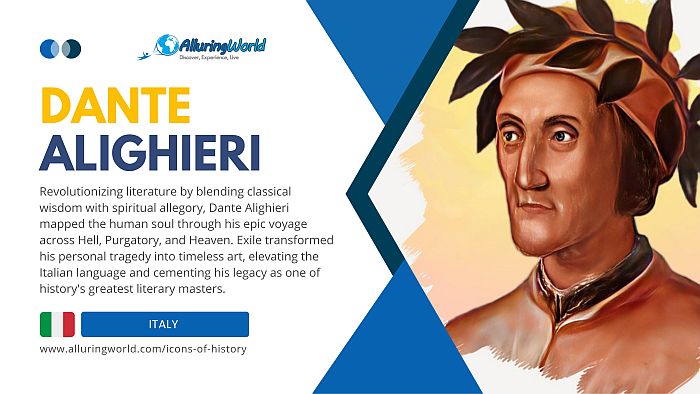
Dante Alighieri ranks among the most important literary personalities throughout the history of our entire world, having made significant contributions through his writings on the topics of poetry, philosophy, and the Italian language. In fact, his masterpiece, The Divine Comedy, revolutionized literature by providing an overall view of the moral, spiritual, and political world. His works incorporate the thoughts of his era and also transcend the intellectual movements of his time period by combining classical learning with Christianity.
The importance of Dante can be found in his talent for combining literary craftsmanship with philosophical and theological insights. Through his literary works, Dante has examined various aspects of human moral life, the essence of God, and complicated issues related to politics and society. Dante’s literary legacy is a good example of how the power of literature can express deep meanings through a combination of imagination, ethics, politics, and spirituality.
Early Life and Education:
Dante Alighieri was born in 1265 in the city of Florence, the capital city of the Tuscany region in central Italy. The time during which he grew up was characterized by political instability in Florence due to conflict between the supporters of the Pope and the supporters of the Holy Roman Emperor. The latter were known as the Ghibellines, while the former were called the Guelphs.
Dante had an extensive background in the liberal arts, where he studied subjects like grammar, rhetoric, and philosophy in addition to classical literature from poets such as Virgil, Cicero, and Ovid. He was also a learned individual in terms of theology and scholastics, through which he gained a knowledge of ethics, metaphysics, and the relationship between reason and divine will.
Early Literary Career and Personal Life:
As a young man, Dante became immersed in the political affairs, and he learned the important circles of Florence, thus earning a reputation as a poet and philosopher. He was married to Gemma Donati around 1274; however, the life of poetry and emotions in Dante was defined by the ideal love that he had for Beatrice Portinari. Beatrice came to play a significant role in Dante’s works, as an incarnation of divine love and a source of moral inspiration. Beatrice is clearly present in La Vita Nuova, Dante’s collection of poems and essays about ideal love and virtue.
It was during this time that Dante also started using his native Italian language in poetry, thus contributing to the establishment of the Tuscan dialect as a literary language. This early period in his life helped Dante prepare for his future projects.
Exile and Political Involvement:
The involvement of Dante in politics was one of the key aspects of his life. As one of the members of the White Guelph party, he served in government positions in Florence and contributed to the governance of the city. But when the Black Guelphs party took over the power in 1302, it forced Dante to be exiled from Florence and not return there anymore.
Exile profoundly influenced Dante’s intellectual and creative development. Unable to return to his native land, he contemplated such questions as justice, leadership, and the proper conduct of both rulers and people. This experience played an important part in the political and moral aspect of his poem “The Divine Comedy,” where Dante contemplates the consequences of improper behavior. Even today, people appreciate this majestic literary work as an art that is studied in schools.
ADVERTISEMENT
The Divine Comedy:
Without a doubt, Dante’s greatest masterpiece is “The Divine Comedy,” which was composed between 1308 and 1320. This epic contains three books: Inferno, Purgatorio, and Paradiso. In it, Dante tells an allegorical story of his own voyage across Hell, Purgatory, and Heaven, where he travels first in the company of the great Roman poet Virgil and then in that of Beatrice.
In the first part of this trilogy, the reader finds a description of punishment and the suffering of souls due to the sins they committed during their lives on Earth. The author demonstrates a remarkable ability not only to understand theological questions but also to portray the world of Hell creatively. Purgatorio addresses repentance and human moral progress and is based on the ideas of redemption and God’s help in improving oneself spiritually.
The style and form of the poem show Dante’s skill in the use of literary devices and also reflect his capacity to impart complicated notions concerning ethics, philosophy, and religion. Through the allegory of the poem, the reader is able to examine issues about justice, virtue, and the purpose of human life.
Philosophical and Theological Thought:
The work of Dante is characterized by a high level of intellectual thought, which is characteristic of that age. He borrowed a lot from Aristotle, Thomas Aquinas, and classical Roman authors, and incorporated their ideas into his philosophy of humanity, its ethics, and theology. Dante’s work deals with issues like the role of reason and faith in people’s lives and ethical duties.
The afterlife described by Dante shows the importance of causality, the results of actions and behavior, and even mercy, reflecting his idea of a world that is ruled not only by justice but also by God’s mercy. Dante shows great awareness of ethics, politics, and theology in his works.
Later Life and Death:
In his last years, Dante resided in Ravenna with the patronage of Guido da Polenta. In this place, he devoted time to writing his works and further improved them by composing various treatises on political and philosophical matters in addition to poetry. Dante passed away in 1321, after which his body was buried in Ravenna, but Florence later endeavored to retrieve it.
Legacy:
Today, it can be said that Dante Alighieri’s contribution to literature is quite enormous and multifaceted. He is considered to be the Father of the Italian language due to the great achievements he made by elevating the Tuscan dialect to the level of high art. In addition to this, Dante had an impact not only on literature but also on philosophy, politics, and theology.
The journey of Dante through human nature, justice, and divinity remains a source of inspiration for many people even today. The fusion of various literary approaches into one has enabled him to create a comprehensive vision of human life.
Conclusion:
In conclusion, it is appropriate to note that Dante Alighieri is a perfect example of the integration of intelligence, talent, and spirituality. He presented a thorough investigation of human morality, divine justice, and virtuousness in his poems and philosophical discourses. Dante’s life experiences, such as his exile, religious piety, and politics, played a pivotal role in shaping his understanding of a morally organized universe that operates on reason and religion. Dante’s legacy in the form of The Divine Comedy makes him one of the most influential philosophers and poets in the world today.