
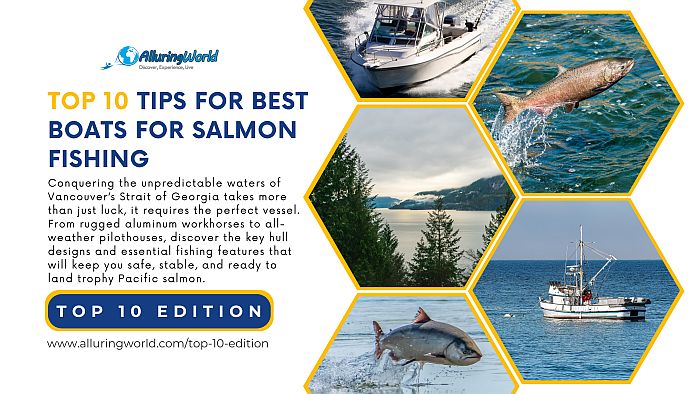
Some people say that Vancouver is the best place to catch Pacific salmon. Whether you’re looking for big Chinook (Kings) in the deep waters off the South Arm or Coho (Silvers) and Sockeye near the Gulf Islands, the experience is top-notch. But the Strait of Georgia is just as beautiful as it is unpredictable. One minute it’s glassy, and the next a strong wind makes a “washing machine” chop that will test both your stomach and your boat.
Your boat is the most important piece of gear you need to go from being a casual weekend warrior to a regular producer. You need a platform that is safe for crossing, stable for trolling, and has the right layout for downrigger setups. This simple yet effective guide will explain what makes a great salmon boat and list the top five styles to think about when you want to buy a boat in Vancouver.
What to Look for in a Boat for Salmon Fishing
You need to know what makes Vancouver’s coastal environment special before you put down a deposit. “Ocean-ready” isn’t just a marketing term; it’s a safety requirement, unlike lake fishing.
1. Stability and type of hull
There is often a short, tight chop in the waters around Vancouver. Most people prefer a Deep-V hull because it cuts through waves instead of pounding over them. To make sure the boat stays stable when a lot of people lean over one side to catch a thrashing 20-pounder, look for one with a wide beam (width).
2. Size and Power of the Engine
A boat between 5 and 7 m (18 and 24 ft) long is the “sweet spot” for the Strait of Georgia. It’s big enough to handle waves on the coast, but small enough to easily follow and launch. For power, make sure you have a reliable main outboard for getting around and, if possible, a smaller “kicker” motor (9.9 hp) for trolling at the right speeds.
3. Features for Fishing
A real salmon boat needs more than just a motor. You should look for:
- Downrigger Mounts: These are important for getting your lures down to the 15 to 45 m (50–150 ft) depths where Chinook like to hang out.
- Fish Finders (Sonar): To find bait balls and thermoclines, you need good CHIRP sonar.
- Livewells and Fish Boxes: A place to keep your catch cold and fresh.
4. Deck Space and Self-Bailing Cockpits
Salmon fishing is an active sport and involves much motion. You have to take care of several downrigger lines, retrieve the fighting salmon from the water, and set your gear back into place. You should go for a boat that comes with a self-draining cockpit that utilizes gravity to remove the water and the blood of the fish into the water via scuppers.
5. Fuel Capacity and Range
The waters surrounding Vancouver are huge, and the hot bite can turn in an instant. Even if you go out from a local marina to fish at South Arm or cross the Strait of Georgia to the Gulf Islands, it will take more fuel than you might think, particularly if you find yourself battling against a strong headwind during the return trip. Make sure your boat is equipped with enough fuel capacity in a built-in tank to apply the “rule of thirds”: thirds for getting out there, thirds for coming home, and thirds for safety.
ADVERTISEMENT
The 5 Best Types of Boats for Salmon Fishing
1. The Pro Choice: An Offshore Sport Fishing Boat
If you want to go to “The Highway” or “The Hump” no matter what the weather is like, a dedicated offshore sport fisher is your best bet. People here know a lot about brands like Grady-White and Pursuit.
- Pros: They are very seaworthy, have cockpits that empty themselves, and have heavy hulls that stay in the water.
- Cons: It costs more and uses more gas.
2. The BC Standard: Aluminum Fishing Boat
If you go to any marina in British Columbia, you’ll see heavy-gauge aluminum boats from companies like Hewescraft or Thunder Jet. These are the Pacific Northwest’s workhorses.
- Pros: They last a long time (you can beach them on rocky shores), don’t need much maintenance, and are easier to tow.
- Disadvantages: It can be louder than fiberglass and moves faster in strong winds.
3. The Comfort King: Pilothouse / Cabin Boat
The fishing season in Vancouver isn’t always sunny. A pilothouse lets you stay warm and dry while you watch the rods on those cold, rainy October mornings when the Coho are running.
- Pros: You can fish there all year round, it’s safe from spray, and it often has a small cabin for sleeping in.
- Cons: The higher wind profile can make docking hard, and there isn’t as much open deck space for casting.
4. Small Fiberglass Boat (The Cheap Entry)
A 4.8 m (16 ft) to 5.2 m (17 ft) fiberglass runabout is a great way to get into the Burrard Inlet or the calmer bays of Horseshoe Bay.
- Pros: It’s cheap, easy to store in a normal garage, and it gets great gas mileage.
- Cons: Only good on “fair weather” days; it can feel crowded with more than two fishermen.
5. Center Console Boat (The All-Around Performer)
A lot of people in Vancouver are buying center consoles. They let you fish in all directions, which is great when a big salmon swims around the boat.
- Pros: The best layout for fishing, and it is easy to clean.
- Cons: You will get wet on windy days, and there isn’t as much storage space as there is on cabin boats.
In conclusion, when you are picking a boat, it is a matter of finding a balance between your dreams and what you can afford. Remember these three things:
- Set Your Limits: A 5.2 m (17 ft) aluminum boat is enough if you only fish along the West Vancouver shoreline. If you want to get to Nanaimo or fish the West Coast of the Island, don’t settle for anything less than 6 m (20 ft) with high sides.
- New vs. Used: The used market in BC is strong, but the saltwater in Vancouver is hard on engines. Always have a professional check the mechanics and look for “galvanic corrosion” on aluminum hulls if you’re buying used.
- The “Kicker” Factor: A kicker motor in Vancouver isn’t just for fishing; it’s also a safety backup. If your main engine breaks down in a shipping lane, that 9.9 hp motor will be your best friend.
To do well in Vancouver’s salmon fishery, you need to be in the right place at the right time and have a boat that can get you there safely. The right boat makes your skills stronger, whether you like the tough durability of an aluminum hull or the dry comfort of a pilothouse.
Are you ready to start your trip on the water? If you’re buying your first boat or upgrading your current one, you can look at a lot of coastal-ready boats and make sure this season is your best one yet. Lines that are tight!