
Read time ca. 5 minutes
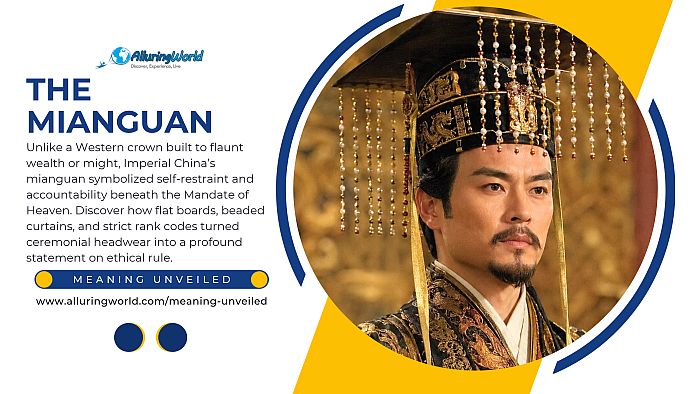
Among the artifacts that we can see today from Imperial China, few hold as much weight as the magnificent mianguan (冕冠). While at first glance the flat-top board and hanging beads appear nothing like a Western crown, the mianguan was not designed to display the wearer’s wealth or strength of arms. Rather, it symbolized ritual responsibility, self-restraint, and the concept of rule beneath the watchful authority of Heaven.
Even after centuries of use in the Chinese court, the mianguan is among the most easily recognizable symbols of traditional Chinese statecraft, and today it appears in museums, excavations, and historical dramas, where it is widely recognized as a great symbol from the vast Chinese Empire.
What Is a Mianguan?
Mianguan, for example, combines the words mian, meaning ceremonial crown, and guan, which is a general term for a cap or headdress, thus referring to it as a crown-cap. It was mainly used at important state events rather than as an instrument of everyday governance, and it belonged to formal court rituals, ancestral sacrifices, coronations, and major diplomatic ceremonies. It was also worn as part of a full ceremonial outfit rather than on its own, paired with matching ritual robes that, for the Emperor, carried twelve traditional symbolic emblems.
Unlike a circlet encrusted with stones, the mianguan combines a tight-fitting cap with a flat board of large size called yan, which is placed above it. Traditionally, the yan was dark on top and red underneath, with rounded front corners and squared-off back corners. Strands of beads called liu hang from the front and back edges of the board, lightly framing the face and softening the wearer’s gaze rather than covering the face itself.
Ancient Origins and the Mandate of Heaven:
The mianguan dates back over two thousand years to the Zhou dynasty (approximately 1046–256 BCE), when much of the Chinese political and ethical philosophy came into being. The Zhou justified their rule on the principle of tianming, or, as translated into English, the Mandate of Heaven, but it was not an unconditional birthright, nor was it the result of conquest alone. Instead, the ruler who maintained social and cosmic order was granted the mandate from heaven, and that mandate could be withdrawn should he become despotic or lax in his duties.
Later on, Confucius would come to recognize Zhou ritual as an important anchor of morality and public order. With Confucianism becoming increasingly entrenched in the governing system, mianguan served as a physical manifestation of responsibility and an indication that ultimate power was bound by morality; a signal that supreme power came with strict ethical obligations.
Design, Jade, and Ritual Hierarchy:
Each part of the mianguan was designed to have its own function and specific role. The horizontal yan board placed above the head represented Heaven arching over the ruler, thereby placing him under moral law above all else.
The liu beaded curtains had a more subtle message to convey. Acting to partially soften the direct gaze of the wearer, they were a symbol of calmness and deliberate judgment; that is, they were supposed to make the individual think and consider things rather than act out of haste or favoritism. Jade was highly favored for making these beads due to its associations with virtue.
The rank was integral and written directly into the design itself. The imperial sumptuary rules tied the number of bead strands to the status of the wearer. Therefore, the Emperor was wearing the fullest arrangement, traditionally with twelve strands. In classical court specifications, each of those strands held twelve beads, making the count itself part of the rank code. On the other hand, the princes, nobles, and other eligible court officials wore fewer strands, or they had a simplified version of the mianguan, as it was coordinated with the strict court codes. To wear such a garment on your head was not a simple fashion slip that opened doors to the Chinese court, but it was rather seen as a status symbol, and if you exceeded the number of strands above your station, then this was considered a serious breach of ritual and political order.
ADVERTISEMENT
Shifting Shapes Across Dynasties:
As expected, the mianguan was not always seen as the full symbol it was during its height, and while the core philosophy behind it endured for many centuries, its exact styling evolved across dynasties as each era left its mark on court dress:
- Han (206 BCE–220 CE): As the ritual state ceremonies of Confucianism became more refined, so too did the ceremonial headwear and costume worn in those ceremonies. Its codification was directly tied to the crown design, jade bead counts, and jade colors, as they were directly related to the imperial and official rank of the wearer.
- Tang (618–907) and Song (960–1279): The aesthetics in the court would change according to the dynasties, but it would be the responsibility of the scholars to constantly analyze classical works and to ensure that the attire adhered to ancient tradition.
- Ming (1368–1644): The rules for court rituals in the Ming dynasty had been well documented throughout the height of this dynasty. Excavated imperial regalia, such as the famous gold-thread headgear from the Dingling Tomb of the Ming Emperor Wanli, offer rare physical evidence of Ming court craftsmanship, even alongside broader ceremonial headwear traditions.
With the rise of the Manchu-led Qing dynasty (1644–1912), court attire shifted toward Manchu ceremonial dress, changing how traditional court headwear was used. This led to the mianguan being largely phased out as a form of Chinese imperial regalia, and in the end it resulted in the end of its use as an active symbol of Chinese imperial sovereignty. With the fall of the Qing dynasty in 1911–1912, aside from a brief, short-lived ceremonial revival under Yuan Shikai, the imperial system ended for good.
Ritual Life and Modern Resonance:
During its golden age, the mianguan appeared on occasions meant to align human rule with cosmic order, such as sacrifices to Heaven at the UNESCO World Heritage-listed Temple of Heaven in Beijing, alongside ancestral rites honoring former rulers in ancestral temples.
Even today, it still catches the eye whether on film or displayed behind glass in museums. Visitors looking into imperial court history often explore collections at institutions like the Palace Museum in Beijing or the National Museum of China to see how these ceremonial traditions are preserved. The modern viewer will likely notice the beaded fringe first but see a more profound message beneath that. Even when film costumes take liberties with historical cuts and trim, the central question behind this crown stays clear: What is responsible leadership?
Conclusion:
Considered to be not merely an ornate reminder of royal pomp, the mianguan was rather an encapsulation of political morality from ancient China. In the form of the flat yan roof, the precise counting of beads, and the rigidity of rank etiquette, the mianguan defined leadership in terms of self-restraint, harmony, and accountability to a higher authority. Long after China’s dynasties have become history, these concepts continue to prompt reflection on power and responsibility.